
Inovation
Breaking Boundaries: The Advancement of Fluoride-based Solid Electrolytes in Energy Storage

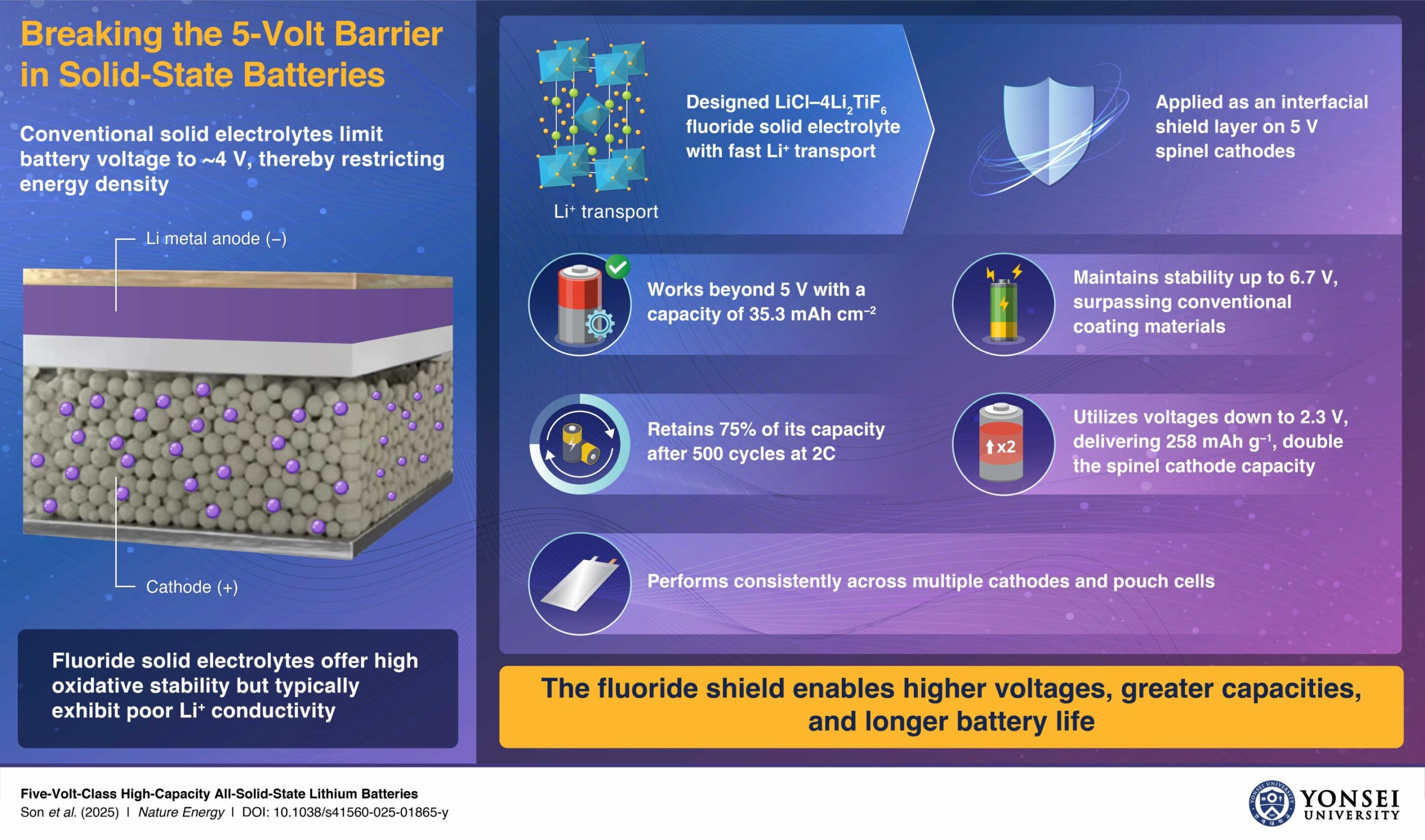
Yonsei University researchers led by Professor Yoon Seok Jung have made a groundbreaking advancement in energy storage technology. They have unveiled a new fluoride-based solid electrolyte that enables all-solid-state batteries (ASSBs) to operate safely beyond 5 volts.
Their research, published in Nature Energy, addresses a long-standing challenge in battery science by achieving high voltage stability without compromising ionic conductivity.
According to Prof. Jung, “Our fluoride solid electrolyte, LiCl–4Li2TiF6, paves the way for high-voltage operation in solid-state batteries, signaling a significant shift in energy storage design.”
Traditionally, battery engineers have aimed to enhance energy density by increasing voltage, but conventional solid electrolytes like sulfides and oxides tend to degrade above 4 V.
The team overcame this limitation by developing a fluoride solid electrolyte (LiCl–4Li2TiF6) that remains stable beyond 5 V and exhibits a Li+ conductivity of 1.7 × 10⁻⁵ S/cm at 30°C, one of the highest in its class.
This innovation allows spinel cathodes such as LiNi0.5Mn1.5O4 (LNMO) to operate safely and efficiently, even under demanding cycling conditions. By applying LiCl–4Li2TiF6 as a protective coating on high-voltage cathodes, interfacial degradation between the cathode and the electrolyte is effectively suppressed.
The research demonstrates a battery that maintains over 75% capacity after 500 cycles and supports an ultrahigh areal capacity of 35.3 mAh/cm2, setting a new benchmark for solid-state systems. The team also showcases practical adaptability in pouch-type batteries, the same format used in electric vehicles and consumer electronics, showcasing consistent performance.
Beyond material innovation, this work sets the stage for a revolutionary battery design model. The fluoride-based shield introduced by the researchers not only enhances electrochemical stability but also enables compatibility with cost-effective halide catholytes like Zr-based systems.
This combination has the potential to significantly reduce material costs while enhancing safety and longevity, addressing key challenges in commercial ASSB technology.
In essence, this research holds great promise—from enabling electric vehicles with extended driving ranges to advancing large-scale renewable energy storage. By leveraging abundant and affordable materials, it supports the global transition to sustainable, carbon-neutral energy systems.
Prof. Jung emphasizes, “This research transcends individual materials; it establishes a new design principle for constructing safe, durable, and high-energy batteries that can drive the future.”
This breakthrough represents a substantial step towards cleaner and more resilient energy solutions, bridging the gap between laboratory innovation and real-world applications, and laying the groundwork for the next generation of sustainable technology.
Citation:
Unlocking next-generation battery performance: Fluoride-based solid electrolyte surpasses voltage limits (2025, October 31)
retrieved 1 November 2025
from https://techxplore.com/news/2025-10-generation-battery-fluoride-based-solid.html
This document is subject to copyright. Apart from any fair dealing for the purpose of private study or research, no
part may be reproduced without the written permission. The content is provided for information purposes only.












Affordable Electric Vehicle Now Available in Australia: Leapmotor B03 Approved for Sale

Reborn in Ashes: The Shattered Faith Saga – Coming to Consoles Soon

Save Big on Xiaomi 17T: £200 Discount on Amazon – Tech Advisor

NUSX and UnternehmerTUM Join Forces to Expand Presence in Munich

Streaming Wars: Disney+ and Hulu Increase Subscription Fees in 2026

The Surprising TRUTH about Samsung – 15 things you did not know.

McLaren’s Legacy: The Remuera and Muriwai Trademarks

Cloudscape Chronicles: A Fumito Ueda-inspired Parkour Adventure

Rising Prices: Samsung Galaxy Tab S12 and Xiaomi Pad 9 Series

EU Takes Action Against Instagram and Facebook for Violating Illegal Content Rules

Warning: Facebook Creators Face Monetization Loss for Stealing and Reposting Videos

Facebook’s New Look: A Blend of Instagram’s Style

Facebook Compliance: ICE-tracking Page Removed After US Government Intervention

Facebook and Instagram to Reduce Personalized Ads for European Users

InstaDub: Meta’s AI Translation Tool for Instagram Videos

Reclaim Your Account: Facebook and Instagram Launch New Hub for Account Recovery

Meta discontinues Messenger apps for Windows and macOS

Breaking Updates: Meta Connect 2025 Unveils Latest Developments
The Surprising TRUTH about Samsung – 15 things you did not know.

10 Incredible Android DIY Hacks!

Does a Cheap 2018 Smartphone beat a 2013 Flagship?

Samsung Galaxy S9 & S9+ UNBOXING!

Samsung Galaxy S9 Plus vs iPhone X

The BEST $300 Phone (2018) ft. MKBHD, Technical Guruji, iJustine + More

Samsung Galaxy S9 Plus Gaming Review! (vs OnePlus 5T)

THE BEST PHONE HTC EVER MADE?

The Truth about Google?
-
 Facebook11 months ago
EU Takes Action Against Instagram and Facebook for Violating Illegal Content Rules
-
 Facebook12 months ago
Warning: Facebook Creators Face Monetization Loss for Stealing and Reposting Videos
-
 Facebook10 months ago
Facebook’s New Look: A Blend of Instagram’s Style
-
 Facebook12 months ago
Facebook Compliance: ICE-tracking Page Removed After US Government Intervention
-
 Facebook10 months ago
Facebook and Instagram to Reduce Personalized Ads for European Users
-
 Facebook12 months ago
InstaDub: Meta’s AI Translation Tool for Instagram Videos
-
 Facebook10 months ago
Reclaim Your Account: Facebook and Instagram Launch New Hub for Account Recovery
-
 Apple11 months ago
Meta discontinues Messenger apps for Windows and macOS
