
Microsoft
Exploring the Boundaries of Artificial Intelligence: Insights from the Frontiers

[Editor’s Note: Agents of Transformation is an independent GeekWire series and 2026 event, underwritten by Accenture, exploring the people, companies, and ideas behind the rise of AI agents.]
REDMOND, Wash. — If AI were a religion, this would probably qualify as a cathedral.
On the edge of Microsoft’s headquarters, overlooking Lake Bill amid a stand of evergreens, a new four-story building has emerged as a destination for business and tech decision-makers.
Equal parts briefing center, conference hall, and technology showroom, Microsoft’s “Experience Center One” offers a curated glimpse of the future — guided tours through glowing demo rooms where AI manages factory lines, models financial markets, and helps design new drugs.
It’s part of a larger scene playing out across tech. As Microsoft, Google, Amazon and others pour billions into data centers, GPUs, and frontier models, they’re making the case that AI represents not a bubble but a business transformation that’s here to stay.

As the new center shows, Microsoft’s pitch isn’t just about off-the-shelf AI models or run-of-the-mill chatbots — it’s about custom agentic systems that act on behalf of workers to complete tasks across a variety of tools and data sources.
That idea runs through nearly everything inside the facility, a glass-encased building featuring an elevated garden in a soaring open-air atrium, just across from Microsoft’s new executive offices on its revamped East Campus.
Experience Center One highlights what Microsoft calls “frontier firms” — ambitious companies using AI to push their operations to the edge of what’s possible in their industries.
Agentic AI is “fast becoming the next defining chapter of a frontier organization,” said Alysa Taylor, Microsoft chief marketing officer for Commercial Cloud and AI, in an interview.
The underlying message is clear: get on board or risk falling behind, both competitively and financially. A new IDC study, commissioned by Microsoft, finds both opportunity in spending big and risk in not being bold enough. Companies integrating AI across an average of seven business functions are realizing a return on investment of 2.84 times, it says. In contrast, “laggards” are seeing returns of 0.84 times — basically losing money on their initial spend.
The divide extends to revenue, too: 88% of frontier firms report top-line growth from their AI initiatives, compared to just 23% of “laggards,” according to the IDC study.
And hey, somebody has to foot the bill for those multi-billion-dollar AI superfactories.
For this second installment in our Agents of Transformation series, GeekWire visited the new Microsoft facility to see first-hand how the company is presenting its vision of the future. Here are some of the takeaways from the sampling of demos we saw.
These are not off-the-shelf solutions. Each demo reflects a custom deployment built with a major customer, showing how AI tools can be tailored to specific business problems.

For example, one shows how Microsoft has worked with BlackRock to integrate a custom AI copilot inside the investment firm’s Aladdin platform to help analysts process large volumes of client and market data more efficiently. It helps reduce the manual work of gathering data and points analysts to potential risks sooner than they might have spotted it on their own.
As another example of the customization, the system is trained to translate natural language requests into “BQL,” BlackRock’s proprietary programming language.
This deep level of integration tracks with the findings in the IDC report. It found that 58% of “frontier firms” are already relying on custom-built or fine-tuned solutions rather than generic models. This is expected to accelerate, with 70% planning to move toward customized tools in the next two years to better handle their proprietary data and compliance needs.
“That’s a trend that we’ve seen even in the low-code movement — taking an out-of-the-box solution, extending it, and customizing it,” said Taylor, the Microsoft commercial CMO.
OpenAI integration remains critical for many Microsoft customers. Another demo focused on Microsoft’s work with Ralph Lauren, showing how the “Ask Ralph” assistant interprets a shopper’s intent and recommends full outfits from available inventory.
Like many of the scenarios inside Experience Center One, this experience runs on Microsoft’s Azure OpenAI Service. It’s a reminder that Microsoft’s partnership with OpenAI — renewed and expanded in recent months — is still a key driver of commercial demand for the tech giant, even as both companies increasingly work with other industry partners.
Teams of agents are starting to redefine industrial work. The clearest example of this was a digital twin simulation from Mercedes-Benz — essentially a virtual version of a factory that lets engineers anticipate and diagnose issues without stopping real production.
The demo begins with a production alert triggered by a drop in efficiency. In a real plant, tracking down the cause (something as small as a slight angle change in a screw) might take a team of specialists days of sorting through machine logs and sensor data.
In Microsoft’s version, a human manager simply asks the system to diagnose what’s causing the problem, through a natural language interface.
“`
Accelerating Scientific Research with AI
When faced with a complex question, a series of AI agents spring into action, each assigned a specific task: one extracts the necessary data, another retrieves machine logs, and a third translates the findings into layman’s terms.
Within a mere 15 minutes, the system delivers a concise analysis of the probable cause and potential solutions, streamlining a process that could otherwise span an entire week.
AI is revolutionizing the pace of scientific discovery. A demonstration featuring Insilico Medicine’s collaboration with Microsoft showcased how AI is significantly reducing the timeline for drug development.
The journey commences with a “digital researcher” sifting through vast quantities of public biomedical data to identify promising disease targets. This labor-intensive task typically requires months of manual analysis by a team of researchers.

A secondary system conducts simulated chemistry experiments in the cloud, generating and ranking potential molecules that could bind to these identified targets. These simulations can be completed within days, a stark contrast to the traditional laboratory work that spans weeks or even months.
An actual case study is presented: Insilico utilized this process to pinpoint a potential target for a lung condition and formulate molecules that could impact it. Subsequently, the company synthesized numerous compounds generated by AI in the laboratory, with one of them advancing to Phase 2a human trials.
These are just glimpses of the innovations showcased at Microsoft’s Experience Center One. During our tour, we encountered displays from various prominent brands, though not all were open to media coverage. As part of our access agreement, we focused solely on publicly approved examples.
While these demonstrations are meticulously selected, the extent to which companies will integrate such systems into their day-to-day operations remains to be seen.

The facility serves as a successor to Microsoft’s longstanding Executive Briefing Center and conference venue, still operational a short distance away on the Redmond campus.
Having been operational for a few months, Experience Center One has welcomed business delegations and political figures, including the prime minister of Luxembourg.

The center is exclusive, accessible by invitation only. Employees can request access for a visit.
Visitors are greeted by a circular driveway, with a plaque honoring John Thompson at the entrance. Thompson, the former Microsoft board chair, oversaw the selection process that led to Satya Nadella becoming CEO. The upper floors house private briefing rooms, and the second floor features a complete cafe. Additionally, the building includes a conference center with three auditoriums.
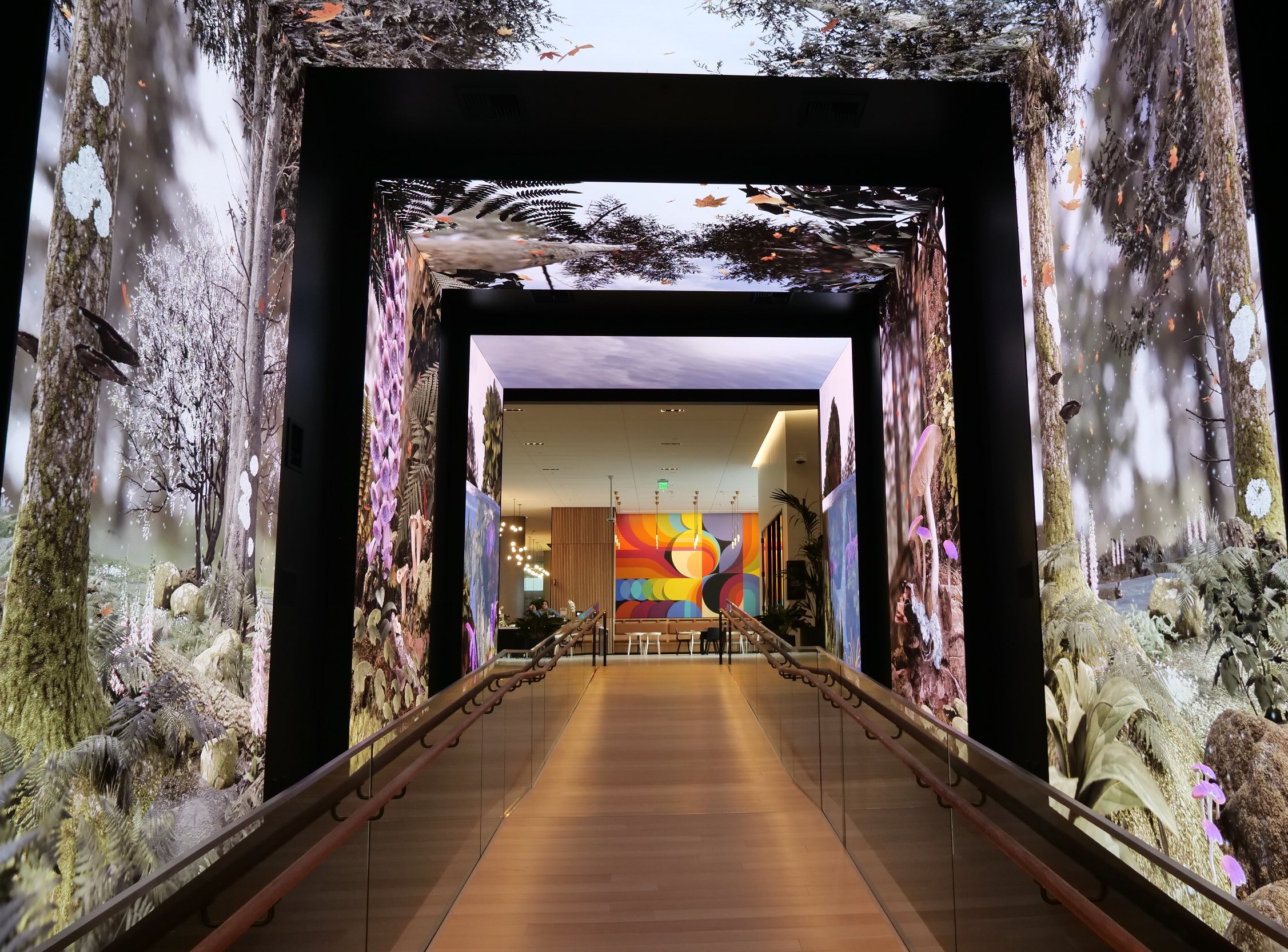
However, the standout feature is the interactive portal. Upon completing the demonstrations, visitors pass through an immersive digital corridor adorned with nature scenes on virtual walls.
As guests traverse the tunnel, motion sensors track their movements, causing digital leaves and particles on the expansive screens to swirl in response. The ambient sounds include nature elements such as birds, wind, and rustling trees, recorded locally in the Redmond and Sammamish region. Moreover, the visual display syncs with a weather API, replicating the outdoor weather conditions inside the tunnel.
This immersive experience aims to provide a moment of tranquility, allowing executives to unwind and refocus as they contemplate future endeavors.
Transform the following:
Before: The weather was cold and dreary.
After: The temperature was low and the skies were overcast.









Samsung Note 9 REVIEW – I’m switching phones.

Enhanced Siri: Fresh Voices and Vibrant Icons

Record-breaking Ferrari Luce EV Sells for $40 Million at Auction

Amazon’s Battle Against Class-Action Lawsuits: A Closer Look at Their Tactics

The Witcher 3: Crafting Realistic NPC Reactions in a World of Chaos

Selecting the Best Accounting Services for Your Small Business

Exploring the Boundaries: Apple’s Intelligence and HomeKit Pushed to the Limits with iCloud+

Experience the Innovative Self-Opening Doors of the BMW X5

Unveiling the Must-Play Titles for PS Plus August 2026

EU Takes Action Against Instagram and Facebook for Violating Illegal Content Rules

Warning: Facebook Creators Face Monetization Loss for Stealing and Reposting Videos

Facebook’s New Look: A Blend of Instagram’s Style

Facebook Compliance: ICE-tracking Page Removed After US Government Intervention

Facebook and Instagram to Reduce Personalized Ads for European Users

InstaDub: Meta’s AI Translation Tool for Instagram Videos

Reclaim Your Account: Facebook and Instagram Launch New Hub for Account Recovery

Meta discontinues Messenger apps for Windows and macOS

Breaking Updates: Meta Connect 2025 Unveils Latest Developments
Samsung Note 9 REVIEW – I’m switching phones.

Xiaomi Pocophone F1 Special Edition UNBOXING and REVIEW

Xiaomi Pocophone F1 vs Mi A2 vs OnePlus 6 Camera Test Comparison

The Most Powerful Phone on Earth – Turing HubblePhone?

RealMe 2 UNBOXING and REVIEW

Does GPU Turbo make this the Best Budget Gaming Phone?

Pixel 3 Leaked Unboxing – Is Google Lying to us?

Vivo V11 Pro UNBOXING AND REVIEW

Vivo V11 Pro vs Pocophone F1 vs Samsung Note 9 Camera Test Comparison
-
 Facebook10 months ago
EU Takes Action Against Instagram and Facebook for Violating Illegal Content Rules
-
 Facebook10 months ago
Warning: Facebook Creators Face Monetization Loss for Stealing and Reposting Videos
-
 Facebook8 months ago
Facebook’s New Look: A Blend of Instagram’s Style
-
 Facebook10 months ago
Facebook Compliance: ICE-tracking Page Removed After US Government Intervention
-
 Facebook8 months ago
Facebook and Instagram to Reduce Personalized Ads for European Users
-
 Facebook10 months ago
InstaDub: Meta’s AI Translation Tool for Instagram Videos
-
 Facebook8 months ago
Reclaim Your Account: Facebook and Instagram Launch New Hub for Account Recovery
-
 Apple10 months ago
Meta discontinues Messenger apps for Windows and macOS
