
Tech News
Exploring the Potential of Generative AI in FinTech: Benefits, Use Cases, and Real-world Examples


Transforming Financial Operations with Generative AI in Fintech
Generative AI in the fintech industry is revolutionizing financial operations, offering solutions that range from personalized financial services to advanced fraud detection, risk management, automation, and operational efficiency. Examples like Airwallex’s AI-Powered “KYC Copilot” and Revolut’s Scam Detection demonstrate the significant impact of Generative AI on the finance sector.
Accelerating data-driven decision-making, personalized customer experiences, operational efficiency, improved credit scoring accuracy, and enhanced security are among the key benefits of Generative AI in fintech. These advantages make the implementation of Generative AI essential for financial institutions looking to stay competitive in the market.

This article delves into the top 5 transformative use cases of generative AI in fintech, highlighting the benefits, real-world examples, implementation strategies, challenges, and future trends in the industry. Understanding how Generative AI is influencing fintech will enable financial institutions to develop Gen-AI-powered solutions tailored to their specific needs.
Key Takeaways
- Generative AI in Fintech streamlines financial operations through personalization, fraud detection, risk management, and more.
- Benefits of Generative AI in Fintech include improved personalization, fraud detection, risk assessment, customer service, automation, and compliance.
- Top uses of Gen AI in Fintech are hyper-personalized financial solutions, advanced fraud detection, robust risk management, and intelligent automation.
- Real-world leaders in AI in Fintech include Revolut, Airwallex, OCBC Bank, and others.
- Future trends in Fintech include autonomous finance, AI copilots, synthetic data, and invisible banking experiences.
Generative AI in FinTech: Market Overview
The adoption of Generative AI in Fintech is projected to grow to $2.17 billion in 2025, with significant growth expected in the coming years, reaching $7.23 billion by 2029. This growth is driven by the focus on personalized financial services, AI for fraud detection, and efficient compliance solutions.
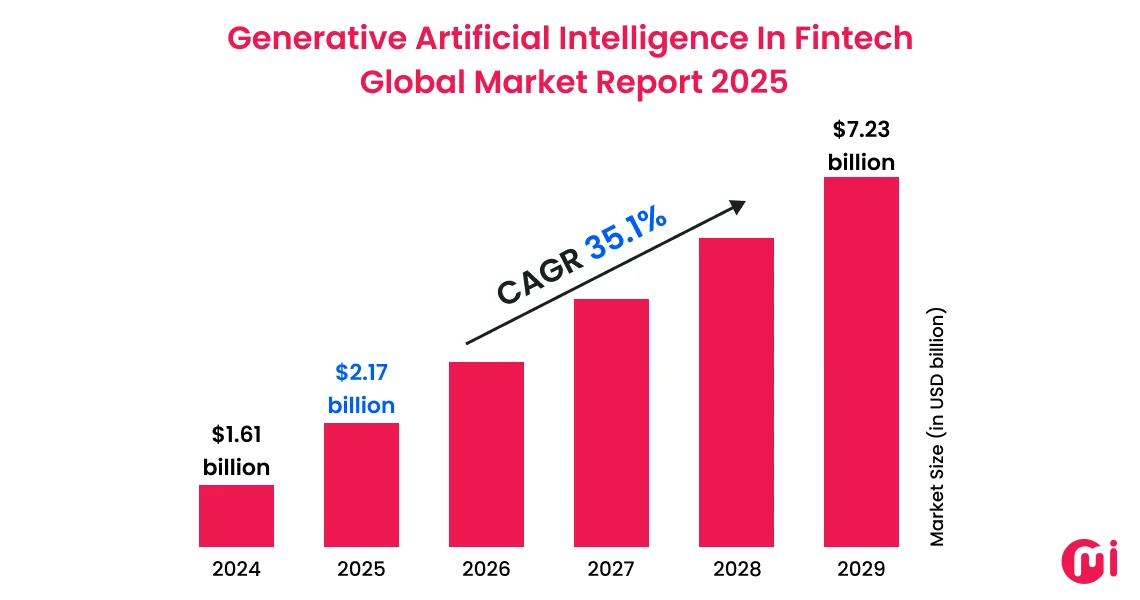
Key trends in Generative AI in Fintech include the integration of AI with blockchain technology, AI-powered trading algorithms, personal financial management tools, and more. AI for credit scoring and lending will be a significant trend in implementing Gen AI in Fintech.
Benefits of Generative AI in FinTech
Generative AI in Fintech offers numerous benefits, including accelerated data-driven decision-making, stronger security, hyper-personalized customer experiences, operational efficiency, improved credit scoring accuracy, and streamlined regulatory compliance. Here’s a breakdown of the benefits:
Accelerated Data-Driven Decision Making
Generative AI in Fintech supports wealth management advisory, lending decisions, and investment planning by interpreting complex financial datasets and producing actionable insights. It identifies market trends, predicts outcomes, and generates scenario-based recommendations faster than human analysts.
Stronger Security and Risk Reduction
Generative AI can detect suspicious behavior patterns and evolving fraud tactics faster than traditional systems, significantly lowering financial losses and strengthening compliance with regulatory frameworks.
Hyper-Personalized Customer Experiences
Generative AI analyzes financial behavior to provide tailored financial guidance and personalized offers, enhancing customer satisfaction and loyalty.
Greater Operational Efficiency and Lower Costs
GenAI-powered solutions automate back-office tasks, reducing processing time and improving productivity in financial institutions.
Improved Credit Scoring Accuracy
Generative AI assesses traditional and alternative data sources, providing more reliable credit decisions for financial institutions.
Streamlined Regulatory Compliance & Reporting
Generative AI automates compliance tasks, ensuring regulatory adherence and maintaining audit-ready documentation.
Superior Customer Service
AI-powered solutions deliver 24/7 customer support, streamline customer assistance, and boost satisfaction.
Top 5 Transformative Use Cases of Generative AI in FinTech
Generative AI use cases in fintech include hyper-personalized financial solutions, advanced fraud detection, robust risk management, intelligent automation, and more. Here’s how Gen AI is shaping the industry:
| GenAI Use Cases in FinTech | Why It’s Important |
| Hyper-Personalization of Financial Services | Enables customized financial products, advisory, credit recommendations, and personal budgeting using GenAI insights. |
| Advanced Fraud Detection & Risk Management | Detects anomalies, predicts risk in real time, reduces false positives, and improves compliance accuracy. |
| Intelligent Automation & Operational Efficiency | Automates financial documentation, underwriting, claims processing, reporting, and back-office tasks. |
| AI-Powered Conversational Customer Service | AI chatbots and voice assistants deliver human-like financial support 24/7 and reduce call center load. |
| Algorithmic Trading & Market Analysis | Predictive AI models generate trading signals, market insights, simulations, and risk-adjusted investment strategies. |
1. Hyper-Personalization of Financial Services
Generative AI in Fintech analyzes customer data to provide tailored recommendations, such as customized investment strategies and loan offers, enhancing customer engagement and loyalty. For example, AlphaSense’s platform processes documents to reduce research time and improve investment decisions.
The failure to leverage the immense potential of generative AI in your marketing strategy isn’t just an oversight — it’s a regret that AI will be happy to tell you that you made later.
— Kevin Farley, the VP of Experience and Engagement, United Heritage Credit Union
2. Advanced Fraud Detection and Risk Management
Generative AI-powered solutions enhance security by analyzing transactional and behavioral data in real time, identifying anomalies and detecting suspicious activities effectively. PayPal has successfully reduced fraud losses by adapting in real-time to evolving threats.
3. Intelligent Automation and Operational Efficiency
Gen AI-powered solutions automate back-office tasks, reducing manual errors, cutting costs, and allowing employees to focus on strategic work. OCBC Bank’s internal AI assistant automates tasks, reducing time spent by employees.
4. AI-Powered Conversational Customer Service
Generative AI-driven chatbots and virtual assistants provide human-like customer support, enhancing the customer experience by offering relevant assistance based on customer history and context. Bank of America’s “Erica” virtual assistant has provided personalized guidance to millions of users.
5. Algorithmic Trading and Market Analysis
Generative AI processes massive datasets to predict market movements and generate data-driven trading strategies, optimizing portfolio management and balancing risk and returns.
Real World Examples of Generative AI in FinTech
Real-world examples of Generative AI in Fintech include Revolut’s scam detection and Airwallex’s AI-powered “KYC Copilot, transforming the industry:
Revolut’s Scam Detection
Revolut uses Generative AI-powered fraud detection models to identify suspicious transactions and protect users from scams, resulting in a 30% reduction in fraud losses caused by card scams.
Airwallex’s AI-Powered “KYC Copilot
Airwallex uses large language models to speed up Know Your Customer (KYC) assessments, resulting in a 50% reduction in false positives, a key component of their due diligence process.
How to Implement Generative AI in FinTech
To implement Generative AI in Fintech, follow a structured roadmap prioritizing strategy, data readiness, governance, and phased implementation:
1. Defining Business Needs and Goals
Identify challenges where Generative AI can provide value and start with a high-impact pilot project to validate outcomes and ROI.
2. Assessing and Preparing Your Data Landscape
Audit data sources and ensure data quality, security, and compliance with privacy regulations.
3. Building a Qualified Team & Involving Stakeholders Early
Assemble a cross-functional team and involve stakeholders to align with organizational needs and regulatory requirements.
4. Selecting the Right Gen AI Tools and Platforms
Choose appropriate foundation models that align with use cases and consider factors like performance and scalability.
5. Developing a Strategic Implementation Plan
Create a detailed roadmap with timelines, milestones, and KPIs to measure success.
6. Piloting, Testing, and Iteration
Deploy the solution in a pilot environment, monitor performance, and continuously improve accuracy and fairness.
7. Scaling Gradually and Evolving
Expand the solution based on pilot success, foster a culture of continuous learning, and stay updated with AI trends for a competitive edge.
Challenges of Generative AI in FinTech and Their Solutions
Adopting Generative AI in financial ecosystems comes with challenges that institutions must navigate:
Data Privacy, Security & Compliance Concerns
Implement secure data governance frameworks, advanced encryption, and privacy-preserving models to maintain data security and compliance.
Model Accuracy, Hallucinations & Risk Vulnerabilities
Validate models, retrain continuously, test against edge cases, and ensure transparency to maintain reliability and fairness.
Regulatory & Ethical Limitations
Adopt responsible-AI frameworks, maintain audit trails, work with regulatory experts, and prioritize explainable AI systems to meet compliance standards.
Integration Complexity with Legacy Systems
Use phased migration, APIs, and hybrid cloud solutions to integrate legacy systems with Gen AI tools gradually.
Talent Shortages & High Investment Needs
Invest in training, partner with AI development firms, and start with pilot projects to demonstrate ROI before scaling.
Future of Generative AI in FinTech
Generative AI will redefine the financial ecosystem by enabling intelligent, autonomous, and personalized financial experiences. Future trends include AI-native financial products, real-time compliance automation, synthetic data innovation, and invisible banking experiences.
- AI-Native Financial Products & New Business Models: Design and simulate financial products, launch AI-built digital products, and adapt continuously to market behavior.
- AI-Powered Regulation & Real-Time Compliance Automation: Interpret laws, monitor transactions, and automate compliance, reducing costs and risk exposure.
- The Role of Synthetic Data in Innovation: Accelerate experimentation and model training with synthetic datasets without exposing sensitive information.
- Next-Gen Customer Experience & Invisible Banking: Deliver personalized and frictionless banking experiences through context-aware financial agents.
How Can MindInventory Help You Integrate Generative AI in Your FinTech Business?
Implementing Generative AI in Fintech is crucial for financial institutions, and MindInventory specializes in building advanced solutions tailored for fintech businesses. Whether you need custom AI model development, data engineering, fraud detection systems, or













The Lord of the Rings: War in the North Legacy Edition – Patch One: The Beginning of a New Journey

Revolutionizing Android: 5 Innovative Features That Will Transform User Experience

Xiaomi 18 Pro: Global Launch Set for 2026, Confirmed by Tech Advisor

Comparing Farmtech Solutions: Poly Tape vs Electric Fence Wire

Unbeatable Deals on Top-tier Apps: Own Them Forever at a Fraction of the Cost

Does a Cheap 2018 Smartphone beat a 2013 Flagship?

Expert Tips for Buying a BMW X5: Insights from a Seasoned Owner of 103 Models

Microsoft’s Bold Vision: The Copilot ‘Super App’ Set to Rival Office in Influence

Lost in the Fantasia: The Rise and Fall of a Colourful JRPG

EU Takes Action Against Instagram and Facebook for Violating Illegal Content Rules

Warning: Facebook Creators Face Monetization Loss for Stealing and Reposting Videos

Facebook’s New Look: A Blend of Instagram’s Style

Facebook Compliance: ICE-tracking Page Removed After US Government Intervention

Facebook and Instagram to Reduce Personalized Ads for European Users

InstaDub: Meta’s AI Translation Tool for Instagram Videos

Reclaim Your Account: Facebook and Instagram Launch New Hub for Account Recovery

Meta discontinues Messenger apps for Windows and macOS

Breaking Updates: Meta Connect 2025 Unveils Latest Developments
Does a Cheap 2018 Smartphone beat a 2013 Flagship?

Samsung Galaxy S9 & S9+ UNBOXING!

Samsung Galaxy S9 Plus vs iPhone X

The BEST $300 Phone (2018) ft. MKBHD, Technical Guruji, iJustine + More

Samsung Galaxy S9 Plus Gaming Review! (vs OnePlus 5T)

THE BEST PHONE HTC EVER MADE?

The Truth about Google?

Samsung S9/ S9+ vs iPhone X vs Galaxy Note 8 Battery Life DRAIN TEST

Samsung S9 / S9+ vs Mate 10 Pro vs iPhone X Charging SPEED Test
-
 Facebook11 months ago
EU Takes Action Against Instagram and Facebook for Violating Illegal Content Rules
-
 Facebook12 months ago
Warning: Facebook Creators Face Monetization Loss for Stealing and Reposting Videos
-
 Facebook10 months ago
Facebook’s New Look: A Blend of Instagram’s Style
-
 Facebook12 months ago
Facebook Compliance: ICE-tracking Page Removed After US Government Intervention
-
 Facebook10 months ago
Facebook and Instagram to Reduce Personalized Ads for European Users
-
 Facebook12 months ago
InstaDub: Meta’s AI Translation Tool for Instagram Videos
-
 Facebook10 months ago
Reclaim Your Account: Facebook and Instagram Launch New Hub for Account Recovery
-
 Apple11 months ago
Meta discontinues Messenger apps for Windows and macOS
