
Security
Enhanced Security Feature: Defender Portal now Allows Admins to Block External Users in Microsoft Teams


Enhanced Security Features Coming to Microsoft Teams in 2026
Microsoft Teams is set to introduce a new security feature that will allow security administrators to prevent external users from sending messages, calls, or meeting invitations to members of their organization. This feature is expected to start rolling out in early January and will be integrated with Defender for Office 365. Admins will be able to manage blocked external contacts through the Tenant Allow/Block List in the Microsoft Defender portal.
The update will work across the Defender XDR web portal and all Teams clients. It is important to note that existing domain blocks or federation configurations in the Teams admin center will not be affected by this update.
Before utilizing this feature, organizations must enable two settings in the Teams admin center, which are disabled by default: “Block specific users from communicating with people in my organization” and “Allow my security team to manage blocked domains and blocked users.”
Once these settings are enabled, security admins with Teams permissions will be able to add, delete, and view blocked external users and domains directly from the Defender portal. The system can support up to 4,000 blocked domains and 200 email addresses.
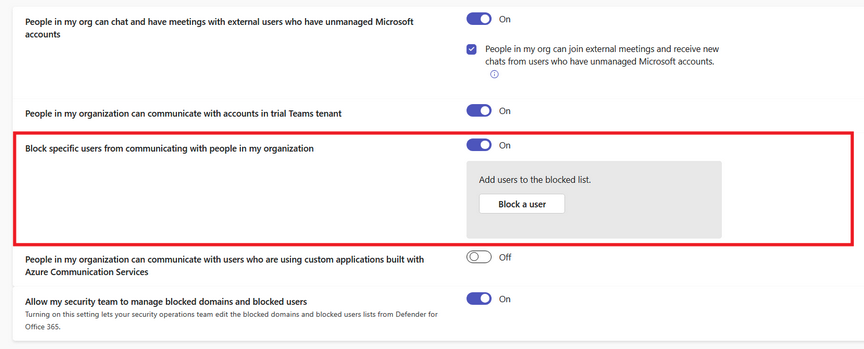
The new capability will be available to all organizations using Teams with Microsoft Defender for Office 365 Plan 1 or Plan 2 subscriptions. This centralized approach aims to enhance security and compliance by giving organizations control over external user access across Microsoft 365 services.
Microsoft has stated that the rollout of this feature will commence in early January 2026 and is expected to be completed by mid-January 2026. The primary purpose of this feature is to prevent cybercrime groups, including ransomware gangs, from exploiting Teams in social engineering attacks targeting employees.
Teams will also provide warnings to admins about suspicious traffic from external domains and will enhance messaging security by enabling malicious URL detection, protection against weaponizable file types, and a system for reporting false positives starting in January.
During the 2024 Enterprise Connect conference, Microsoft revealed that over 320 million people use Teams each month, highlighting the platform’s widespread adoption.

Broken IAM isn’t just an IT problem – the impact ripples across your whole business.
This practical guide covers why traditional IAM practices fail to keep up with modern demands, examples of what “good” IAM looks like, and a simple checklist for building a scalable strategy.













The Lord of the Rings: War in the North Legacy Edition – Patch One: The Beginning of a New Journey

Revolutionizing Android: 5 Innovative Features That Will Transform User Experience

Xiaomi 18 Pro: Global Launch Set for 2026, Confirmed by Tech Advisor

Comparing Farmtech Solutions: Poly Tape vs Electric Fence Wire

Unbeatable Deals on Top-tier Apps: Own Them Forever at a Fraction of the Cost

Does a Cheap 2018 Smartphone beat a 2013 Flagship?

Expert Tips for Buying a BMW X5: Insights from a Seasoned Owner of 103 Models

Microsoft’s Bold Vision: The Copilot ‘Super App’ Set to Rival Office in Influence

Lost in the Fantasia: The Rise and Fall of a Colourful JRPG

EU Takes Action Against Instagram and Facebook for Violating Illegal Content Rules

Warning: Facebook Creators Face Monetization Loss for Stealing and Reposting Videos

Facebook’s New Look: A Blend of Instagram’s Style

Facebook Compliance: ICE-tracking Page Removed After US Government Intervention

Facebook and Instagram to Reduce Personalized Ads for European Users

InstaDub: Meta’s AI Translation Tool for Instagram Videos

Reclaim Your Account: Facebook and Instagram Launch New Hub for Account Recovery

Meta discontinues Messenger apps for Windows and macOS

Breaking Updates: Meta Connect 2025 Unveils Latest Developments
Does a Cheap 2018 Smartphone beat a 2013 Flagship?

Samsung Galaxy S9 & S9+ UNBOXING!

Samsung Galaxy S9 Plus vs iPhone X

The BEST $300 Phone (2018) ft. MKBHD, Technical Guruji, iJustine + More

Samsung Galaxy S9 Plus Gaming Review! (vs OnePlus 5T)

THE BEST PHONE HTC EVER MADE?

The Truth about Google?

Samsung S9/ S9+ vs iPhone X vs Galaxy Note 8 Battery Life DRAIN TEST

Samsung S9 / S9+ vs Mate 10 Pro vs iPhone X Charging SPEED Test
-
 Facebook11 months ago
EU Takes Action Against Instagram and Facebook for Violating Illegal Content Rules
-
 Facebook12 months ago
Warning: Facebook Creators Face Monetization Loss for Stealing and Reposting Videos
-
 Facebook10 months ago
Facebook’s New Look: A Blend of Instagram’s Style
-
 Facebook12 months ago
Facebook Compliance: ICE-tracking Page Removed After US Government Intervention
-
 Facebook10 months ago
Facebook and Instagram to Reduce Personalized Ads for European Users
-
 Facebook12 months ago
InstaDub: Meta’s AI Translation Tool for Instagram Videos
-
 Facebook10 months ago
Reclaim Your Account: Facebook and Instagram Launch New Hub for Account Recovery
-
 Apple11 months ago
Meta discontinues Messenger apps for Windows and macOS
