
AI
Alibaba’s RynnBrain: The New Challenger in Robotics AI Race

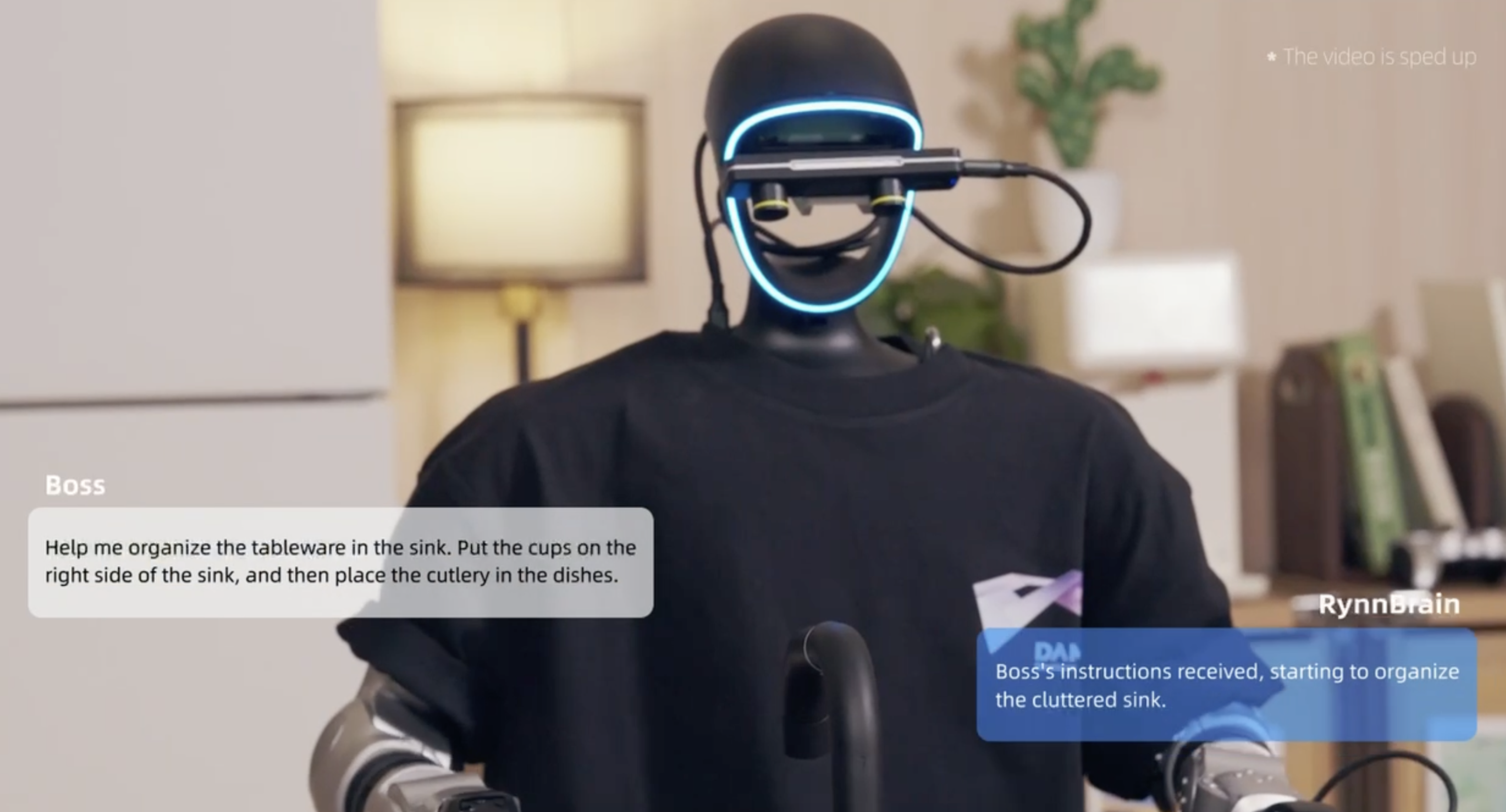
Alibaba’s entrance into the realm of AI that powers robots, not just chatbots, has been marked by the unveiling of RynnBrain, an open-source model aimed at aiding robots in perceiving their environment and carrying out physical tasks. This move reflects China’s growing emphasis on physical AI as the demand for machines capable of working alongside or replacing humans rises due to aging populations and labor shortages. In the quest to develop what Nvidia CEO Jensen Huang refers to as a “multitrillion-dollar growth opportunity,” Alibaba joins the ranks of Nvidia, Google DeepMind, and Tesla.
Setting itself apart from its competitors, Alibaba has opted for an open-source approach with RynnBrain, making it freely accessible to developers to expedite adoption, similar to its strategy with the Qwen family of language models, considered among China’s most advanced AI systems. Video demonstrations from Alibaba’s DAMO Academy showcase RynnBrain-powered robots engaging in tasks like identifying fruit and placing it in baskets, which may seem simple but necessitate sophisticated AI for object recognition and precise movements.
RynnBrain falls under the vision-language-action (VLA) model category, integrating computer vision, natural language processing, and motor control to enable robots to interpret their surroundings and carry out appropriate actions. Unlike conventional robots following preprogrammed instructions, physical AI systems like RynnBrain empower machines to learn from experience and adjust their behavior in real-time, marking a shift from automation to autonomous decision-making in physical environments.
The timing of these advancements indicates a broader inflection point, as physical AI transitions from a research-oriented timeline to an industrial one, as per Deloitte’s 2026 Tech Trends report. With simulation platforms and synthetic data generation shortening iteration cycles before real-world implementation, this shift is primarily driven by economic imperatives. Developed economies are grappling with the reality of increasing demand for production, logistics, and maintenance, outpacing the supply of labor. The OECD foresees stagnation or decline in working-age populations across developed nations in the coming decades due to accelerated aging.
Certain regions, particularly parts of East Asia like China, Japan, and South Korea, are already experiencing the impact of demographic aging, declining fertility, and tightening labor markets on automation decisions in logistics, manufacturing, and infrastructure. This trend underscores the broader trajectory that other advanced economies are likely to follow. China, in particular, has surged ahead of the U.S. in humanoid robots’ development, with plans to ramp up production in the near future.
The governance aspect emerges as a critical constraint amid the accelerated capabilities of physical AI, transcending mere model performance concerns. In physical environments, failures cannot be rectified post facto, necessitating a robust governance framework to address responsibility, authority, and intervention in AI-driven operations. The World Economic Forum highlights the shift from system capabilities to governance as AI begins to oversee tasks like goods movement and labor coordination in physical settings.
The governance framework encompasses executive governance, setting risk tolerance and mandates; system governance, embedding constraints into engineered reality through stop rules and change controls; and frontline governance, granting workers the authority to override AI decisions. As physical AI gains momentum, technical capabilities may converge, but governance frameworks are likely to diverge. Neglecting governance could yield initial gains but magnify vulnerabilities at scale.
The U.S.-China competition exhibits an asymmetry, with China’s expedited deployment cycles and willingness to pilot systems in controlled industrial environments potentially accelerating learning curves. However, governance frameworks effective in structured factory settings may not translate seamlessly to public spaces where autonomous systems must navigate unpredictable human behavior.
Present deployments of physical AI are concentrated in warehousing and logistics, reflecting the acute labor market pressures in these sectors. Companies like Amazon and BMW are leveraging AI-driven robotics for improved efficiency and dexterity in their operations, while healthcare and smart city initiatives are exploring AI applications for surgical procedures, patient care, and infrastructure maintenance.
The regional competitive landscape is evolving rapidly, with South Korea’s significant investment in AI semiconductors signaling the importance of domestic chip manufacturing capacity for physical AI deployment. Leading players like NVIDIA, Google DeepMind, and Tesla are developing AI models to drive advancements in robotics, aiming to revolutionize automation through the convergence of AI capabilities with physical manipulation.
As simulation environments improve and learning cycles shorten, the strategic focus is shifting from the adoption of physical AI to its governance at scale. For China, the ability to govern its robotics deployment effectively will determine whether its early lead translates into sustained industrial dominance or serves as a cautionary tale about scaling systems faster than the required governance infrastructure can sustain.
(Article by Alibaba)









Valhalla: The Ultimate Road-Ready Supercar

Hands-Free Ordering: How Alexa Simplifies Grubhub and Uber Eats

iPhone 12 / 12 Pro Unboxing – ft MKBHD!

Stealthy Malware Tactics: ClickFix and WMI Persistence in Browser Credential Theft

The Long Dark Reaches a Conclusion, But It’s Just the Beginning

Yupp.ai’s Closure: A Reflection on the Rise and Fall of a16z’s Investment

Half a Century of Apple: Celebrating the Successes and Challenges

Upgrade Your Email Identity: Say Goodbye to Your Embarrassing Gmail Username

Bloodbath: A Brutal Display with a Missing Edge

EU Takes Action Against Instagram and Facebook for Violating Illegal Content Rules

Warning: Facebook Creators Face Monetization Loss for Stealing and Reposting Videos

Facebook Compliance: ICE-tracking Page Removed After US Government Intervention

Facebook’s New Look: A Blend of Instagram’s Style

Facebook and Instagram to Reduce Personalized Ads for European Users

InstaDub: Meta’s AI Translation Tool for Instagram Videos

Reclaim Your Account: Facebook and Instagram Launch New Hub for Account Recovery

Meta discontinues Messenger apps for Windows and macOS

Breaking Updates: Meta Connect 2025 Unveils Latest Developments
iPhone 12 / 12 Pro Unboxing – ft MKBHD!

iPhone 12 Pro vs iPhone 12 vs iPhone 11 Pro Camera Test Comparison.

Huawei Mate 40 Pro Unboxing – WHAT.

iPhone 12 vs iPhone 12 Pro / 11 Pro Max / 11 Pro / 11 / XR / SE Battery Life DRAIN Test.

19 Smartphone Gadgets that Blew me Away.

iPhone 12 Pro Max Unboxing & Review!

iPhone 12 Pro Max vs Samsung Note 20 Ultra / Huawei Mate 40 Pro Camera Test Comparison.

iPhone 12 Pro Max vs Samsung Note 20 Ultra / Huawei / Xiaomi / OnePlus Battery Life DRAIN Test.

The BEST Smartphone of 2020 🏆
-
 Facebook5 months ago
EU Takes Action Against Instagram and Facebook for Violating Illegal Content Rules
-
 Facebook6 months ago
Warning: Facebook Creators Face Monetization Loss for Stealing and Reposting Videos
-
 Facebook6 months ago
Facebook Compliance: ICE-tracking Page Removed After US Government Intervention
-
 Facebook4 months ago
Facebook’s New Look: A Blend of Instagram’s Style
-
 Facebook4 months ago
Facebook and Instagram to Reduce Personalized Ads for European Users
-
 Facebook6 months ago
InstaDub: Meta’s AI Translation Tool for Instagram Videos
-
 Facebook4 months ago
Reclaim Your Account: Facebook and Instagram Launch New Hub for Account Recovery
-
 Apple5 months ago
Meta discontinues Messenger apps for Windows and macOS
