
Amazon
Amazon Prime Now: Revolutionizing Rapid Delivery in Seattle

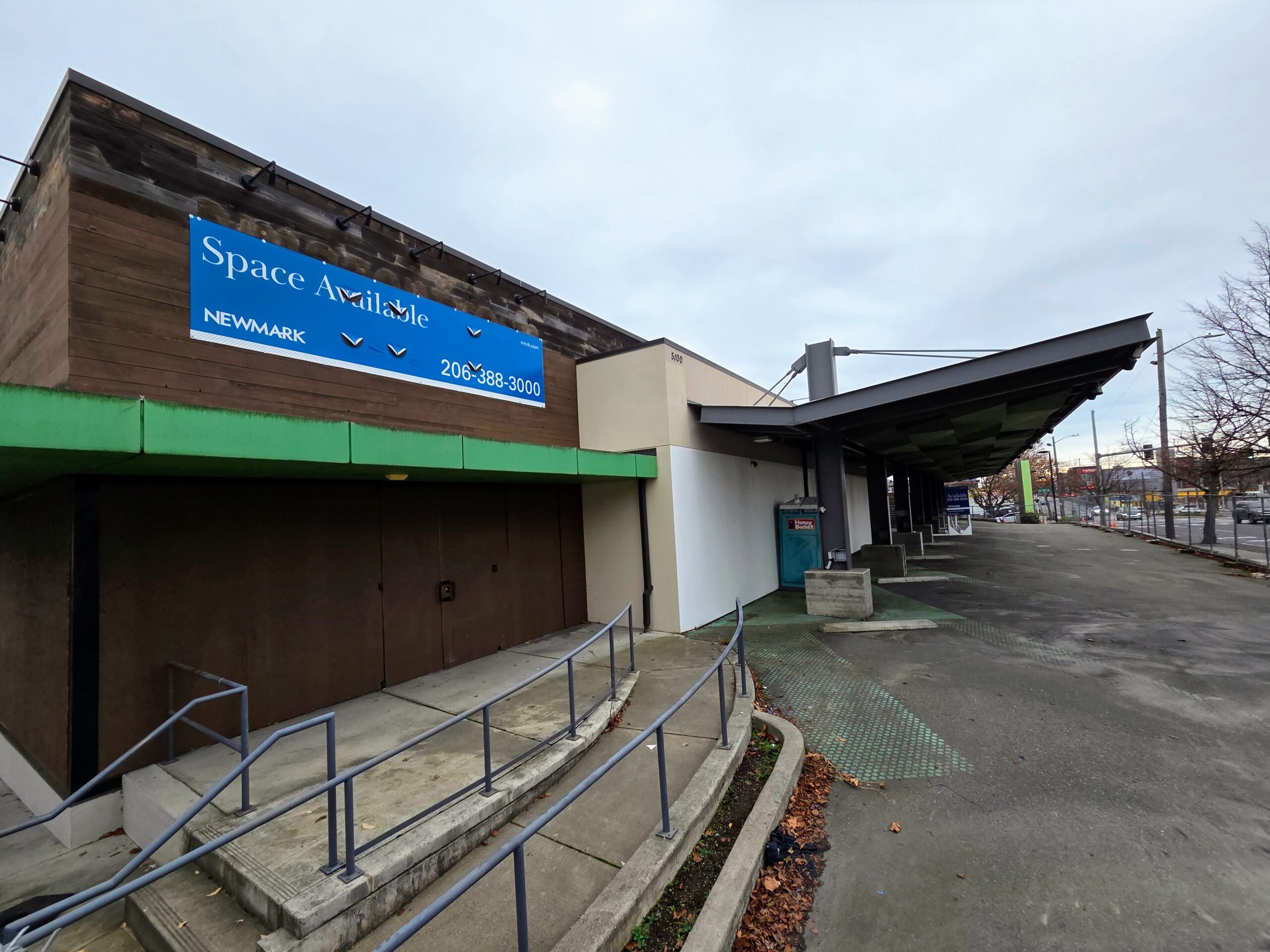
Amazon’s former Fresh Pickup site in Seattle’s Ballard neighborhood, which closed since early 2023, is slated to become a new rapid-dispatch delivery hub for Amazon Flex drivers, according to permit filings. (GeekWire Photo / Todd Bishop)
Amazon will try a new twist on local deliveries at a shuttered site in Seattle’s Ballard neighborhood: a retail-style delivery hub for rapid dispatch of Amazon Flex drivers.
Permit filings describe it as a store in which no customers will ever set foot. Instead, Amazon employees will fulfill online orders — picking and bagging items in a back-of-house stockroom, placing the completed orders on shelves at the front of the space, and handing them off to Amazon Flex drivers for rapid delivery in the surrounding neighborhood.
The documents outline a continuous flow in which drivers arrive, scan in, retrieve a packaged customer order, confirm it with an associate, and depart within roughly two minutes. The operation is expected to run 24 hours a day, seven days a week.
It will operate “much like a convenience store,” Amazon says in one filing.
The plans for the former Amazon Fresh Pickup site, at 5100 15th Ave. NW, haven’t been previously reported. The project uses the code “ZST4,” with the “Z” designation representing a new category of Amazon site that aligns with the recently introduced “Amazon Now” delivery type — short, sub-one-hour delivery blocks from dedicated pickup locations.

“Amazon Now” is a recent addition to the delivery types available to Amazon Flex drivers.
Recent screenshots shared by Amazon Flex drivers on Facebook show Amazon Now at similarly named sites, such as ZST3 in Seattle’s University District and ZPL3 in Philadelphia, suggesting the Ballard project is part of a broader rollout of small, hyperlocal delivery operations.
It’s part of Amazon’s larger push into “sub-same-day” delivery — in which smaller, urban fulfillment centers carry a limited set of high-demand items for faster turnaround. The company has been trying different approaches in this realm for several years, looking for the right combination of logistics and economics.
Amazon is far from alone in exploring new models for ultrafast delivery. GoPuff, DoorDash, Uber Eats, Glovo, FreshDirect and others all operate variations of quick-commerce or micro-fulfillment networks, often using partnerships or “dark stores” — retail-style storefronts that are closed to the public and used solely to fulfill online orders at high speed.
Amazon’s Flex program launched 10 years ago. Flex drivers are independent contractors who deliver packages for the company using their own vehicles, signing up for delivery blocks through the Amazon Flex app. The program has often been described as Uber for package delivery.
What’s different about the new Seattle site, and the Amazon Now initiative, is the speed and simplicity of the operation, as described in the filings. It emphasizes rapid handoffs, with drivers cycling through in minutes rather than loading up for longer delivery routes.
The permit filings emphasize that some delivery drivers will use personal e-bikes and scooters to make deliveries, reflecting the smaller size of the orders and the short distances involved.
Testing the economics
Supply-chain analyst Marc Wulfraat of MWPVL International, who tracks Amazon’s logistics network, said the approach is similar to its legacy Prime Now and Amazon Fresh local delivery sites, with the twist of operating more like a store than a warehouse, based on Amazon’s description.
He said that could mean Amazon will stock perishable items in cooler displays in addition to shelf-stable goods. (That could align with Amazon’s recent effort to integrate fresh groceries directly into Amazon.com orders, letting customers add produce and other chilled items to standard same-day deliveries.)
The filing doesn’t detail the types of products to be available from the site, except that they will be “essential items and local products that are in-demand and hyper-focused on the needs of local customers within the community.”
“I tend to view these as lab experiments to test if the concept is profitable,” Wulfraat said.
The challenge with these small-format sites, he explained, is that each order tends to be low-value, which means the combined cost of fulfilling and delivering it can take up a large share of the revenue — raising questions about whether the model can be profitable.
Amazon has experimented with similar ideas before.
In late 2024, the company shut down “Amazon Today,” a same-day delivery program that used Flex drivers to pick up small orders from mall and brick-and-mortar retailers. CNBC reported at the time that the service struggled because drivers often left the stores with only one or two items, making the cost per delivery far higher than traditional warehouse-based routes.
That pullback illustrated the economic challenges of ultrafast delivery and smaller orders. But by operating the new Seattle “store” itself, the company should be able to control more of the variables, including inventory flow, pickup efficiency, and the labor required in the process.
Under the plan, the new Ballard hub will be staffed by four shifts of six to eight Amazon employees each — which translates into 24 to 32 employees per day. The site is expected to dispatch about 240 vehicles over a 24-hour period, with peak volumes of 15 to 20 trips per hour.

The Amazon Fresh Pickup in Seattle’s Ballard neighborhood when it opened in 2017. (GeekWire File Photo / Kevin Lisota)
It will be the second time for this building to host an Amazon retail experiment. The site previously operated as one of only two standalone Amazon Fresh Pickup locations in the U.S., offering drive-up grocery retrieval and package returns for Prime members beginning in 2017.
Amazon closed the Ballard pickup site in early 2023 amid a broader pullback from several brick-and-mortar initiatives, shifting focus to other Amazon Fresh stores, Whole Foods, and online grocery delivery.
Fitting the Seattle Delivery Hub into Zoning Requirements
Ever since its closure, the building has remained shut, waiting for a new purpose to breathe life into its walls.
Adhering to Zoning Regulations
The concept of the new Seattle delivery hub not only highlights its retail-like characteristics but also plays a crucial role in ensuring that the facility aligns with the zoning regulations focused on retail activities.
The location is specifically zoned for auto-oriented retail and service establishments, with the authorization to operate as a retail store for general sales and services, a classification that Amazon acquired in 2016 during the transformation of the building from a restaurant. The site, formerly known as Louie’s Cuisine of China, now holds the potential to serve a new purpose under Amazon’s ownership.
If the city confirms that the new facility meets the retail criteria, Amazon might bypass a formal change-of-use evaluation, which typically triggers additional assessments such as traffic impact studies, environmental checks, and upgrades to meet current building codes.
Amazon’s permit application consistently references retail terms and portrays Flex drivers as customer representatives, indicating a customer-oriented approach. The narrative in the filings, dated Oct. 31, states, “Our store will have a small front-of-house area where customer-selected products are available for customer representatives (Amazon Flex Drivers) to come in to pick up the purchased products.”
This strategy could potentially set a precedent for regions where authorities are tightening regulations on “dark stores” within retail districts. Cities like New York, Amsterdam, and Paris have taken steps to regulate or prohibit micro-fulfillment centers in storefronts, citing concerns that they diminish the vibrancy of urban areas and violate zoning laws.
As of now, there is no confirmed timeline for the opening of the new facility. We have reached out to Amazon for comments on the project and will update this post with any further details.
[Special thanks to the anonymous source who alerted us about the filing. If you have valuable information to share related to our coverage, please reach out to us via email at [email protected] or through our online form.]












The Future of Brand Discovery: AEO vs. GEO in the Age of AI (2026)

Government Announces Crackdown on Gouging Amid Record Fuel Prices

iPhone 12 vs iPhone 12 Pro / 11 Pro Max / 11 Pro / 11 / XR / SE Battery Life DRAIN Test.

TeamPCP Releases Telnyx Versions on PyPI, Conceals Malicious Stealer in WAV Files

The Sunday Gazette: Gaming News and Reviews

Y Combinator Graduate Glimpse Secures $35M Funding Round with a16z Leading Investment

Upgrade to iOS 26.4: The Latest and Greatest Features

Koenigsegg Gemera Hits the Production Line: A 6-Year Journey from Unveiling to Reality

Director Patel’s Email Inbox Hacked by FBI, Investigation Underway

EU Takes Action Against Instagram and Facebook for Violating Illegal Content Rules

Warning: Facebook Creators Face Monetization Loss for Stealing and Reposting Videos

Facebook Compliance: ICE-tracking Page Removed After US Government Intervention

Facebook’s New Look: A Blend of Instagram’s Style

Facebook and Instagram to Reduce Personalized Ads for European Users

InstaDub: Meta’s AI Translation Tool for Instagram Videos

Reclaim Your Account: Facebook and Instagram Launch New Hub for Account Recovery

Meta discontinues Messenger apps for Windows and macOS

Breaking Updates: Meta Connect 2025 Unveils Latest Developments
iPhone 12 vs iPhone 12 Pro / 11 Pro Max / 11 Pro / 11 / XR / SE Battery Life DRAIN Test.

19 Smartphone Gadgets that Blew me Away.

iPhone 12 Pro Max Unboxing & Review!

iPhone 12 Pro Max vs Samsung Note 20 Ultra / Huawei Mate 40 Pro Camera Test Comparison.

iPhone 12 Pro Max vs Samsung Note 20 Ultra / Huawei / Xiaomi / OnePlus Battery Life DRAIN Test.

The BEST Smartphone of 2020 🏆

The Self-Healing Smartphones!

Apple is not what it used to be.

Smartphones are Boring now.
-
 Facebook5 months ago
EU Takes Action Against Instagram and Facebook for Violating Illegal Content Rules
-
 Facebook6 months ago
Warning: Facebook Creators Face Monetization Loss for Stealing and Reposting Videos
-
 Facebook6 months ago
Facebook Compliance: ICE-tracking Page Removed After US Government Intervention
-
 Facebook4 months ago
Facebook’s New Look: A Blend of Instagram’s Style
-
 Facebook4 months ago
Facebook and Instagram to Reduce Personalized Ads for European Users
-
 Facebook6 months ago
InstaDub: Meta’s AI Translation Tool for Instagram Videos
-
 Facebook4 months ago
Reclaim Your Account: Facebook and Instagram Launch New Hub for Account Recovery
-
 Apple5 months ago
Meta discontinues Messenger apps for Windows and macOS
