
Mobile Tech
Breaking Records: Gemini AI Powers $143.8B in Revenue

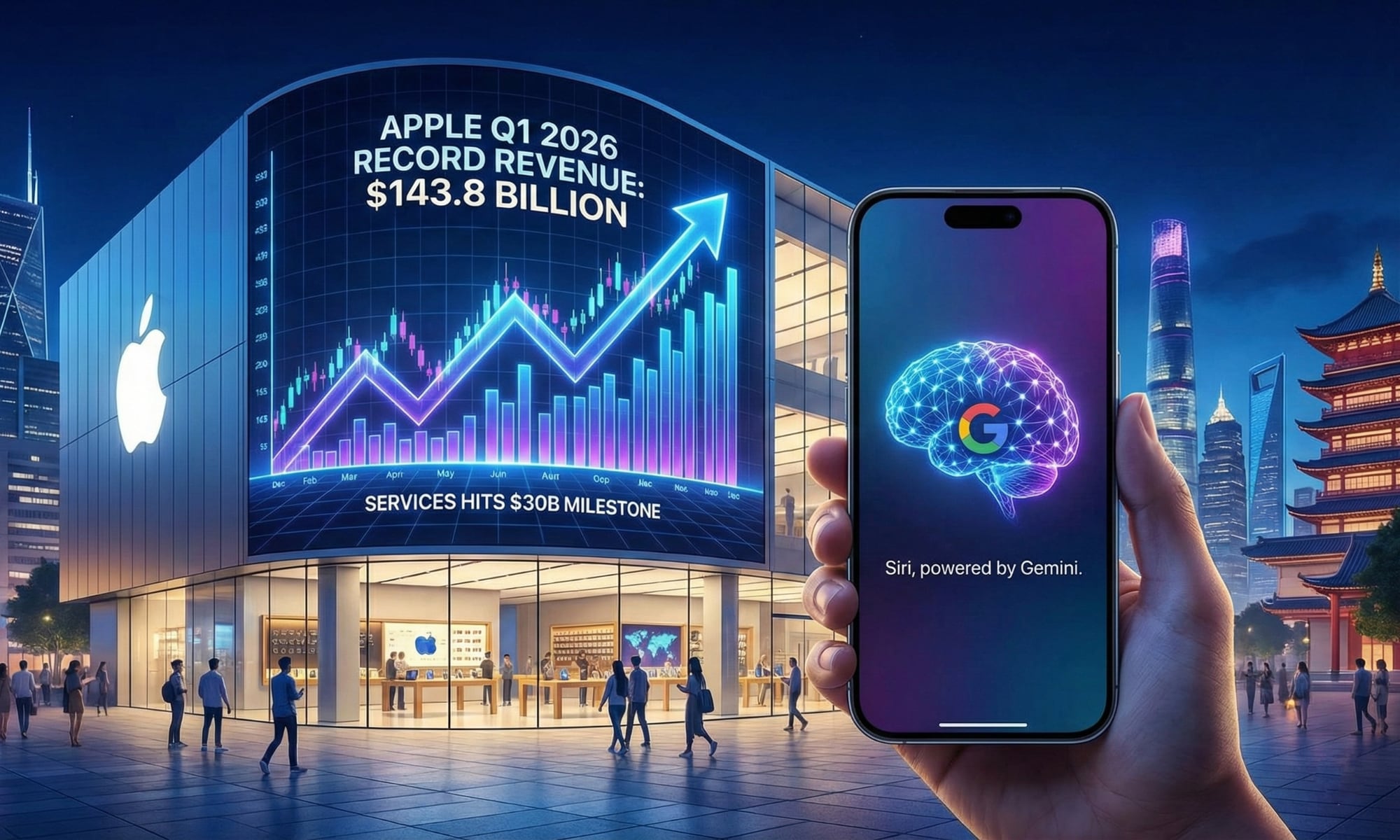
Today, Apple announced its Q1 2026 “holiday quarter” earnings, once again shattering records — and blowing away Wall Street expectations — by posting the largest year-over-year increase since the COVID-19 pandemic in 2021.
Apple’s revenue for its fiscal 2026 first quarter, which ended on December 27, 2025, was a staggering $143.8 billion, up 16 percent from Q1 2025.
As we anticipated when Apple crossed the $100 billion mark for a fourth quarter last year, that was indeed just the tip of the iceberg. Apple’s Q4 ends in September, not long after the new iPhone models launch each year. In this case, Apple only had the preorders and a week of in-store sales to bolster its Q4 2025 numbers.
However, that quarter ended with incredible momentum — and Apple struggling to keep up with demand — suggesting that the holiday quarter that followed between October and December was going to be a big one — and it was.
During the December quarter, our record business performance and strong margins led to EPS growth of 19 percent, setting a new all-time EPS record. These exceptionally strong results generated nearly $54 billion in operating cash flow, allowing us to return almost $32 billion to shareholders.
Kevan Parekh, Apple CFO
The Numbers
Apple’s fiscal year ends in September, which is why the final calendar quarter of the year is actually Q1 2026. This time around, the company posted quarterly revenue of $143.76 billion — it’s highest by a long shot — with diluted earnings per share (EPS) of $2.84, up an even higher 19 percent from the year-ago quarter.
It’s no surprise that this driven by the iPhone, which accounted for just over 59% of overall revenue. As usual, Services was in second place marking its own milestone as it crossed the $30 billion threshold, leaving Apple’s remaining three categories coming in as distant runners-up. Here’s the breakdown.
| Segment | Q1 2026 Revenue | Growth (YoY) | Key Driver |
|---|---|---|---|
| iPhone | $85.3B | +23.3% | iPhone 17 & China Rebound |
| Services | $30.0B | +13.9% | Milestone $30B Mark |
| iPad | $8.6B | +6.3% | M5 iPad Pro Launch |
| Wearables | $11.5B | -2.2% | AirPods Pro 3 Constraints |
| Mac | $8.4B | -6.7% | Tough 2025 Comp |
Today, Apple is proud to report a remarkable, record-breaking quarter, with revenue of $143.8 billion, up 16 percent from a year ago and well above our expectations. iPhone had its best-ever quarter driven by unprecedented demand, with all-time records across every geographic segment, and Services also achieved an all-time revenue record, up 14 percent from a year ago. We are also excited to announce that our installed base now has more than 2.5 billion active devices, which is a testament to incredible customer satisfaction for the very best products and services in the world.
Tim Cook, Apple CEO
The iPhone Carries the Day
With its September launch schedule, the iPhone always makes up over half of Apple’s sales each holiday quarter, and while it captured a 3% larger share than last year’s iPhone 16 lineup, which came in at slightly under 56%, this year’s number is more in line with previous quarters, which have otherwise averaged 58.9% since Q1 2019.
During the earnings call that followed, Tim Cook credited much of the iPhone’s sales performance to China, where it did much better than Apple anticipated. While iPhone sales grew 23.3% globally over last year’s holiday quarter, the spike in China was much higher at 38%, creating what Cook declared “the best iPhone quarter in history in Greater China.”
It is driven by the customer enthusiasm for the iPhone 17 lineup. And I would tell you that during the quarter, traffic in our stores in China grew by strong double digits year over year. It was a terrific quarter. Our installed base reached an all-time high in both Greater China and Mainland China. And we set an all-time record for the upgraders, and we saw strong double-digit growth on switchers.
Tim Cook
There may have also been some pent-up demand in China, as the iPhone Air failed to launch there until October due to delays in getting the eSIM technology cleared by Chinese regulators. However, when it finally did launch, Apple couldn’t make them fast enough to keep up with demand.
That’s a problem Apple is still facing. Cook mentioned several times during the call that Apple has been constrained on the supply side and hasn’t been able meet consumer demand for the new models. When one analyst asked how long he expected supply challenges to impact Apple’s ability to “ship to true demand,” Cook candidly replied that “It is difficult to estimate demand when you have not met the demand,” as it effectively leaves Apple chasing a moving target.
Services Dominate the Rest of the Landscape
Apple had surprisingly little to say about its Services business this year, considering that it just grew by another 13.9%, reaching an all-time high of $30 billion.
To put that in perspective, the iPhone and Services together accounted for just over 80% of Apple’s revenue in the last quarter, dwarfing the other three product categories.
That’s not to say that the Mac, iPad, and Wearables aren’t doing well, as they still collectively accounted for $28.5 billion in revenue, but it’s also notable that the only one of those categories to grow was the iPad, and its 6.3% increase, while still quite respectable, was dwarfed by the double-digit growth in iPhone and Services.
Still, it’s worth keeping in mind that Apple only released a single new iPad during the quarter, the high-end M5 iPad Pro, so it’s likely most of the growth came from its older tablet lineup.
The latest addition to Apple’s product lineup was the single M5 MacBook Pro, which was the only new Mac released during the quarter. In the Wearables category, the company had high hopes for growth, especially with the introduction of three new Apple Watches and the AirPods Pro 3. Despite these new releases, the category saw a decline of 2.2%, continuing a trend of shrinking earnings in Q1 since 2023.
CEO Tim Cook attributed some of the decline to constraints on the AirPods Pro 3 supply, suggesting that the category would have performed better otherwise. He also noted that over half of customers purchasing an Apple Watch during the quarter were new to the product.
During the earnings call, the focus shifted to Apple’s partnership with Google to utilize Gemini technology for Siri. Cook briefly mentioned the collaboration before moving on to other topics, leaving analysts with unanswered questions. When pressed for details, Cook reiterated that Google’s AI technology was chosen for its capabilities and that Apple would maintain control over its usage.
Looking ahead, Apple is optimistic about the future, projecting a 13-16% year-over-year growth for the March quarter. This outlook indicates that the company’s “supercycle” still has momentum.












Apple WWDC 2026: The Ultimate Guide to What’s Coming Next

Unleashing the Beast: The 2027 Mercedes-AMG GT Black Series

15 Smartphone FAILS to ruin your day 😂

Data Breach at Mazda: Employee and Partner Information Exposed

City of Legends: Wartales Expansion – Choose Your Fate

Xiaomi 17 vs 17 Ultra Comparison: Why You Should Consider the Standard Model

Insight Partners Investigates ‘Fake Compliance’ Allegations, Delays Demos and Scrubs Investment Plans

Wuthering Heights: A Tale of Love and Loss Streaming Now

The Evolution of Apple’s AirPods Max: Unveiling the AirPods Max 2

EU Takes Action Against Instagram and Facebook for Violating Illegal Content Rules

Warning: Facebook Creators Face Monetization Loss for Stealing and Reposting Videos

Facebook Compliance: ICE-tracking Page Removed After US Government Intervention

Facebook’s New Look: A Blend of Instagram’s Style

Facebook and Instagram to Reduce Personalized Ads for European Users

InstaDub: Meta’s AI Translation Tool for Instagram Videos

Reclaim Your Account: Facebook and Instagram Launch New Hub for Account Recovery

Meta discontinues Messenger apps for Windows and macOS

Breaking Updates: Meta Connect 2025 Unveils Latest Developments
15 Smartphone FAILS to ruin your day 😂

World’s Biggest Smartphone Collection?

I switched to iPhone – This is what I found out.

What happened to Beats by Dre?

DON’T buy a Screen Protector before watching this.

Beware of Fake Reviewers! ⚠️

Xiaomi Mi 11 Unboxing & Review.

The Galaxy S21 Ultra is Better than you think.

Samsung Galaxy S21 Ultra vs iPhone 12 Pro Max Camera Test Comparison.
-
 Facebook5 months ago
EU Takes Action Against Instagram and Facebook for Violating Illegal Content Rules
-
 Facebook5 months ago
Warning: Facebook Creators Face Monetization Loss for Stealing and Reposting Videos
-
 Facebook5 months ago
Facebook Compliance: ICE-tracking Page Removed After US Government Intervention
-
 Facebook3 months ago
Facebook’s New Look: A Blend of Instagram’s Style
-
 Facebook4 months ago
Facebook and Instagram to Reduce Personalized Ads for European Users
-
 Facebook5 months ago
InstaDub: Meta’s AI Translation Tool for Instagram Videos
-
 Facebook4 months ago
Reclaim Your Account: Facebook and Instagram Launch New Hub for Account Recovery
-
 Apple5 months ago
Meta discontinues Messenger apps for Windows and macOS
