
Inovation
Breakthrough in Red Quantum LEDs: Engineers Achieve Record 31% Efficiency for Enhanced Display Color and Brightness

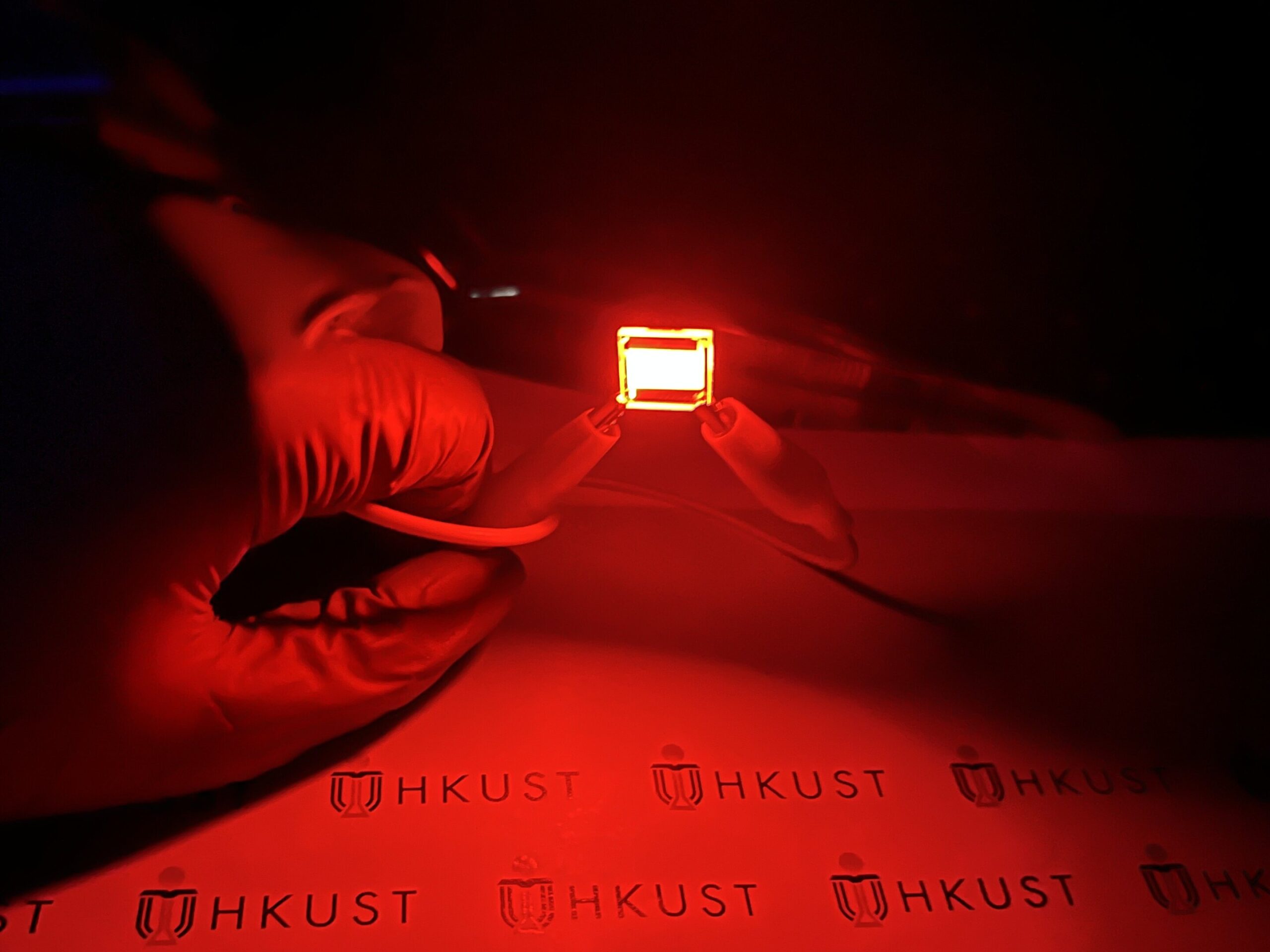
A team of researchers from the School of Engineering at The Hong Kong University of Science and Technology (HKUST) has made significant progress in the field of quantum rod light-emitting diodes (QR-LEDs), achieving record-high efficiency levels for red QR-LEDs. This breakthrough is expected to bring about significant advancements in next-generation display and lighting technologies, promising users of smartphones and televisions a more vibrant and enhanced visual experience. The findings have been published in the journal Advanced Materials.
Light-emitting diodes (LEDs) have been widely used in electronic devices for many years. Recent advancements in quantum materials have led to the development of quantum dot LEDs (QD-LEDs) and QR-LEDs. QD-LEDs offer superior color purity and brightness compared to traditional LEDs. However, the outcoupling efficiency has become a major challenge, limiting further improvements in performance.
Quantum rods, the basis of QR-LEDs, are elongated nanocrystals with unique optical properties that can be tailored to enhance light emission direction and improve outcoupling efficiency. Despite these advantages, QR-LEDs face challenges such as low photoluminescence quantum yield and leakage current due to poor thin-film quality.
To address these obstacles, a research team led by Prof. Abhishek K. Srivastava, Associate Professor of the Department of Electronic and Computer Engineering (ECE), focused on enhancing the optical performance of QR-LEDs through improved synthesis techniques. They achieved a remarkable photoluminescence quantum yield of up to 92% for both green and red quantum rods, along with uniform size distribution and shape confinement, crucial for optimizing QR-LED performance.
Past studies often overlooked carrier leakage caused by irregular quantum rod films and its impact on light coupling efficiency in QR-LEDs. To overcome this issue, the team developed an equivalent circuit model to illustrate the negative effects of leakage current in traditional QR-LED structures.
By strategically modifying the QR-LED device structure, the team achieved a dual breakthrough: enhancing balanced carrier injections and suppressing leakage current. As a result, the optimized red QR-LEDs reached a peak EQE of 31% and a peak brightness of 110,000 cd m⁻², setting a new standard in red QR-LED research. The team also applied their approach to green “dot-in-rod” quantum rods, achieving a peak EQE of 20.2% and an ultra-high luminance of 250,000 cd m⁻².
Prof. Srivastava emphasized the importance of their work in advancing the field of anisotropic nanocrystals and their commercial applications. He highlighted the fundamental advantages of quantum rods over quantum dots and the necessity of tailored solutions for elongated shaped nanocrystals like QR-LEDs.
Citation:
Engineers achieve record 31% efficiency in red quantum LEDs for enhanced display color and brightness (2025, November 4)
retrieved 9 November 2025
from https://techxplore.com/news/2025-11-efficiency-red-quantum-display-brightness.html
This document is subject to copyright. Apart from any fair dealing for the purpose of private study or research, no
part may be reproduced without the written permission. The content is provided for information purposes only.










The End of Security: iOS 13 and 14 Vulnerabilities in 2026

Exclusive Look: The 2027 Chevrolet Corvette Grand Sport Unleashed at Sebring

DON’T buy a Screen Protector before watching this.

Exploiting Vulnerable Drivers: How EDR Killers Use BYOVD to Disable Security

Alphabet’s X Unveils Innovative Spinout Targeting Costly Bureaucratic Challenges

Lawsuit: Halide co-founder accuses Sebastiaan de With of code theft for Apple

Previewing the Next Level: Apple Unveils iOS 26.4 RC for iPhone with Exciting New Features

Revamped Design: BMW’s Modern Makeover for the i3 Sedan

GitHub Actions Exploited in Trivy Vulnerability Scanner Breach, Infostealer Unleashed

EU Takes Action Against Instagram and Facebook for Violating Illegal Content Rules

Warning: Facebook Creators Face Monetization Loss for Stealing and Reposting Videos

Facebook Compliance: ICE-tracking Page Removed After US Government Intervention

Facebook’s New Look: A Blend of Instagram’s Style

Facebook and Instagram to Reduce Personalized Ads for European Users

InstaDub: Meta’s AI Translation Tool for Instagram Videos

Reclaim Your Account: Facebook and Instagram Launch New Hub for Account Recovery

Meta discontinues Messenger apps for Windows and macOS

Breaking Updates: Meta Connect 2025 Unveils Latest Developments
DON’T buy a Screen Protector before watching this.

Beware of Fake Reviewers! ⚠️

Xiaomi Mi 11 Unboxing & Review.

The Galaxy S21 Ultra is Better than you think.

Samsung Galaxy S21 Ultra vs iPhone 12 Pro Max Camera Test Comparison.

Samsung S21 Ultra vs iPhone Battery Life Test!

The Truth about Xiaomi “Air Charging”

DON’T buy this Smartphone.

Galaxy S21 Ultra – Exynos vs Snapdragon.
-
 Facebook5 months ago
EU Takes Action Against Instagram and Facebook for Violating Illegal Content Rules
-
 Facebook5 months ago
Warning: Facebook Creators Face Monetization Loss for Stealing and Reposting Videos
-
 Facebook5 months ago
Facebook Compliance: ICE-tracking Page Removed After US Government Intervention
-
 Facebook3 months ago
Facebook’s New Look: A Blend of Instagram’s Style
-
 Facebook3 months ago
Facebook and Instagram to Reduce Personalized Ads for European Users
-
 Facebook5 months ago
InstaDub: Meta’s AI Translation Tool for Instagram Videos
-
 Facebook4 months ago
Reclaim Your Account: Facebook and Instagram Launch New Hub for Account Recovery
-
 Apple5 months ago
Meta discontinues Messenger apps for Windows and macOS
