
Gadgets
Comparing SONOFF PoE Dongle Max and Home Assistant Connect ZBT-2Zigbee & Thread Coordinators: A Comprehensive Review

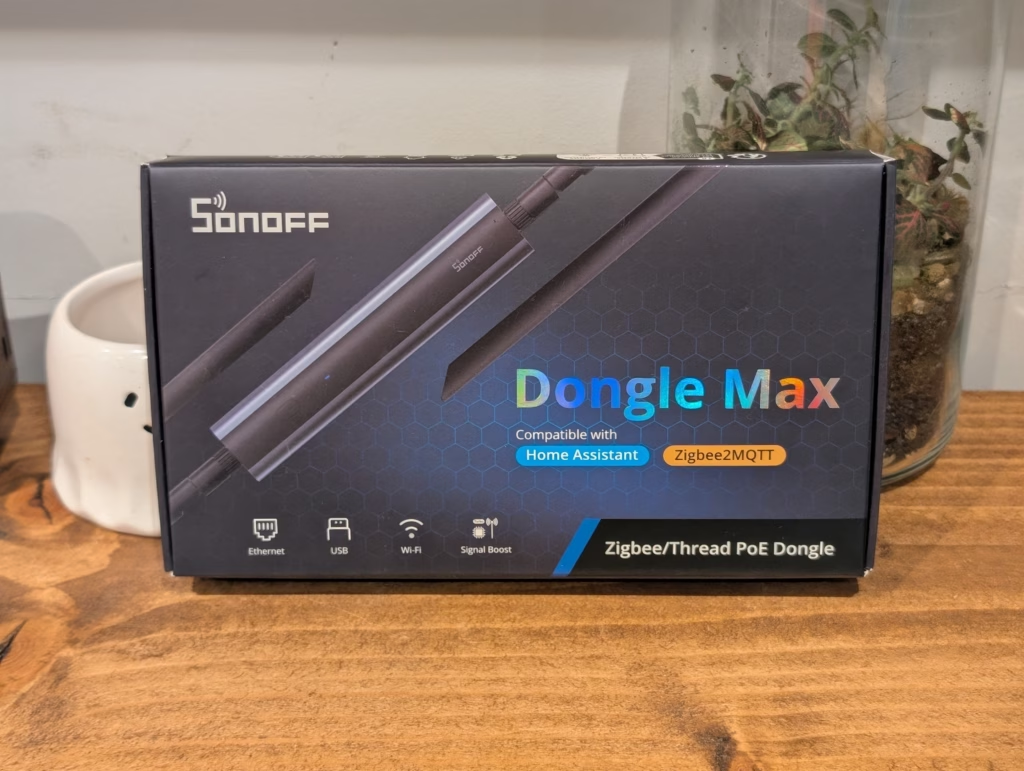
Any links to online stores should be assumed to be affiliates. The company or PR agency provides all or most review samples. They have no control over my content, and I provide my honest opinion.
SONOFF PoE Dongle Max Review vs Home Assistant Connect ZBT-2 Zigbee & Thread Coordinators
Summary
The Sonoff PoE Dongle Max is an excellent, flexible, and well-built upgrade for anyone running Home Assistant, offering superior placement options, stronger radio performance, and a far more capable interface than traditional USB-only coordinators. Its PoE support and dual-chip design make it a powerful alternative to the ZBT-2, especially in homes where server placement limits Zigbee coverage. While the setup is not always flawless and true multi-protocol support remains a work in progress, the Dongle Max delivers outstanding performance for the price and is an easy recommendation for users who want a robust, centrally placed Zigbee or Thread coordinator.
Pros
- Outstanding range and signal quality with dual external antennas
- PoE and Ethernet allow optimal placement away from server interference
- Excellent web interface with easy firmware management
- Strong value for money compared to the ZBT-2
Cons
- MultiPAN support is still experimental and not suitable for production use
I have an increasing number of smart home devices, and like many enthusiasts, I run Home Assistant, allowing me to integrate different smart home ecosystems into a cohesive system.
However, because I am constantly reviewing things, I have never really set up Home Assistant properly. I have often relied on proprietary systems and only use HA when I need them to interact with each other. The main one being getting Aqara motion sensors to trigger Philips Hue lights.
I previously used the Home Assistant Connect ZBT-1 for both Thread and Zigbee, but it was a bit temperamental, especially in the dual protocol mode, so I stuck with my old messy way of dealing with things.
With the recent launch of the Home Assistant Connect ZBT-2 and Sonoff PoE Dongle Max, I finally motivated myself to start setting up HA properly as my main hub for my smart home.
Specification
| Specification | Details |
| Model | Dongle-M |
| Colour | Dim Grey |
| Casing Materials | Aluminium, PC+ABS |
| Connection Options | Ethernet / Wi-Fi / USB (supports PoE) |
| USB Interface | Type-C |
| Network Interface | RJ45 |
| Power Input | 5V⎓1A (Type-C) or 48V⎓0.25A (PoE) |
| Wireless Protocols | Zigbee 3.0, Wi-Fi IEEE 802.11b/g/n 2.4GHz |
| SoC | EFR32MG24+ / ESP32D0WD |
| Serial Interface Protocol | EmberZNet (EZSP) |
| Antenna Gain | 5dBi |
| Number of Antennas | 2 |
| Operating Temperature | -10°C to 60°C |
| Supported Firmware | Zigbee Coordinator, Zigbee Router, Thread RCP, MultiPAN (Beta) |
| Additional Features | Web Console, AP Hotspot, Webhooks, WireGuard |
| Supported Platforms | Home Assistant, Hubitat, Alexa, SmartThings |
| In the Box | USB Type-C cable (1m) |
Features
High-Performance Chipset
The Dongle Max uses a dual-chip design combining the Silicon Labs EFR32MG24 with an ESP32D0WDR2. The EFR32MG24 handles Zigbee and Thread protocols, while the ESP32 manages Wi-Fi connectivity and the web interface. This separation of duties allows each processor to focus on its specific tasks. The EFR32MG24 is Silicon Labs’ current-generation chip for smart home protocols, offering improved processing headroom compared to the older EFR32MG21 found in many existing dongles.
Flexible Connectivity Options
The dongle supports three connection methods: Ethernet, Wi-Fi, and USB. The RJ45 port also accepts Power over Ethernet, allowing a single cable to provide both data and power. This flexibility means you can position the dongle away from your server or home automation hub if needed, which can be useful for optimising Zigbee coverage in larger properties. Wi-Fi operates on the 2.4GHz band using 802.11b/g/n.
Web-Based Management Interface
A built-in web console provides access to device status, configuration settings, logs, and alerts through a browser. This removes the need for command-line configuration, making initial setup and ongoing management more straightforward. The interface also supports webhook integration for notifications and includes WireGuard VPN capability for secure remote access.
Easy Firmware Management
Firmware updates and changes can be performed directly through the web interface without physical access to the device. The Dongle Max supports multiple firmware options including Zigbee Coordinator, Zigbee Router, Thread RCP, and MultiPAN (currently in beta). Switching between these modes does not require manual flashing or additional software.
Reliable Build Quality
The unit features dual external antennas with 5dBi gain, both of which are adjustable for optimising signal coverage. The aluminium housing provides better heat dissipation than plastic alternatives and has undergone 24-hour salt spray testing for corrosion resistance. The device carries CE, FCC, and RoHS certifications. Operating temperature range is -10C to 60C.
Design
If you are used to Zigbee coordinators looking like oversized USB memory sticks, the Dongle Max will be a surprise. It resembles a miniature router more than a traditional dongle.
There are two large antennas, a USB-C cable, a mounting clip, screws for wall installation, and a sticker to assist with placement. Everything is professionally branded and labelled, which represents a clear step up from earlier Sonoff products.
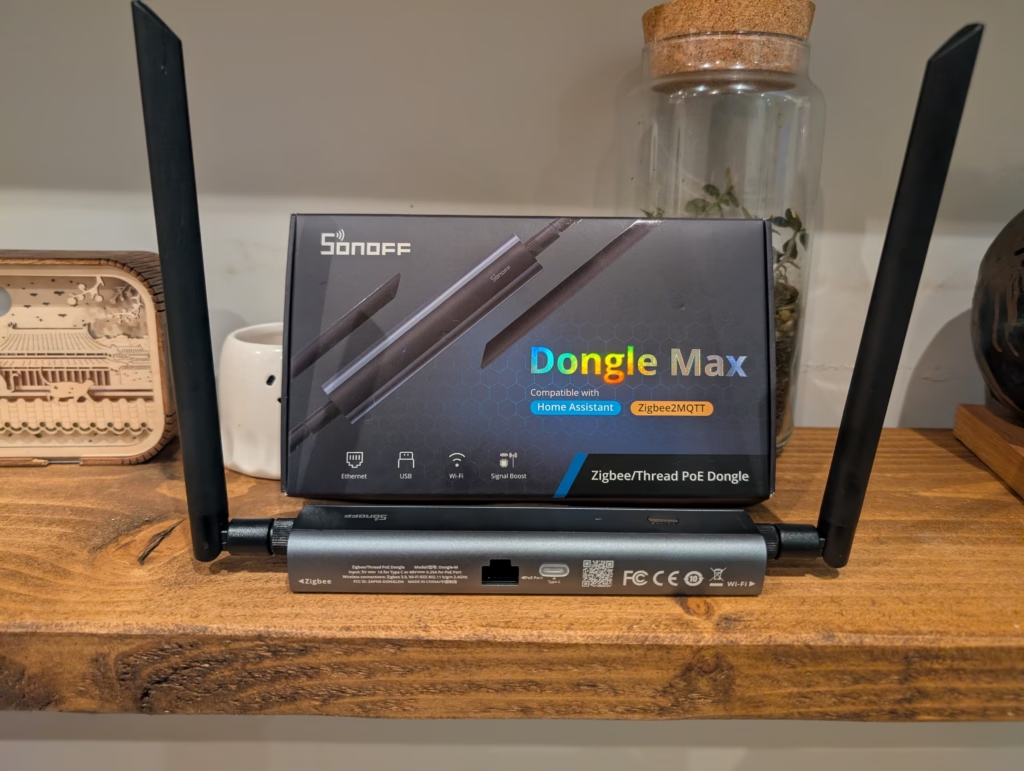
The body is constructed from aluminium with a PC and ABS plastic top panel. At 95mm by 50mm by 20mm (excluding antennas), it is compact enough to be unobtrusive but substantial enough to feel like a quality product. The two connection ports are located on one side of the device, while the antennas mount on opposite ends. This arrangement makes sense from a signal propagation perspective, though it does mean the device takes up a bit more desk or shelf space than a simple USB dongle.
There is a small button on the top of the unit, though its function is somewhat unclear from the documentation.
Based on my testing, it seems to be used for initiating pairing mode, although the fantastic web interface has made it unnecessary for me to use it.
Hardware Under the Hood
The Dongle Max utilizes a dual-chip design that combines the Silicon Labs EFR32MG24 with an ESP32D0WDR2. This represents a significant architectural difference from standard USB coordinators like the ZBT-2.
The EFR32MG24 is Silicon Labs’ latest-generation chip for smart home protocols, offering enhanced processing capacity and a +20dBm radio amplifier compared to the older EFR32MG21 found in many existing dongles. It handles the bulk of the work for the Zigbee or Thread network.
The ESP32 handles the operational side of the device, including the Ethernet connection, Wi-Fi connectivity, and the web-based management interface. This division of responsibilities allows the radio processor to focus solely on maintaining the mesh network without being weighed down by network management tasks.
Flexible Connectivity and PoE
One of the key selling points of the Dongle Max is its flexibility. While the ZBT-2 is limited to USB connectivity, the Sonoff offers three connection options:
- USB: You can directly plug it into your server like a traditional dongle.
- Wi-Fi: You can position it anywhere with power and connect over your wireless network (although this may introduce potential latency and reliability issues).
- Ethernet with PoE: This is considered the ideal choice.
The RJ45 port supports Power over Ethernet (PoE). With a PoE switch, a single network cable provides both data and power. This eliminates the main issue with Zigbee, which is interference. USB 3.0 ports on computers produce significant noise on the 2.4GHz spectrum, affecting Zigbee range.
With PoE, I was able to place the Dongle Max in the center of my home, mounted high on a wall, while keeping my Home Assistant server in a rack in the garage. This central location significantly improved the signal quality for my devices compared to having the coordinator tucked away in a corner.
Web-Based Management Interface
Since the device runs on an ESP32, it hosts its own local web interface. This feature is typically reserved for more expensive enthusiast devices, such as those from SMLIGHT.
The web interface allows access to device status, configuration settings, logs, and alerts through a browser. This eliminates the need for command-line configuration, simplifying initial setup and ongoing management. You can check system uptime, memory usage, and even visualize nearby network signal strength to help select a Zigbee channel that doesn’t overlap with your Wi-Fi.
The interface also supports webhook integration for notifications and includes WireGuard VPN capability. This means you could potentially install this dongle in a remote location (like a vacation home) and securely tunnel back to your primary Home Assistant instance over the internet.
Firmware Management
Firmware updates and mode changes can be done directly through the web interface without physical access to the device. The Dongle Max supports multiple firmware options, including Zigbee Coordinator, Zigbee Router, Thread RCP, and MultiPAN (currently in beta). Switching between these modes doesn’t require manual flashing tools or holding down boot buttons; you simply upload the file via the browser and wait for the reboot.
Set Up
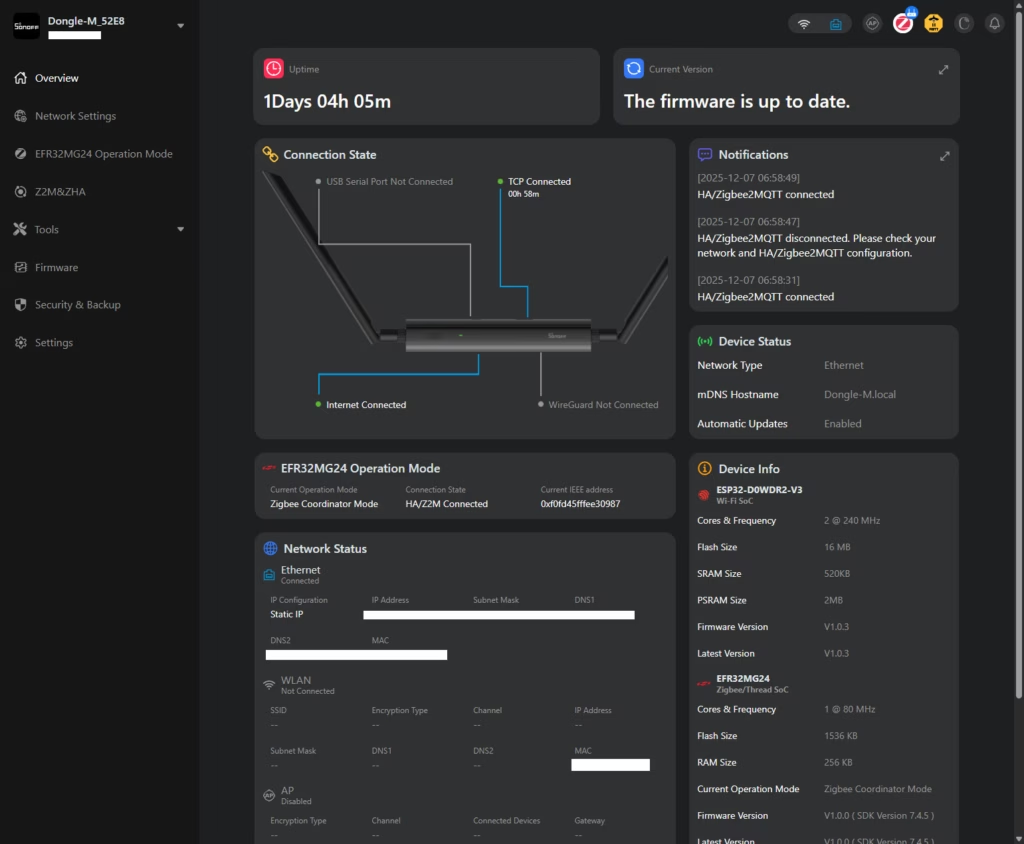
I set up the Sonoff using POE, so all I had to do was plug it in, then access the local web UI to manage it.
Within the web UI, you can adjust settings and functions, with the main one being the operation mode. Choose between Zigbee Router Mode, Zigbee Coordinator Mode, or Thread RCP Mode for the Sonoff Web GUI. Generally, Zigbee Coordinator or Thread RCP modes are recommended. The Sonoff can also support running Zigbee and Thread simultaneously using multiPAN. Out of the box, this feature is not supported, but it is available on the new Beta firmware.
However, multiPAN is not recommended by Home Assistant, and due to the issues I encountered with the ZBT-1, I decided to stick to one protocol. I also have the ZBT-2, which I will use for Thread (or vice versa).
### WireGuard VPN
### Adding to Home Assistant & Migration
I recently rebuilt my Home Assistant installation, so I did not have to migrate a large number of devices. However, depending on what you are migrating from and the devices you are migrating, the process can vary. One user mentioned having to re-pair over 100 out of 125 devices when they installed their ZBT-2.
When adding the Sonoff to Home Assistant, it should be a straightforward process, but I did encounter some issues.
If you use the ZHA integration, Home Assistant should automatically detect the Sonoff and allow you to add it with a username and password. However, in my case, this did not work.
Alternatively, you can manually add it by following these steps:
1. Navigate to Settings > Integrations and add the ZHA integration.
2. Set Serial device path to Enter Manually.
3. Select a radio type as EZSP.
4. Enter the Serial device path as socket://Dongle-M.local:6638.
5. Set Port speed to 115200.
6. Data flow control should be software.
7. Choose the Network Settings Method to restore from backup or create a new one.
8. Complete the setup.
I also faced issues with this method, but after changing the IP and assigning a static IP, the manual setup worked perfectly.
### Performance
In terms of performance, my old Home Assistant installation was disorganised due to using multiple hubs and frequently swapping devices for reviews. The Sonoff Zigbee Max has been performing excellently as my Zigbee coordinator. It quickly identifies and pairs devices, and I appreciate being able to do this from a browser.
The dual 5dBi external antennas on the Sonoff Zigbee Max are not just for show. The signal strength reported by devices was consistently higher than previous devices I used. The ability to position the Max centrally via PoE allowed me to cover the entire house without needing additional router plugs.
Despite concerns about latency with Ethernet-connected coordinators, I have not noticed any issues with the responsiveness of automations. Lights trigger instantly, and my Home Assistant instance runs on a powerful mini PC, which likely helps mitigate any network overhead.
One of the main reasons for using the Sonoff Zigbee Max was to integrate Philips Hue with Aqara via Matter. While technically it worked fine, the main issue was the lack of “friendly names” imported by Aqara via Matter, leading to manual identification and renaming of devices. When using Home Assistant in conjunction with the Sonoff Max, the functionality becomes much simpler due to proper naming conventions right from the start.
### Comparison: Sonoff Max vs Home Assistant Connect ZBT-2

The Home Assistant Connect ZBT-2, developed by Nabu Casa, is priced around GBP 52.99 (often found on sale for around GBP 40). It is a USB stick featuring the EFR32MG24 chip.
– **Hardware Differences:** The ZBT-2 is a sleek white polycarbonate stick designed for plug-and-play use. However, being USB-only, it needs to be situated close to your server, potentially causing Zigbee signal issues. In contrast, the Sonoff Max offers Ethernet connectivity, allowing for placement based on optimal radio wave coverage, not server location.
– **Performance:** Both devices utilize the same radio chip (MG24), implying identical raw processing power. Nevertheless, the Sonoff’s external antennas and power stability (PoE vs. USB power) give it an advantage in real-world range and link quality.
– **Ease of Use:** The ZBT-2 is simpler if it functions correctly from the start, as it is natively supported by HA updates. The Sonoff demands a bit more networking know-how (IP addresses, web UIs), but provides greater power for troubleshooting issues.
### Price and Alternative Options
The SONOFF is priced at an RRP of £41.40, with my Black Friday purchase at £35, later dropping to £32.74.
The Home Assistant Connect Zigbee/Thread/Matter Adapter (ZBT-2) can be purchased from Pimoroni.com for £41.90 after factoring in shipping and taxes.
A popular alternative to these devices is the MR1, MR2, and MR3 from SMLIGHT. These options are akin to the Sonoff, offering PoE support and simultaneous Thread and Zigbee compatibility. The SMLIGHT MR1 can be found on Amazon for £84, but on Aliexpress, it’s available for around £45. The MR2 and MR3 possess slightly different radios, likely yielding minimal performance discrepancies.
### Overall
My experience with the Sonoff Dongle Max has been truly impressive. While there are more affordable Sonoff versions that would likely meet my requirements, investing around £40 in a high-quality Zigbee or Thread dongle for my extensive smart home device collection feels justified.
Though both Zigbee and Thread networks expand as more devices are added, I find comfort in having my primary Zigbee coordinator centrally located in my home for optimal signal coverage. While my ZBT-2 is functioning flawlessly as a Thread Border Router in my loft, I have yet to encounter any issues.
**What I Liked:**
– **Placement Flexibility:** PoE enables installation in the ideal location for radio coverage.
– **Build Quality:** The solid aluminum casing dissipates heat efficiently and exudes a premium feel.
– **Web Interface:** Exceptional tools for firmware flashing and channel scanning without command line interaction.
– **Price:** More cost-effective than the official ZBT-2 while offering additional hardware features.
**What I Didn’t Like:**
– **Setup Glitches:** The auto-discovery in Home Assistant ZHA was buggy and necessitated manual IP configuration.
– **MultiPAN:** Still in an experimental phase, implying a choice between Zigbee or Thread functionality, not both simultaneously.
**SONOFF PoE Dongle Max Review vs Home Assistant Connect ZBT-2 Zigbee & Thread Coordinators**
**Summary:**
The Sonoff PoE Dongle Max is a commendable upgrade for Home Assistant users, delivering superior placement options, enhanced radio performance, and a more robust interface compared to conventional USB-only coordinators. With PoE support and a dual-chip design, the Dongle Max proves to be a formidable alternative to the ZBT-2, especially in environments where server placement hinders Zigbee coverage. While setup may not always be seamless, and complete multi-protocol support is a work in progress, the Dongle Max offers exceptional performance for its price, making it a compelling choice for users seeking a sturdy, centrally located Zigbee or Thread coordinator.
*Author: James – Editor and Owner of Mighty Gadget*
James is a UK-based tech enthusiast with a passion for technology spanning various domains. His expertise ranges from computers and networking to mobile devices, wearables, and smart home gadgets. As a fitness enthusiast, he also delves into fitness-related technology, merging lifestyle, fitness, and tech trends on his blog. With a dedication to technology and insightful content, James aims to continue providing engaging and informative articles to his readers.
Welcome to our website
Thank you for visiting our site. We hope you find the information you are looking for.
Feel free to reach out to us if you have any questions or need further assistance.
Transform the following sentence:
Original: She was singing loudly in the shower.
Transformed: Loudly singing in the shower was she. Transform the following:
Original: “I am going to the store to buy some groceries.”
Transformed: “I will be heading to the store to purchase groceries.”






Ultimate Efficiency: JAC Hunter PHEV Ute Challenges BYD Shark 6 with Improved Fuel Economy and Range

Smartphones are Boring now.

Unbeatable Savings: Top Picks from Amazon’s Big Spring Sale

Russian Hacker Sentenced to Prison for Cyberattacks Conducted by TA551 Botnet

Pixel 9a: Enhanced Fingerprint Sensor and Unbeatable Price Drop

Unlocking Success: The Essential Elements of a Thriving Business

The Final Frontier: For All Mankind Season 6

Lyria 3 Pro: Crafting Catchy Three-Minute AI Jams

Samsung Galaxy A57 Review: The Ultimate Choice for Everyday Use

EU Takes Action Against Instagram and Facebook for Violating Illegal Content Rules

Warning: Facebook Creators Face Monetization Loss for Stealing and Reposting Videos

Facebook Compliance: ICE-tracking Page Removed After US Government Intervention

Facebook’s New Look: A Blend of Instagram’s Style

Facebook and Instagram to Reduce Personalized Ads for European Users

InstaDub: Meta’s AI Translation Tool for Instagram Videos

Reclaim Your Account: Facebook and Instagram Launch New Hub for Account Recovery

Meta discontinues Messenger apps for Windows and macOS

Breaking Updates: Meta Connect 2025 Unveils Latest Developments
Smartphones are Boring now.

The Fastest Android Phone Ever.

Unboxing the $122,000 Smartphone. 🤯

Are Linux Smartphones about to KILL Android?

15 Smartphone FAILS to ruin your day 😂

World’s Biggest Smartphone Collection?

I switched to iPhone – This is what I found out.

What happened to Beats by Dre?

DON’T buy a Screen Protector before watching this.
-
 Facebook5 months ago
EU Takes Action Against Instagram and Facebook for Violating Illegal Content Rules
-
 Facebook5 months ago
Warning: Facebook Creators Face Monetization Loss for Stealing and Reposting Videos
-
 Facebook5 months ago
Facebook Compliance: ICE-tracking Page Removed After US Government Intervention
-
 Facebook4 months ago
Facebook’s New Look: A Blend of Instagram’s Style
-
 Facebook4 months ago
Facebook and Instagram to Reduce Personalized Ads for European Users
-
 Facebook5 months ago
InstaDub: Meta’s AI Translation Tool for Instagram Videos
-
 Facebook4 months ago
Reclaim Your Account: Facebook and Instagram Launch New Hub for Account Recovery
-
 Apple5 months ago
Meta discontinues Messenger apps for Windows and macOS
