
Security
Enhanced Memory Scans Coming to Windows: Preventing BSOD Crashes

Windows 11 Introduces New Memory Scan Feature After BSOD
Microsoft has recently initiated testing for a novel feature on Windows 11 that prompts users to run a memory scan upon logging in following a blue screen of death (BSOD) occurrence.
When a bugcheck triggers a BSOD (a critical Windows kernel or driver error that the OS cannot recover from), notifications will appear to initiate the proactive memory diagnostics feature.
The primary objective of this feature is to enhance system reliability by detecting and addressing memory issues that could potentially lead to system instability before they escalate.
As of now, the feature is not accessible on ARM64 devices and systems with Administrator Protection or BitLocker without Secure Boot.
“We’re introducing a new feature that helps improve system reliability. If your PC experiences a bugcheck (unexpected restart), you may see a notification when signing in suggesting a quick memory scan,” stated Windows Insider Program lead Amanda Langowski.
“If you choose to run it, the system will schedule a Windows Memory Diagnostic scan to run during your next reboot (taking 5 minutes or less on average) and then continue to Windows. If a memory issue is found and mitigated, you will see a notification post-reboot.”
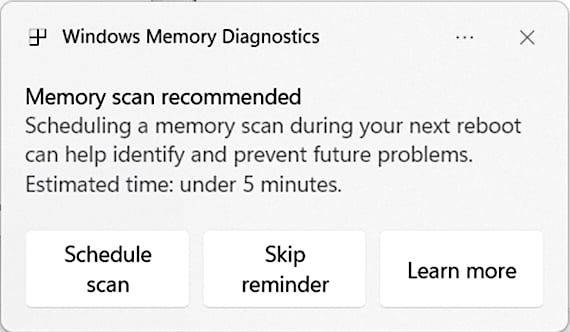
During this initial testing phase, all bugcheck codes will trigger a Windows memory diagnostics notification while Microsoft investigates the correlation between OS crashes and memory corruption. The targeting will eventually be refined to encompass a narrower range of such errors.
The feature is currently being rolled out to Windows Insiders in the Dev and Beta channels who have installed Windows 11 Insider Preview Build 26220.6982 (KB5067109) and Windows 11 Insider Preview Build 26120.6982 (KB5067109), respectively.
Furthermore, Microsoft has also commenced testing new connectivity functionalities for its AI-powered Copilot digital assistant, enabling it to link with Outlook and Gmail email accounts, as well as third-party services like Google Calendar and Google Drive.
Recent developments include the introduction of Copilot Actions, a new Windows 11 Copilot feature allowing AI agents to execute tasks on local files and applications.
Microsoft clarified to BleepingComputer that each Agent Workspace, where Copilot Actions perform tasks, is established as a Windows Remote Desktop child session, rather than operating within a Windows Sandbox or as a virtual machine.
46% of environments had passwords cracked, almost doubling from 25% last year.
Receive the Picus Blue Report 2025 for a comprehensive analysis of prevention, detection, and data exfiltration trends.











Lost Legacy: The Disappearance of AC Schnitzer and the Changing Automotive Landscape

Cyber Warfare: The Battlefront of the Digital Age

Monster Hunter Stories 3: The Challenge of Twisted Reflection

Revolutionizing Cash-Pay Clinic Prescribing: VITL Secures $7.5M Amid GLP-1 Boom

Balancing Act: The Decision to Shut Down Sora

Exclusive Arrival: Cupra Born VZ Lands in Australia – But There’s a Twist!

iPhone 12 Pro Max vs Samsung Note 20 Ultra / Huawei Mate 40 Pro Camera Test Comparison.

ClickFix: The New Threat to macOS Security

Kingdom Come: Deliverance 2 – The Rise of Artificial Intelligence

EU Takes Action Against Instagram and Facebook for Violating Illegal Content Rules

Warning: Facebook Creators Face Monetization Loss for Stealing and Reposting Videos

Facebook Compliance: ICE-tracking Page Removed After US Government Intervention

Facebook’s New Look: A Blend of Instagram’s Style

Facebook and Instagram to Reduce Personalized Ads for European Users

InstaDub: Meta’s AI Translation Tool for Instagram Videos

Reclaim Your Account: Facebook and Instagram Launch New Hub for Account Recovery

Meta discontinues Messenger apps for Windows and macOS

Breaking Updates: Meta Connect 2025 Unveils Latest Developments
iPhone 12 Pro Max vs Samsung Note 20 Ultra / Huawei Mate 40 Pro Camera Test Comparison.

iPhone 12 Pro Max vs Samsung Note 20 Ultra / Huawei / Xiaomi / OnePlus Battery Life DRAIN Test.

The BEST Smartphone of 2020 🏆

The Self-Healing Smartphones!

Apple is not what it used to be.

Smartphones are Boring now.

The Fastest Android Phone Ever.

Unboxing the $122,000 Smartphone. 🤯

Are Linux Smartphones about to KILL Android?
-
 Facebook5 months ago
EU Takes Action Against Instagram and Facebook for Violating Illegal Content Rules
-
 Facebook5 months ago
Warning: Facebook Creators Face Monetization Loss for Stealing and Reposting Videos
-
 Facebook6 months ago
Facebook Compliance: ICE-tracking Page Removed After US Government Intervention
-
 Facebook4 months ago
Facebook’s New Look: A Blend of Instagram’s Style
-
 Facebook4 months ago
Facebook and Instagram to Reduce Personalized Ads for European Users
-
 Facebook6 months ago
InstaDub: Meta’s AI Translation Tool for Instagram Videos
-
 Facebook4 months ago
Reclaim Your Account: Facebook and Instagram Launch New Hub for Account Recovery
-
 Apple5 months ago
Meta discontinues Messenger apps for Windows and macOS
