
Inovation
Enhancing Carbon Dioxide Conversion to Methane through Membrane Reactor Properties: An Investigation

Climate change, accelerated by human activities, has emerged as a significant environmental issue in the current era. Governments and organizations worldwide are progressively taking substantial steps to address this challenge.
An important initiative in this direction involves the development of innovative technologies that can capture and convert low-concentration carbon dioxide into valuable products.
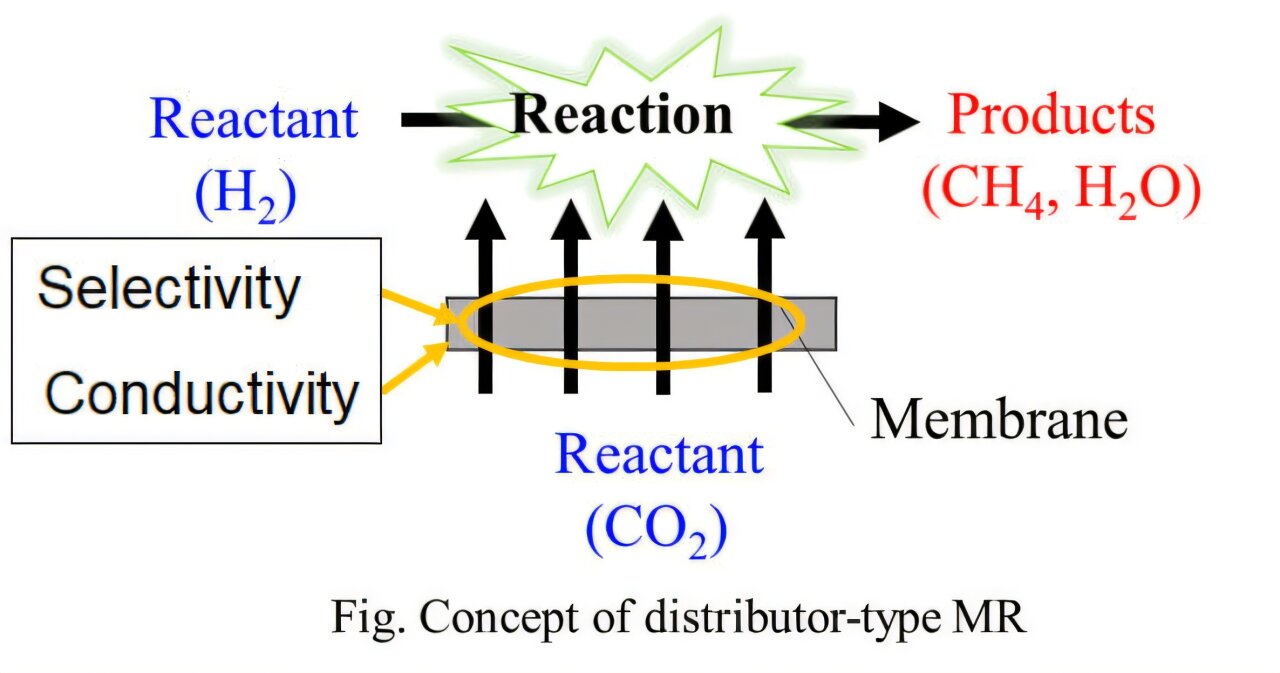
Recently, scientists have put forth carbon dioxide methanation in a membrane reactor as a promising method. Distribution-type membrane reactors, in particular, are attractive due to their ability to enhance catalyst activity by mitigating hotspot formation.
While the effectiveness of membrane reactors has been demonstrated, the efficiency of membrane properties and the heat transfer characteristics of membrane materials still pose uncertainties.
In a recent study, a team of researchers led by Professor Mikihiro Nomura from Shibaura Institute of Technology in Japan, along with Yuka Shimizu from the same institute and Marcin Moździerz, Grzegorz Brus, and Elzbieta Fornalik-Wajs from AGH University of Krakow in Poland, has showcased the novelty of distribution-type membrane reactor for carbon dioxide utilization.
Their findings have been published in Catalysis Today.
“Through a dual-degree program between Shibaura Institute of Technology and AGH University of Krakow, we assessed heat transfer in membrane components, allowing us to highlight the specific advantages of the membrane reactors discussed in our research,” explained Prof. Nomura.
Subsequently, the team managed to regulate the reaction rate within the reactor by distributing reactant feeding through the membrane. They then conducted precise thermal conductivity evaluation of the porous alumina (Al2O3) membrane, with detailed physical and chemical structural features analyzed through laser flash analysis measurements.
The researchers observed a 36.4% lower thermal conductivity in the solid part of the sample compared to non-porous alumina.
Furthermore, the team employed a catalytic membrane with a silica separation layer, exhibiting a hydrogen gas permeance of 1.4 × 10⁻⁶ mol m−2 s−1 Pa−1> and a hydrogen-to-carbon dioxide selectivity of 35.9, in the distributor-type membrane reactor test. They achieved a high carbon dioxide conversion rate of 92.3% at 350 ℃.
Building on these outcomes, the team conducted simulations using Ansys Fluent software to investigate the impact of membrane thermal conductivity and permselectivity.
By setting carbon dioxide permeance of the membrane at 3.91 × 10⁻⁸ mol m−2 s−1 Pa−1 for all scenarios, the team found that a carbon dioxide permselective membrane with a high selectivity of 35.9 produced approximately 1.4 times more methane compared to a hydrogen permselective membrane with a low selectivity of 0.10. Additionally, a higher thermal conductivity of the membrane helped in suppressing temperature rise in the reactor.
“Membrane reactors offer the advantage of spatially distributed reactant feeding within the reactor, allowing for better control over reaction rates and temperature profiles in both the axial (flow) and radial (membrane surface) directions,” noted Prof. Nomura.
“This distinctive capability and membrane design make them ideal for deployment in small-scale facilities. Therefore, implementing membrane reactors in small-scale carbon dioxide emission sources—commonly owned by numerous small- and medium-sized enterprises with limited resources—will accelerate the realization of a carbon-neutral society.
“Specifically, we foresee their application in small combustion devices like boilers, an area that has received minimal attention in the fight against global warming.”
These findings can also provide insights into other exothermic processes, such as hydrocarbon partial oxidation in membrane reactor systems, bolstering sustainable technologies.
Citation:
Investigating membrane reactor properties that enhance carbon dioxide conversion to methane (2025, October 30)
retrieved 2 November 2025
from https://techxplore.com/news/2025-10-membrane-reactor-properties-carbon-dioxide.html
This document is subject to copyright. Apart from any fair dealing for the purpose of private study or research, no
part may be reproduced without the written permission. The content is provided for information purposes only.













iPhone 12 Pro Max vs Samsung Note 20 Ultra / Huawei / Xiaomi / OnePlus Battery Life DRAIN Test.

Stealthy Malware: The Hidden Threat Within Telnyx PyPI Package

Harvest of Suspicion: Grave Seasons Murder Mystery Farming Sim Arrives in August

Tech Giants Clash: OpenAI Halts Sora as Meta Faces Legal Setback

Apple’s AI Playlist Playground: Where Music Goes to Die

Beyond the Stars: For All Mankind Season 5 Unveiled in Liminal Film Expose

Top 10 Fuel-Efficient Cars for Less Than $50,000

The Illusionists: Mastering Deception in Hacking and ArtForgery

PUBG: Blindspot Shuts Down Early Despite Record Revenues

EU Takes Action Against Instagram and Facebook for Violating Illegal Content Rules

Warning: Facebook Creators Face Monetization Loss for Stealing and Reposting Videos

Facebook Compliance: ICE-tracking Page Removed After US Government Intervention

Facebook’s New Look: A Blend of Instagram’s Style

Facebook and Instagram to Reduce Personalized Ads for European Users

InstaDub: Meta’s AI Translation Tool for Instagram Videos

Reclaim Your Account: Facebook and Instagram Launch New Hub for Account Recovery

Meta discontinues Messenger apps for Windows and macOS

Breaking Updates: Meta Connect 2025 Unveils Latest Developments
iPhone 12 Pro Max vs Samsung Note 20 Ultra / Huawei / Xiaomi / OnePlus Battery Life DRAIN Test.

The BEST Smartphone of 2020 🏆

The Self-Healing Smartphones!

Apple is not what it used to be.

Smartphones are Boring now.

The Fastest Android Phone Ever.

Unboxing the $122,000 Smartphone. 🤯

Are Linux Smartphones about to KILL Android?

15 Smartphone FAILS to ruin your day 😂
-
 Facebook5 months ago
EU Takes Action Against Instagram and Facebook for Violating Illegal Content Rules
-
 Facebook5 months ago
Warning: Facebook Creators Face Monetization Loss for Stealing and Reposting Videos
-
 Facebook5 months ago
Facebook Compliance: ICE-tracking Page Removed After US Government Intervention
-
 Facebook4 months ago
Facebook’s New Look: A Blend of Instagram’s Style
-
 Facebook4 months ago
Facebook and Instagram to Reduce Personalized Ads for European Users
-
 Facebook5 months ago
InstaDub: Meta’s AI Translation Tool for Instagram Videos
-
 Facebook4 months ago
Reclaim Your Account: Facebook and Instagram Launch New Hub for Account Recovery
-
 Apple5 months ago
Meta discontinues Messenger apps for Windows and macOS
