
Security
Enhancing Enterprise Security: Unlocking Secrets with Passwork 7

Introducing Passwork 7: An Advanced Enterprise Password and Secrets Management Solution
Written by: Eirik Salmi, System Analyst at Passwork
Organizations today face the challenge of managing credentials across distributed teams, applications, and infrastructure. These credentials include passwords, API keys, certificates, and tokens, each requiring different access patterns and security controls. While traditional password managers cater to individual user needs, they often fall short when it comes to handling operational complexity at scale.
Different roles within organizations have varying requirements. DevOps teams need programmatic access, security teams demand audit trails, and IT administrators require granular control over credentials. This diversity in needs has led to a demand for platforms that can manage both human and machine credentials within a unified framework.
In its latest release, Passwork has made significant changes to its credential organization, access control, and administrative functionality based on feedback from production environments. The focus of this update is on improving usability and enhancing security, with special attention to workflow efficiency and feature accessibility.
Passwork 7 aims to address the concrete operational need of maintaining credential security, enforcing access policies, and enabling team collaboration without disrupting existing workflows. This review will delve into the practical capabilities and integration characteristics of Passwork 7.
Understanding Enterprise Password Management
Enterprise password management goes beyond simple login credential storage. It encompasses the entire lifecycle of sensitive authentication data within an organization, including secure generation, encrypted storage, controlled access, automated rotation, and comprehensive auditing.
Unlike consumer-oriented password managers, enterprise solutions must be able to support complex organizational structures, integrate with existing infrastructure such as LDAP and SSO, provide role-based access control (RBAC), and maintain detailed compliance logs. For organizations managing large numbers of employees and credentials, these capabilities are essential.
The Challenge of Secrets Management
While passwords are used for authenticating human users, secrets serve as authentication credentials for machine-to-machine communication. These secrets include API keys, database connection strings, SSH keys, access tokens, and digital certificates, enabling secure connections across distributed systems.
The challenge lies in managing these secrets at scale and across distributed environments. Modern infrastructure generates secrets rapidly, embedded in various files, environment variables, and deployment manifests. Without centralized governance, organizations face risks such as security exposure, operational chaos, compliance gaps, and DevOps bottlenecks.
-
Security exposure: Hardcoded credentials in application code create persistent attack surfaces and increase the risk of breaches.
-
Operational chaos: Scattered secrets across systems make rotation nearly impossible.
-
Compliance gaps: The absence of centralized audit mechanisms hinders visibility into access patterns, credential usage, and policy enforcement.
-
DevOps bottlenecks: Manual credential distribution slows down deployment pipelines.
Effective secrets management addresses these challenges by providing centralized storage, automated rotation, programmatic access, and operational transparency.
A full-featured trial of Passwork is available with no feature limitations. Additionally, a Black Friday promotion is scheduled to run from November 26 through December 3, 2025, offering discounts of up to 50%.
Organizations planning credential management implementations may benefit from testing Passwork during this period and taking advantage of the Black Friday discount.
Get your Black Friday 50% discount
Passwork 7: Revolutionizing Enterprise Security with Two-in-One Platform
Passwork has evolved beyond traditional password storage to become a comprehensive secrets management platform. The system now combines two fully-featured products into one unified interface:
-
Password manager: An intuitive interface for securely storing and sharing credentials for daily work. The streamlined design reduces onboarding time, making it practical for organizations with employees of varying technical expertise.
-
Secrets management system: Programmatic access through REST API, Python connector, CLI, and Docker containers enables DevOps teams to automate credential workflows without compromising security.
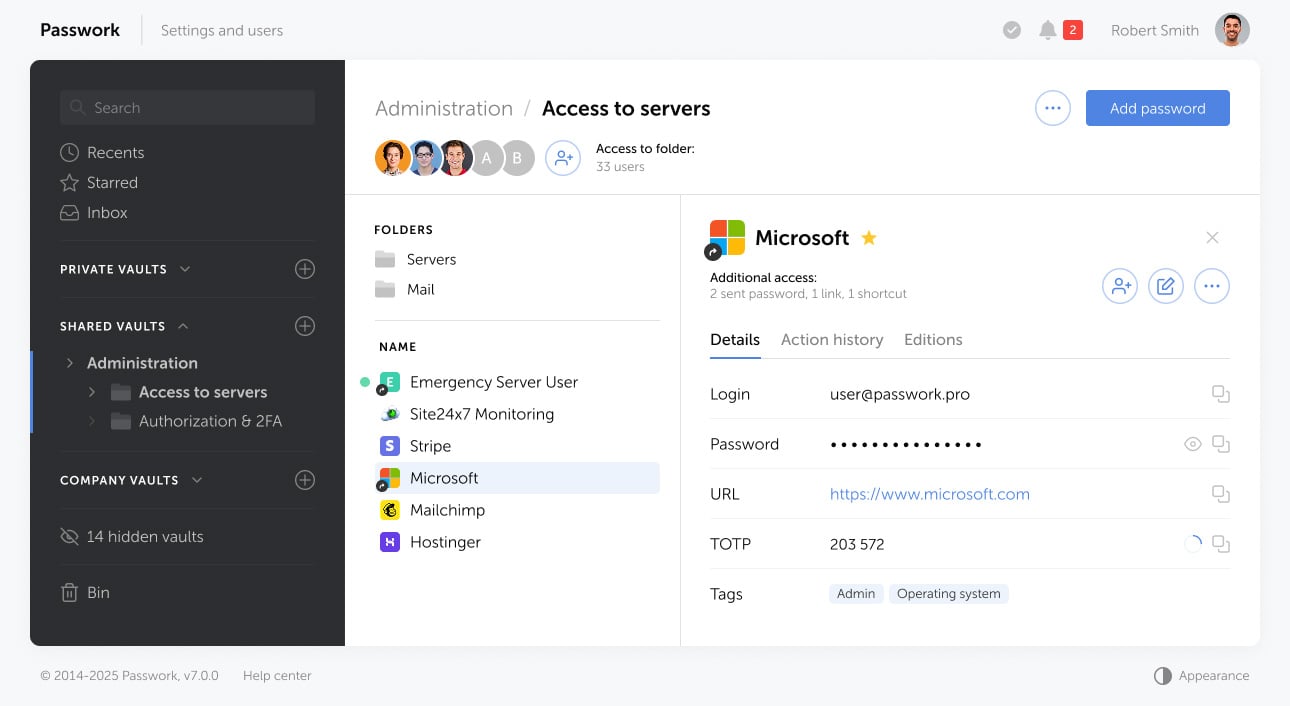
This dual-functionality approach eliminates the need for separate tools, reducing complexity, licensing costs, and enhancing security posture.
Key Features of Passwork for Enhanced Enterprise Security
Passwork’s feature set addresses the practical challenges of enterprise credential security by structuring access across departments, maintaining audit trails for compliance, and automating credential management without disrupting workflows.
Flexible Vault Architecture
Similar to most enterprise password management platforms, Passwork organizes data hierarchically with passwords nested in folders contained within vaults. However, Passwork’s vault layer offers more granular control and flexibility in defining and distributing access.
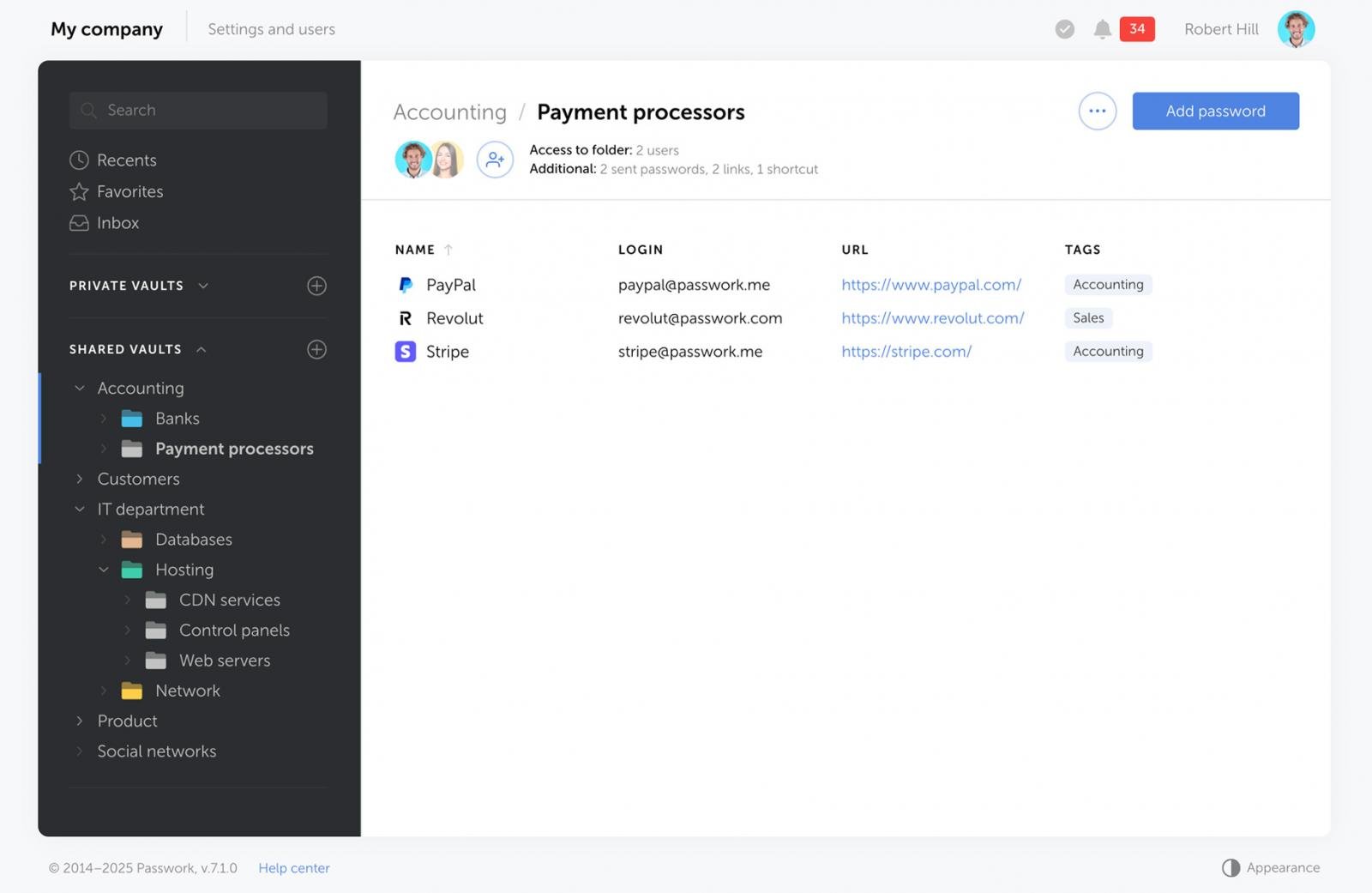
In version 7, Passwork introduced a vault types architecture that revolutionizes how organizations structure credential access. The system offers three approaches:
-
Company vaults: Automatically include corporate administrators alongside the vault creator to ensure continuous oversight.
-
Custom vault types: Represent the most powerful option, allowing administrators to create unlimited vault types tailored to specific departments, projects, or security requirements. Each custom type can have designated administrators, configured creator permissions, and rules about who can create new vaults.
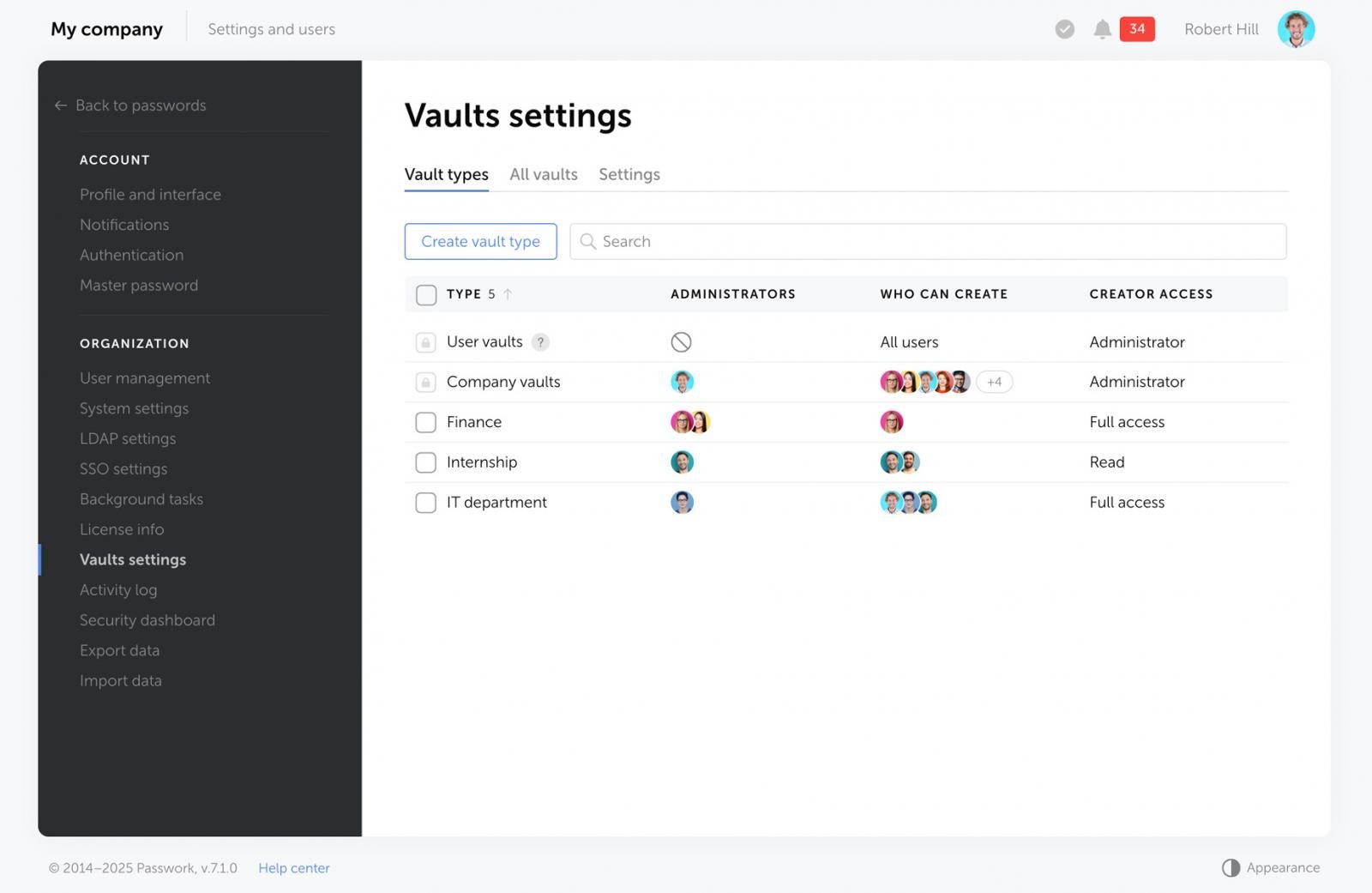
This level of flexibility enables organizations to mirror their internal structure within Passwork. For example, an IT director can manage IT vaults, a finance director can oversee financial credentials, and HR can maintain employee access information—all within a single platform with appropriate isolation and oversight.
Furthermore, a security administrator can be granted access across all vaults for audit and compliance purposes without disrupting departmental autonomy. Organizations with strict security policies can disable user vault creation entirely, enforcing a model where all credentials reside exclusively in company-controlled or custom vault types.
Granular Access Control with RBAC and User Groups
Access control in Passwork operates through a role-based system that can scale from small teams to enterprise deployments. Administrators create roles that define specific permissions, dictating what actions users can perform within the system.
The system imposes no artificial limits on role creation, allowing organizations to implement precisely tailored permission structures. For instance, certain users may have rights to manage specific roles and groups while being restricted from accessing system configurations. Department heads can have control over their team’s credentials without accessing data from other departments.
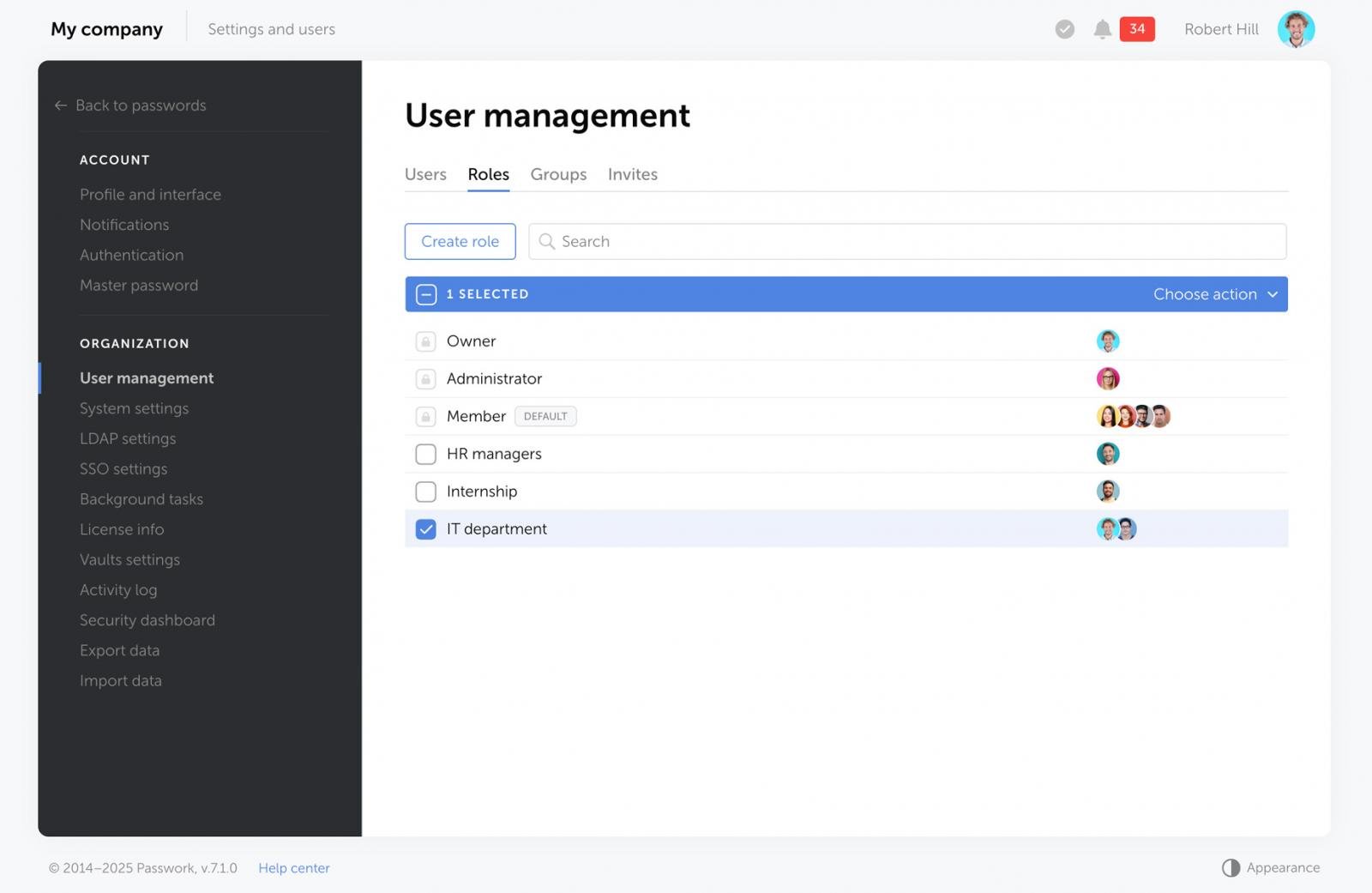
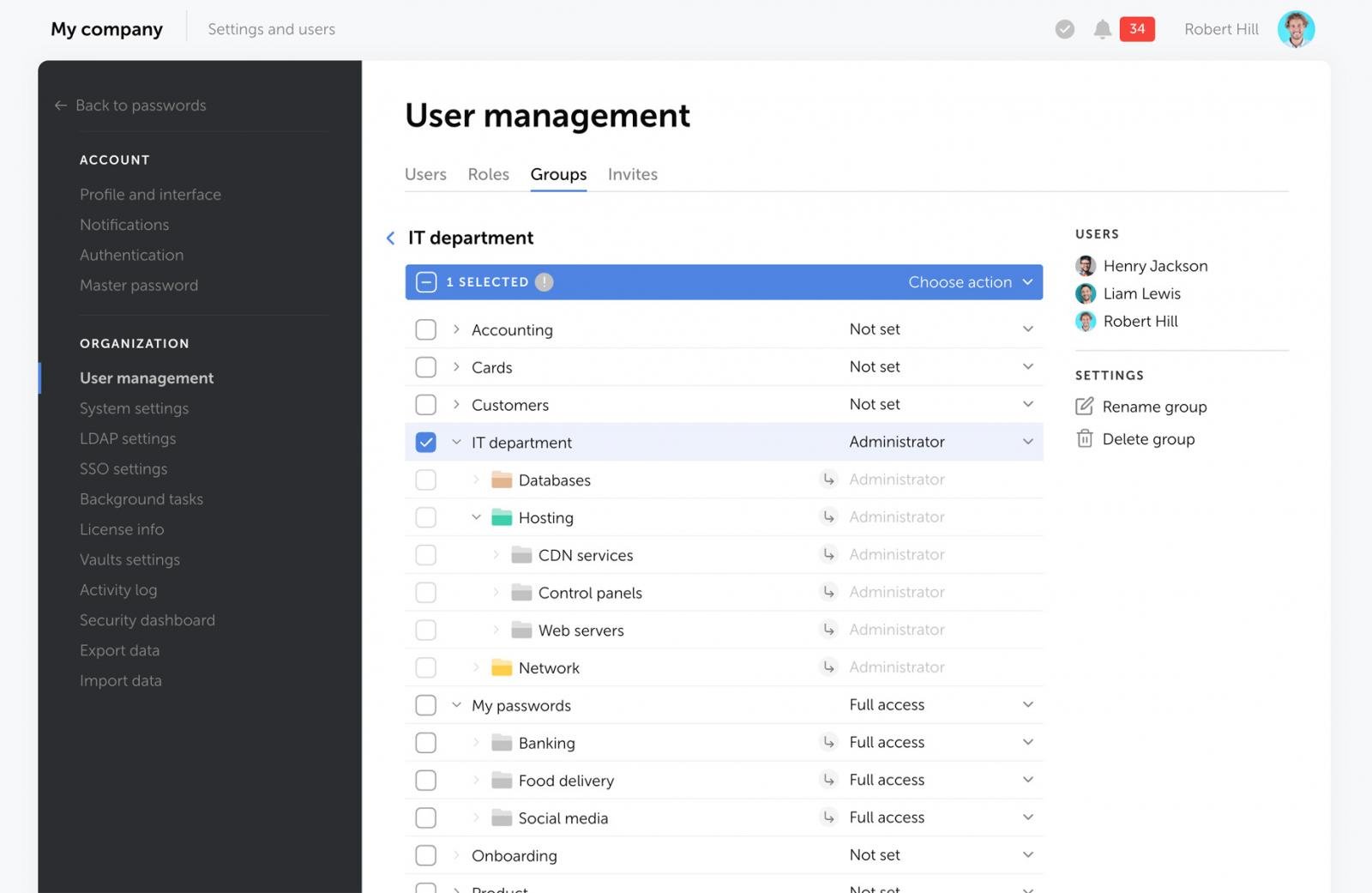
User groups further streamline permission management by automatically inheriting the group’s permissions across relevant vaults and folders when users are added to a group. This approach reduces administrative overhead during onboarding or departmental restructuring.
Secure Credential Sharing for Internal and External Users
Passwork offers various methods for credential sharing designed for specific use cases:
-
Internal sharing: Enables secure credential distribution to individuals or groups within the company, with permissions cascading through the vault and folder hierarchy to ensure users access only what they need.
-
External sharing: Addresses the challenge of securely providing credentials to contractors, vendors, or temporary partners by generating secure, time-limited links that grant access without requiring external users to create accounts or install software.
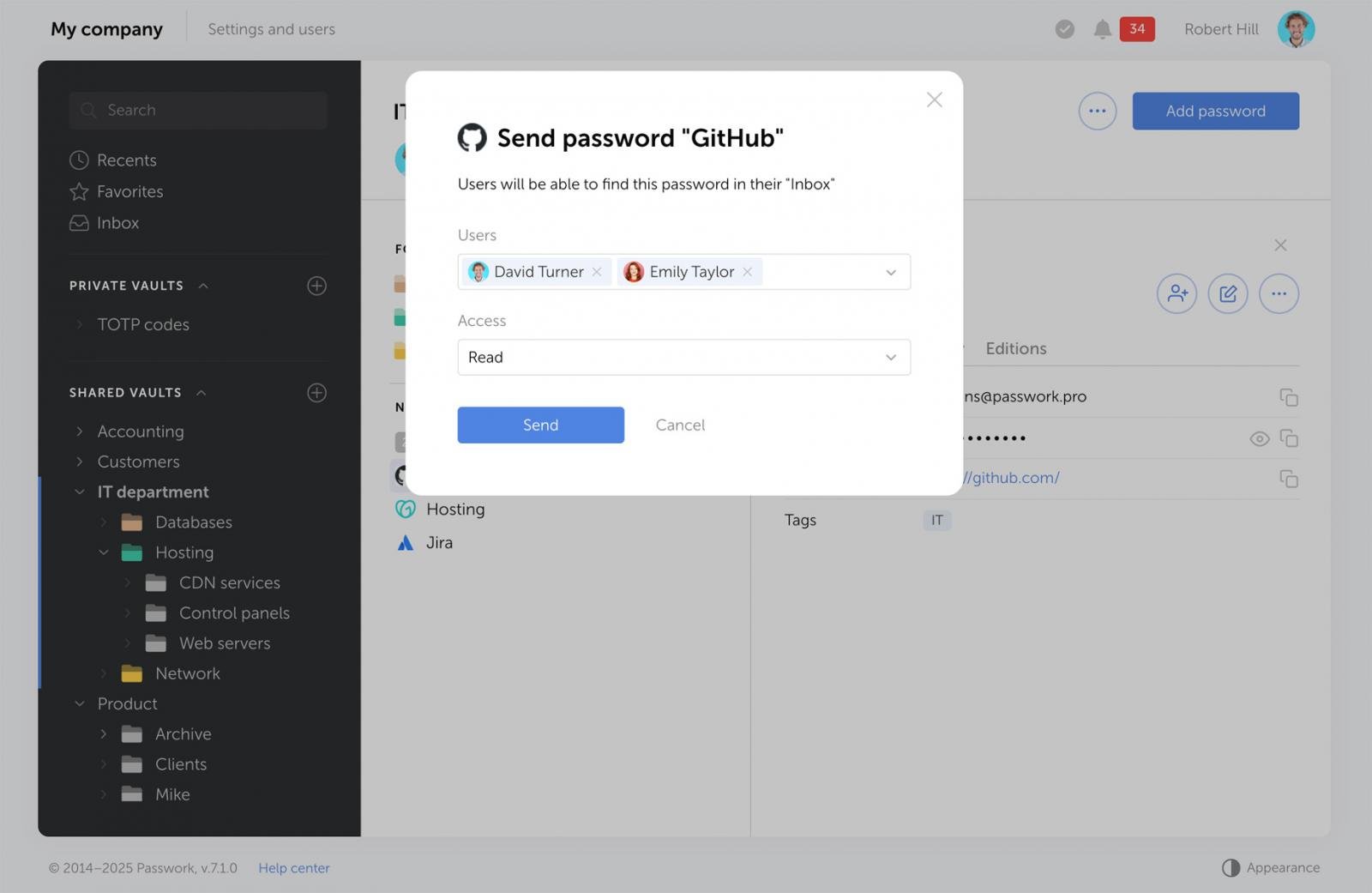
The platform also offers granular password sharing through its internal password sending system and shortcuts. Access can be revoked at any time, and the system automatically reminds administrators of which users previously had access to each credential through the security dashboard.
Every sharing action generates audit logs, providing complete visibility into credential access patterns and supporting compliance requirements.
Complete Audit Trails and Compliance
Passwork generates activity log entries for every action taken within the platform, allowing organizations to track who accessed which credentials, when, and what actions were performed. These logs can be exported for analysis or integration with SIEM systems.
This operational transparency facilitates regulatory compliance, such as SOC 2, ISO 27001, and GDPR, and enables rapid incident response. In case of suspicious activity, administrators can quickly identify affected credentials and revoke access.
Enhanced Notification System
In addition to audit logs, Passwork 7 introduces customizable notifications with flexible delivery options. Users can choose notification types and delivery methods, whether in-app or via email, for authentication events and activity log entries.
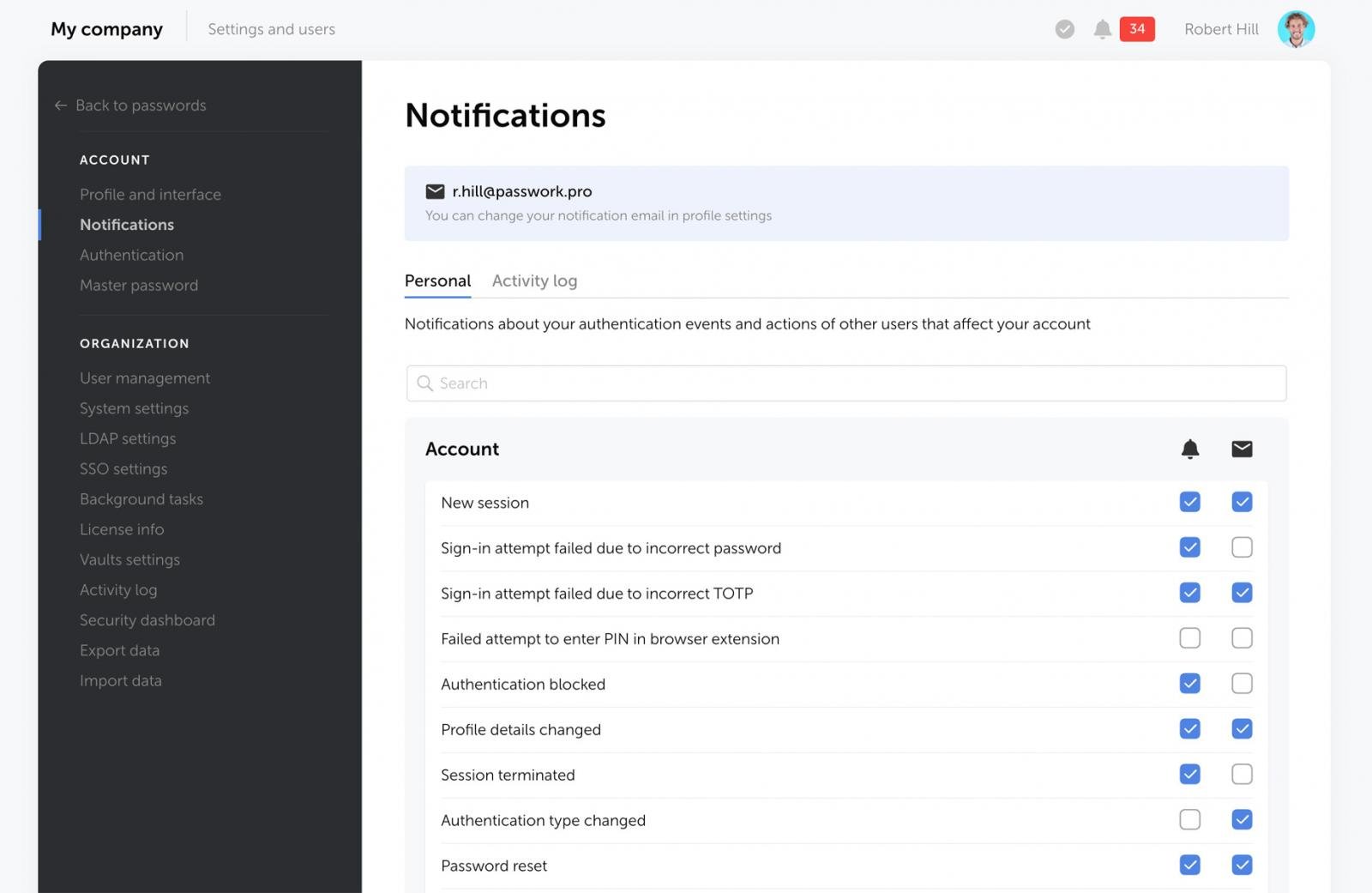
Each event type can be configured independently, allowing users to receive critical security alerts via email immediately and routine activity updates in-app at their convenience. Users also have the option to disable notifications for specific event types if needed.
Integration with Corporate Identity Infrastructure
Passwork offers comprehensive SSO and LDAP support for seamless integration with existing authentication systems in enterprise deployments. Disabling an account in Active Directory, for example, results in immediate revocation of access in Passwork.
Automation Tools: Python Connector, CLI, and Docker
Passwork’s API-first architecture allows for complete programmatic control over the platform, with every function accessible through the REST API. This enables DevOps teams to automate access provisioning, update credentials programmatically, integrate Passwork into deployment pipelines, and export logs for security analysis.
The platform provides multiple automation tools tailored for different workflows:
-
Python connector: The official Python library abstracts low-level API calls and cryptographic operations, simplifying the automation process.
-
Command-line interface (CLI): Enables shell script integration and manual credential management from the terminal, allowing DevOps engineers to incorporate Passwork operations into deployment scripts and automation workflows.
-
Docker container: The official Docker image simplifies deployment in containerized environments, seamlessly integrating with Kubernetes, container orchestration platforms, and microservices architectures.
Zero-Knowledge Architecture
Passwork’s Zero Knowledge mode encrypts all data client-side before transmission, ensuring maximum security even if attackers compromise the server. Each user maintains their own master password, which is never transmitted to the server, allowing only the user to decrypt their accessible credentials.
Self-Hosted Deployment
Passwork operates as a self-hosted password manager, running entirely on the organization’s infrastructure, whether on-premises servers or private cloud environments. This deployment model ensures that no credentials ever touch third-party servers.
This self-hosted approach addresses critical requirements that cloud-based solutions may not fulfill, including data sovereignty and compliance, network isolation, custom security policies, and zero vendor dependency.
For enterprises where credential security cannot rely on external providers, the self-hosted architecture of Passwork is foundational.
Why Choose Passwork for Enterprise Environments
Passwork 7 offers a unified solution for password and secrets management, prioritizing practical deployment and operational efficiency. With features such as self-hosted deployment, a unified platform, API-first architecture, flexible access control, zero-knowledge encryption, and comprehensive automation tools, Passwork is tailored to meet the security, flexibility, and automation needs of modern organizations.
Migrating from Other Password Managers
Passwork supports seamless migration from existing password management solutions, providing import tools and documentation for common formats. Planning the vault structure before migration can ensure optimal organization from the start, reflecting departmental and security policies in the new system.
Organizations migrating from other password managers can benefit from a 10% discount offered by Passwork, making the transition both technically smooth and financially advantageous.
Conclusion
Passwork offers a unified approach to password and secrets management that focuses on practical deployment and operational efficiency. With its vault architecture, access control model, and user-friendly interface, Passwork caters to organizations of different scales and operational contexts.
The platform’s ISO 27001 certification demonstrates compliance with internationally recognized information security standards, making it essential for organizations in regulated sectors or handling sensitive data under strict governance requirements.
Free Trial Options and Black Friday Offers
A full-featured trial of Passwork is available without any feature limitations, allowing organizations to evaluate the platform against their infrastructure and security policies before committing. Additionally, a Black Friday promotion from November 26 to December 3, 2025, offers discounts of up to 50%.
For businesses looking to consolidate credential management, enhance security posture, and establish audit-ready access governance, Passwork 7 provides a comprehensive solution designed for rapid deployment with minimal operational disruption.
Start your free trial today and take advantage of our Black Friday discount available from November 26 to December 3, 2025.
Sponsored and Authored by Passwork.












Apple Enhances Security Protocols in macOS Terminal to Combat ClickFix Attacks

Avatar Legends: Battle for Supremacy – Available July 2nd!

Uncovering the Truth: The X-Files Revival – Everything You Need to Know

Unraveling the Mystery of Intestate Succession: Navigating the Consequences of Dying Without a Will

Unveiling the Accuracy of AI-Driven Price Prediction Tools in the Forex Market

Future Trends: Machine Learning Applications in Finance for 2026

The Anticipated Arrival of the Entry-Level iPad

The Future of Brand Discovery: AEO vs. GEO in the Age of AI (2026)

Government Announces Crackdown on Gouging Amid Record Fuel Prices

EU Takes Action Against Instagram and Facebook for Violating Illegal Content Rules

Warning: Facebook Creators Face Monetization Loss for Stealing and Reposting Videos

Facebook Compliance: ICE-tracking Page Removed After US Government Intervention

Facebook’s New Look: A Blend of Instagram’s Style

Facebook and Instagram to Reduce Personalized Ads for European Users

InstaDub: Meta’s AI Translation Tool for Instagram Videos

Reclaim Your Account: Facebook and Instagram Launch New Hub for Account Recovery

Meta discontinues Messenger apps for Windows and macOS

Breaking Updates: Meta Connect 2025 Unveils Latest Developments

iPhone 12 vs iPhone 12 Pro / 11 Pro Max / 11 Pro / 11 / XR / SE Battery Life DRAIN Test.

19 Smartphone Gadgets that Blew me Away.

iPhone 12 Pro Max Unboxing & Review!

iPhone 12 Pro Max vs Samsung Note 20 Ultra / Huawei Mate 40 Pro Camera Test Comparison.

iPhone 12 Pro Max vs Samsung Note 20 Ultra / Huawei / Xiaomi / OnePlus Battery Life DRAIN Test.

The BEST Smartphone of 2020 🏆

The Self-Healing Smartphones!

Apple is not what it used to be.

Smartphones are Boring now.
-
 Facebook5 months ago
EU Takes Action Against Instagram and Facebook for Violating Illegal Content Rules
-
 Facebook6 months ago
Warning: Facebook Creators Face Monetization Loss for Stealing and Reposting Videos
-
 Facebook6 months ago
Facebook Compliance: ICE-tracking Page Removed After US Government Intervention
-
 Facebook4 months ago
Facebook’s New Look: A Blend of Instagram’s Style
-
 Facebook4 months ago
Facebook and Instagram to Reduce Personalized Ads for European Users
-
 Facebook6 months ago
InstaDub: Meta’s AI Translation Tool for Instagram Videos
-
 Facebook4 months ago
Reclaim Your Account: Facebook and Instagram Launch New Hub for Account Recovery
-
 Apple5 months ago
Meta discontinues Messenger apps for Windows and macOS
