
Inovation
Enhancing Stability: Universal In-Situ Cross-Linking Strategy for Inverted Perovskite Solar Cells

Hole-selective self-assembled monolayers (SAMs) are thin organic films crucial in modern optoelectronic devices, especially in perovskite and silicon-perovskite tandem solar cells. However, their inherent instability often compromises device performance.
In a recent study published in Nature, a team led by Prof. Yang Chunlei and Assoc. Prof. Zhang Jie from the Shenzhen Institute of Advanced Technology of the Chinese Academy of Sciences, along with Prof. Alex K.-Y. Jen from City University of Hong Kong, introduced a universal in-situ cross-linking strategy to reinforce SAM molecules, addressing stability issues in high-efficiency inverted perovskite solar cells.
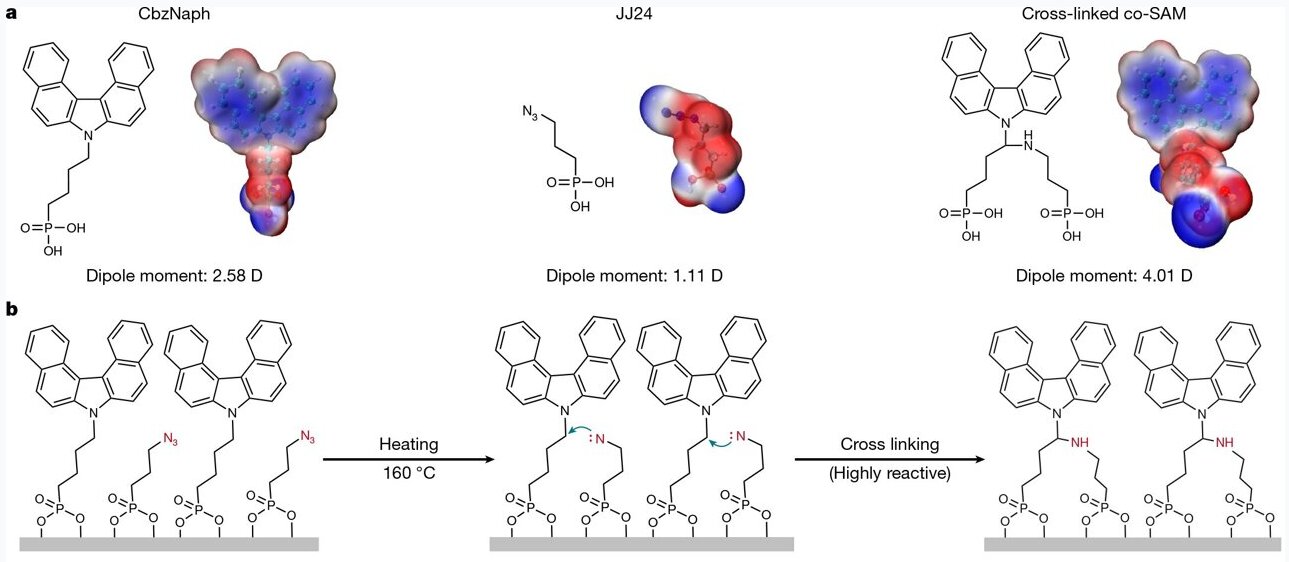
The team designed a novel azide-functionalized SAM molecule, JJ24, with an optimized carbon chain length. This molecule enhances the distribution uniformity of the host SAM molecule CbzNaph on a transparent conductive oxide (TCO) substrate while suppressing defects and voids during self-assembly.
The azide group in JJ24 can undergo thermal activation to form in-situ covalent cross-linking with alkyl chains of CbzNaph molecules, creating a tightly assembled co-SAM layer.
This structure improves the orientation of CbzNaph, reducing degradation at the perovskite buried interface and minimizing non-radiative recombination losses at the device interface.
By implementing this strategy, the researchers fabricated inverted perovskite solar cells with a certified power conversion efficiency (PCE) of 26.9%. These devices exhibited no efficiency degradation after 1,000 hours of continuous operation under ISOS-L-2 testing standards and retained over 98% of their initial PCE after 700 thermal cycles between –40°C and 85°C, demonstrating exceptional stability.
This study offers a practical approach to enhance the operational stability of high-efficiency SAM-based devices on rough substrates, with significant potential for advancing the commercialization of inverted perovskite photovoltaics and next-generation perovskite-based tandem solar cells.
Citation:
Universal in-situ cross-linking strategy enhances stability of inverted perovskite solar cells (2025, November 14)
retrieved 16 November 2025
from https://techxplore.com/news/2025-11-universal-situ-linking-strategy-stability.html
This document is subject to copyright. Apart from any fair dealing for the purpose of private study or research, no
part may be reproduced without the written permission. The content is provided for information purposes only.













Qilin Ransomware Breach Confirmed by Die Linke German Political Party

Wrangling Data: How Nomadic Secured $8.4 Million for Autonomous Vehicle Insights

On-the-Go Meetings: Google Meet Now Available on CarPlay

Breaking News: The BMW M2 CS Shooting Brake Hoax Shakes the Internet

NASA’s Tech Troubles: The Artemis II Outlook Reload

Hims & Hers Takes Action: Responds to Zendesk Support Ticket Breach

The Elder Scrolls Online: Night Market Chronicles – A Glimpse of Skyrim in 2027

Whoop Soars to $10 Billion Valuation: A Game-Changer in the Fitness Tech Industry

United App Introduces Real-Time TSA Wait Times Feature for Top US Airports

EU Takes Action Against Instagram and Facebook for Violating Illegal Content Rules

Warning: Facebook Creators Face Monetization Loss for Stealing and Reposting Videos

Facebook Compliance: ICE-tracking Page Removed After US Government Intervention

Facebook’s New Look: A Blend of Instagram’s Style

Facebook and Instagram to Reduce Personalized Ads for European Users

InstaDub: Meta’s AI Translation Tool for Instagram Videos

Reclaim Your Account: Facebook and Instagram Launch New Hub for Account Recovery

Meta discontinues Messenger apps for Windows and macOS

Breaking Updates: Meta Connect 2025 Unveils Latest Developments

6G – Explained!

Is Samsung about to take over?

The Problem with Fast Chargers.

if smartphone commercials were honest.

iPhone 12 – What were Apple thinking?

OnePlus 8T vs Google Pixel 5 – The Brutal Truth.

iPhone 12 / 12 Pro Unboxing – ft MKBHD!

iPhone 12 Pro vs iPhone 12 vs iPhone 11 Pro Camera Test Comparison.

Huawei Mate 40 Pro Unboxing – WHAT.
-
 Facebook5 months ago
EU Takes Action Against Instagram and Facebook for Violating Illegal Content Rules
-
 Facebook6 months ago
Warning: Facebook Creators Face Monetization Loss for Stealing and Reposting Videos
-
 Facebook6 months ago
Facebook Compliance: ICE-tracking Page Removed After US Government Intervention
-
 Facebook4 months ago
Facebook’s New Look: A Blend of Instagram’s Style
-
 Facebook4 months ago
Facebook and Instagram to Reduce Personalized Ads for European Users
-
 Facebook6 months ago
InstaDub: Meta’s AI Translation Tool for Instagram Videos
-
 Facebook4 months ago
Reclaim Your Account: Facebook and Instagram Launch New Hub for Account Recovery
-
 Apple6 months ago
Meta discontinues Messenger apps for Windows and macOS
