
Security
EvilTokens: The Fuel Behind Microsoft Device Code Phishing Attacks

A cutting-edge malicious tool known as EvilTokens has emerged, introducing device code phishing capabilities that enable hackers to compromise Microsoft accounts and enhance their tactics for business email compromise attacks.
This sophisticated kit is distributed to cybercriminals via Telegram and is continuously evolving, with its creator expressing intentions to expand its support to include Gmail and Okta phishing pages.
Device code phishing attacks exploit the OAuth 2.0 device authorization flow, allowing threat actors to infiltrate a victim’s account by deceiving the user into authorizing a malicious device.
This technique has been extensively documented and utilized by various threat groups, including Russian entities identified as Storm-237, UTA032, UTA0355, UNK_AcademicFlare, and TA2723, as well as the data extortion group ShinyHunters.
EvilTokens Attacks
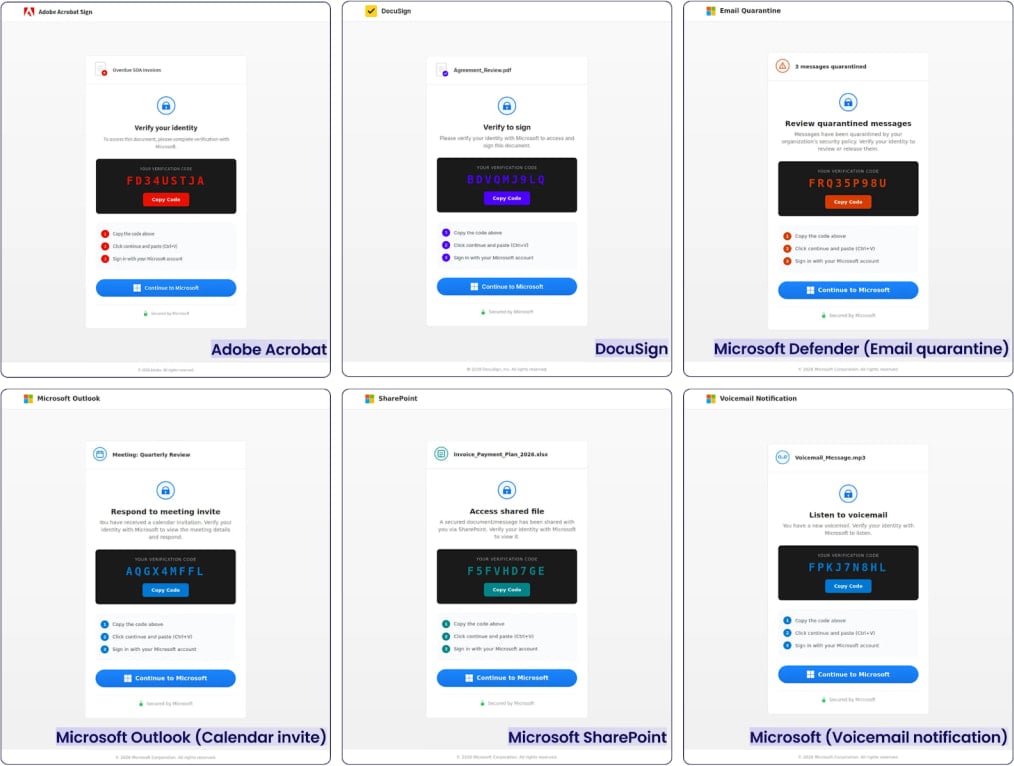
Researchers at Sekoia, a company specializing in threat detection and response, have observed EvilTokens attacks where victims receive emails containing documents (PDF, HTML, DOCX, XLSX, or SVG) that feature either a QR code or a hyperlink to an EvilTokens phishing template.
These deceptive emails mimic legitimate business communication, such as financial documents, meeting invitations, logistics or purchase orders, payroll notices, or shared documents through services like DocuSign or SharePoint, often targeting employees in finance, HR, logistics, or sales roles.
Source: Sekoia
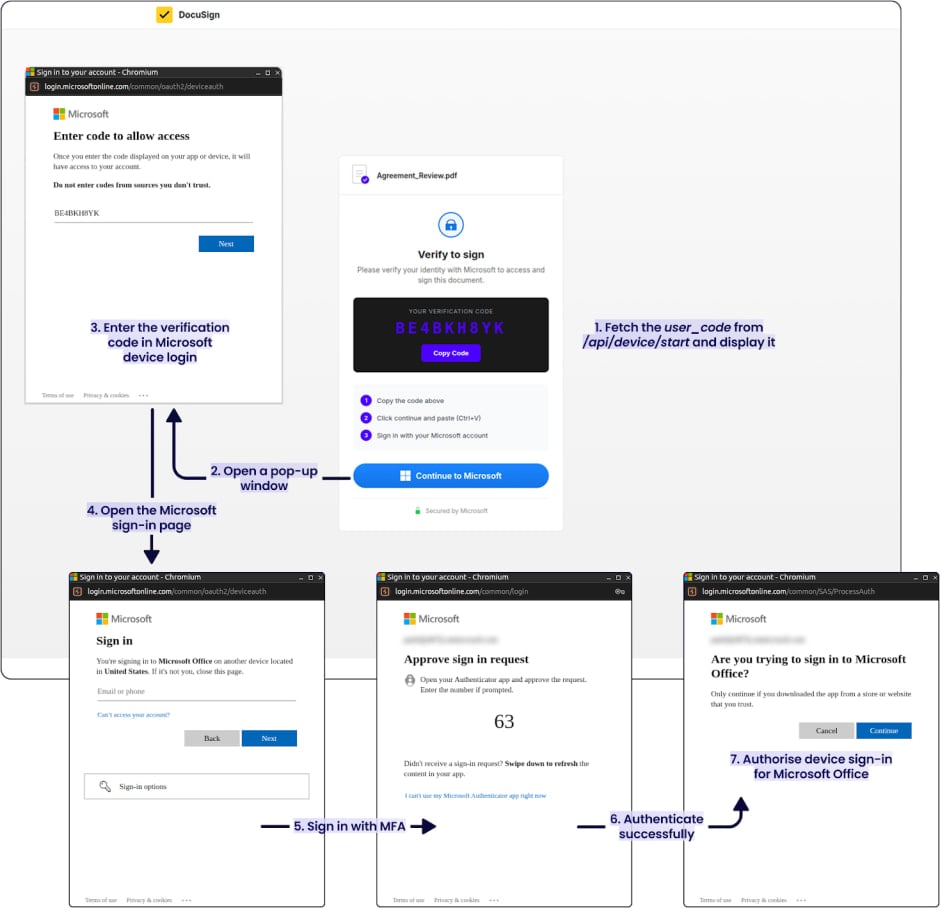
Upon clicking the provided link, victims are directed to a phishing page that impersonates a trusted service (e.g., Adobe Acrobat or DocuSign), displaying a verification code and instructions for completing identity verification.
The fraudulent page prompts users to click a “Continue to Microsoft” button, redirecting them to the authentic Microsoft device login page.
During this stage, the attacker employs a legitimate client (such as any Microsoft application) to request a device code, manipulating the victim into authenticating the legitimate Microsoft URL from the threat actor.
Source: Sekoia
This tactic allows the attacker to acquire both a short-lived access token and a refresh token for persistent access.
With these tokens, the attacker gains immediate access to the victim’s associated services, including email, files, Teams data, and the ability to perform Single Sign-On (SSO) impersonation across Microsoft services.
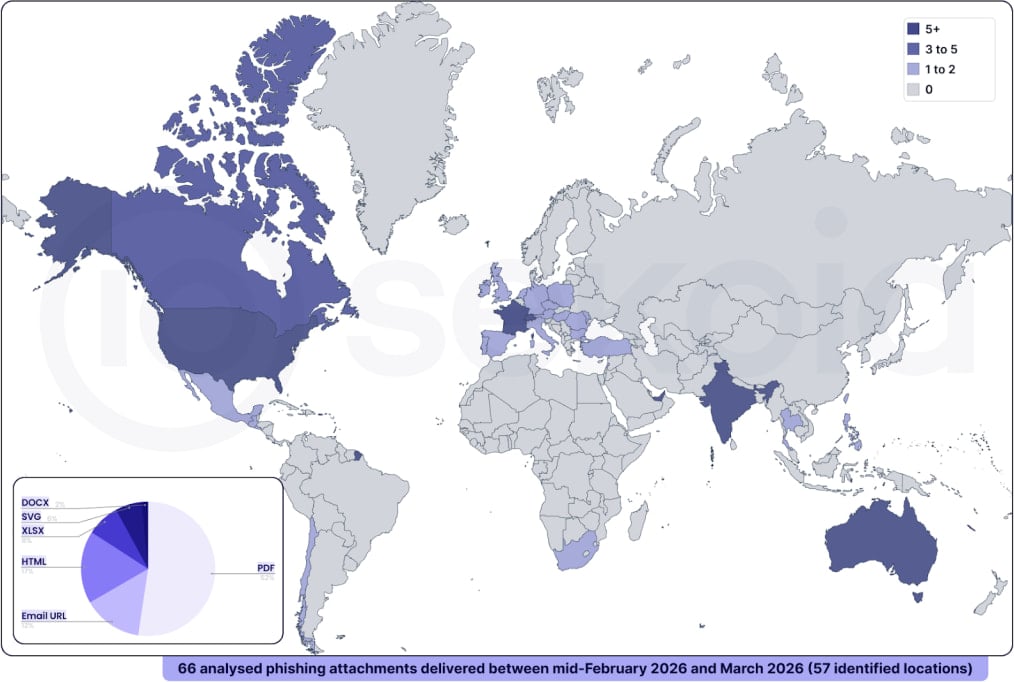
Sekoia researchers have analyzed EvilTokens’ infrastructure and identified campaigns with a global reach, affecting countries like the United States, Canada, France, Australia, India, Switzerland, and the UAE.
Source: Sekoia
In addition to sophisticated phishing techniques, Sekoia researchers highlight that the EvilTokens phishing-as-a-service (PhaaS) operation offers advanced functionalities for conducting Business Email Compromise (BEC) attacks through automation.
The diverse range of campaigns indicates that EvilTokens is already being widely utilized by threat actors involved in phishing and BEC activities.
Sekoia provides Indicators of Compromise (IoC), technical insights, and YARA rules to assist defenders in thwarting attacks leveraging the EvilTokens PhaaS kit.

Automated pentesting proves the path exists. BAS proves whether your controls stop it. Most teams run one without the other.
This whitepaper maps six validation surfaces, shows where coverage ends, and provides practitioners with three diagnostic questions for any tool evaluation.











Enhanced Suspension and Trim Options for the 2026 Mitsubishi Triton Ute Range

The Microsoft Engineer Who Inspired Steve Jobs to Invent the iPad: A Tribute on Apple’s 50th Anniversary

iPhone 12 – What were Apple thinking?

EvilTokens: The Fuel Behind Microsoft Device Code Phishing Attacks

Immerse Yourself in 11 Minutes of Mortal Shell II Gameplay

The Edge of My Seat: 3 Thrilling Series Coming Soon to Sky TV

The Costly Error New Employers Often Make

Unveiling the Trojan: How Hackers Infiltrated the Internet’s Code Library

Apple Rolls Out iOS 18 Security Update – Upgrade Your iPhone Today!

EU Takes Action Against Instagram and Facebook for Violating Illegal Content Rules

Warning: Facebook Creators Face Monetization Loss for Stealing and Reposting Videos

Facebook Compliance: ICE-tracking Page Removed After US Government Intervention

Facebook’s New Look: A Blend of Instagram’s Style

Facebook and Instagram to Reduce Personalized Ads for European Users

InstaDub: Meta’s AI Translation Tool for Instagram Videos

Reclaim Your Account: Facebook and Instagram Launch New Hub for Account Recovery

Meta discontinues Messenger apps for Windows and macOS

Breaking Updates: Meta Connect 2025 Unveils Latest Developments
iPhone 12 – What were Apple thinking?

OnePlus 8T vs Google Pixel 5 – The Brutal Truth.

iPhone 12 / 12 Pro Unboxing – ft MKBHD!

iPhone 12 Pro vs iPhone 12 vs iPhone 11 Pro Camera Test Comparison.

Huawei Mate 40 Pro Unboxing – WHAT.

iPhone 12 vs iPhone 12 Pro / 11 Pro Max / 11 Pro / 11 / XR / SE Battery Life DRAIN Test.

19 Smartphone Gadgets that Blew me Away.

iPhone 12 Pro Max Unboxing & Review!

iPhone 12 Pro Max vs Samsung Note 20 Ultra / Huawei Mate 40 Pro Camera Test Comparison.
-
 Facebook5 months ago
EU Takes Action Against Instagram and Facebook for Violating Illegal Content Rules
-
 Facebook6 months ago
Warning: Facebook Creators Face Monetization Loss for Stealing and Reposting Videos
-
 Facebook6 months ago
Facebook Compliance: ICE-tracking Page Removed After US Government Intervention
-
 Facebook4 months ago
Facebook’s New Look: A Blend of Instagram’s Style
-
 Facebook4 months ago
Facebook and Instagram to Reduce Personalized Ads for European Users
-
 Facebook6 months ago
InstaDub: Meta’s AI Translation Tool for Instagram Videos
-
 Facebook4 months ago
Reclaim Your Account: Facebook and Instagram Launch New Hub for Account Recovery
-
 Apple5 months ago
Meta discontinues Messenger apps for Windows and macOS
