
Security
Global Espionage: State Actor’s Covert Operations in 155 Countries

A state-sponsored threat group has compromised dozens of networks of government and critical infrastructure entities in 37 countries in global-scale operations dubbed ‘Shadow Campaigns’.
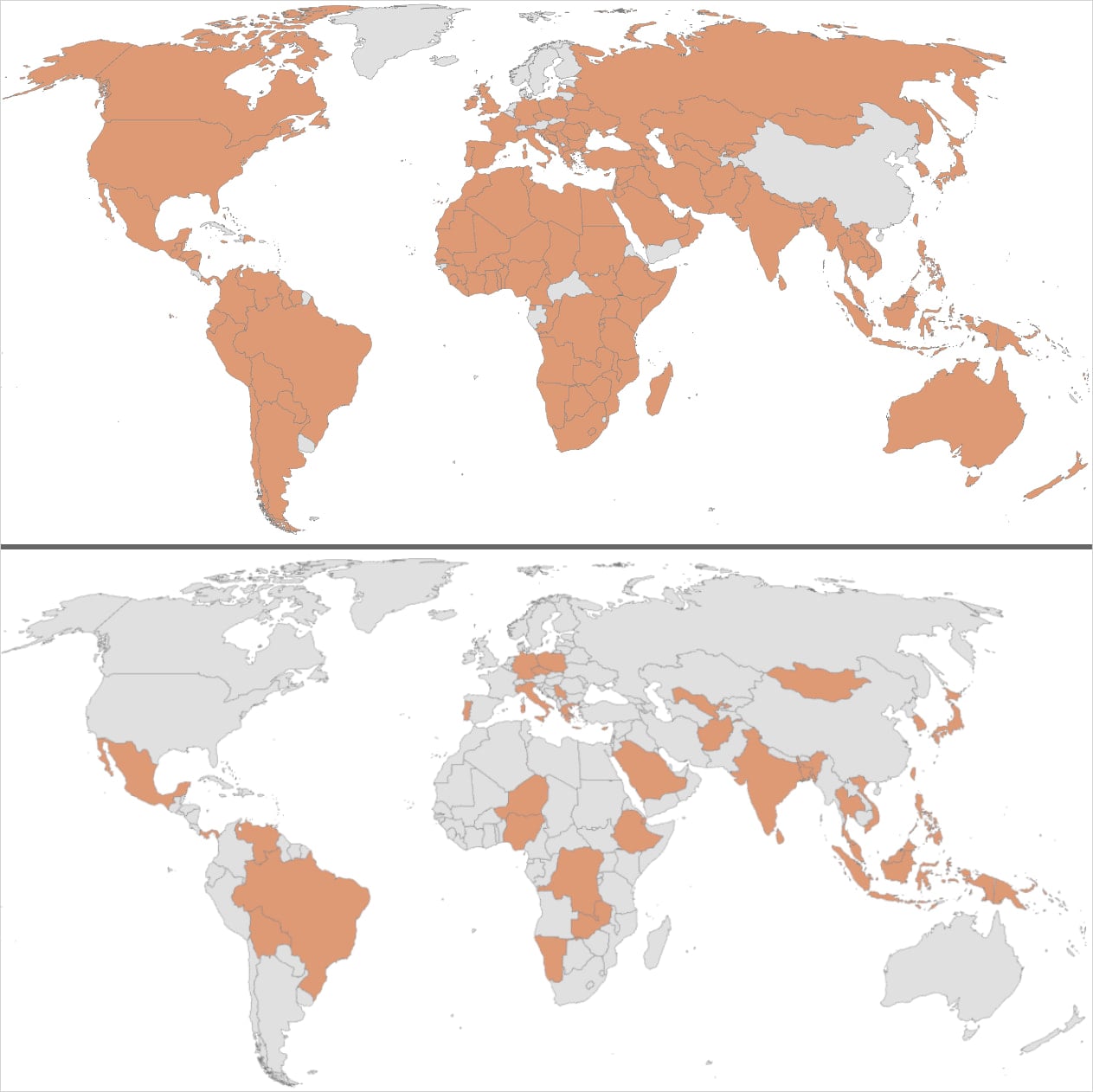
Between November and December last year, the actor also engaged in reconnaissance activity targeting government entities connected to 155 countries.
According to Palo Alto Networks’ Unit 42 division, the group has been active since at least January 2024, and there is high confidence that it operates from Asia. Until definitive attribution is possible, the researchers track the actor as TGR-STA-1030/UNC6619.

‘Shadow Campaigns’ activity focuses primarily on government ministries, law enforcement, border control, finance, trade, energy, mining, immigration, and diplomatic agencies.
Unit 42 researchers confirmed that the attacks successfully compromised at least 70 government and critical infrastructure organizations across 37 countries.
This includes organizations engaged in trade policy, geopolitical issues, and elections in the Americas; ministries and parliaments across multiple European states; the Treasury Department in Australia; and government and critical infrastructure in Taiwan.
Source: Unit 42
The list of countries with targeted or compromised organizations is extensive and focused on certain regions with particular timing that appears to have been driven by specific events.
The researchers say that during the U.S. government shutdown in October 2025, the threat actor showed increased interest in scanning entities across North, Central and South America (Brazil, Canada, Dominican Republic, Guatemala, Honduras, Jamaica, Mexico, Panama, and Trinidad and Tobago).
Significant reconnaissance activity was discovered against “at least 200 IP addresses hosting Government of Honduras infrastructure” just 30 days before the national election, as both candidates indicated willingness to restore diplomatic ties with Taiwan.
Unit 42 assesses that the threat group compromised the following entities:
- Brazil’s Ministry of Mines and Energy
- the network of a Bolivian entity associated with mining
- two of Mexico’s ministries
- a government infrastructure in Panama
- an IP address that geolocates to a Venezolana de Industria Tecnológica facility
- compromised government entities in Cyprus, Czechia, Germany, Greece, Italy, Poland, Portugal, and Serbia
- an Indonesian airline
- multiple Malaysian government departments and ministries
- a Mongolian law enforcement entity
- a major supplier in Taiwan’s power equipment industry
- a Thai government department (likely for economic and international trade information)
- critical infrastructure entities in the Democratic Republic of the Congo, Djibouti, Ethiopia, Namibia, Niger, Nigeria, and Zambia
Unit 42 also believes that TGR-STA-1030/UNC6619 also tried to connect over SSH to infrastructure associated with Australia’s Treasury Department, Afghanistan’s Ministry of Finance, and Nepal’s Office of the Prime Minister and Council of Ministers.
Apart from these compromises, the researchers found evidence indicating reconnaissance activity and breach attempts targeting organizations in other countries.
They say that the actor scanned infrastructure connected to the Czech government (Army, Police, Parliament, Ministries of Interior, Finance, Foreign Affairs, and the president’s website).
The threat group also tried to connect to the European Union infrastructure by targeting more than 600 IP hosting *.europa.eu domains. In July 2025, the group focused on Germany and initiated connections to more than 490 IP addresses that hosted government systems.
Shadow Campaigns attack chain
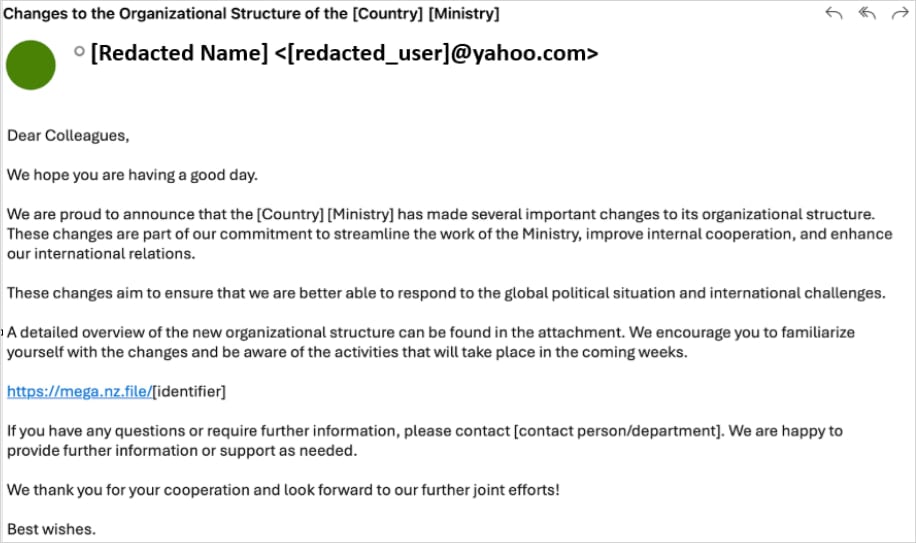
Early operations relied on highly tailored phishing emails sent to government officials, with lures commonly referencing internal ministry reorganization efforts.
The emails embedded links to malicious archives with localized naming hosted on the Mega.nz storage service. The compressed files contained a malware loader called Diaoyu and a zero-byte PNG file named pic1.png.
Source: Unit 42
Unit 42 researcher found that the Diaoyu loader would fetch Cobalt Strike payloads and the VShell framework for command-and-control (C2) under certain conditions that equate to analysis evasion checks.
“Beyond the hardware requirement of a horizontal screen resolution greater than or equal to 1440, the sample performs an environmental dependency check for a specific file (pic1.png) in its execution directory,” the researchers say.
They explain that the zero-byte image acts as a file-based integrity check. In its absence, the malware terminates before inspecting the compromised host.
To evade detection, the loader looks for running processes from the following security products: Kaspersky, Avira, Bitdefender, Sentinel One, and Norton (Symantec).
Apart from phishing, TGR-STA-1030/UNC6619 also exploited at least 15 known vulnerabilities to achieve initial access. Unit 42 found that the threat actor leveraged security issues in SAP Solution Manager, Microsoft Exchange Server, D-Link, and Microsoft Windows.
New Linux rootkit
TGR-STA-1030/UNC6619’s toolkit used for Shadow Campaigns activity is extensive and includes webshells such as Behinder, Godzilla, and Neo-reGeorg, as well as network tunneling tools such as GO Simple Tunnel (GOST), Fast Reverse Proxy Server (FRPS), and IOX.
However, researchers also discovered a custom Linux kernel eBPF rootkit called ‘ShadowGuard’ that they believe to be unique to the TGR-STA-1030/UNC6619 threat actor.
“eBPF backdoors are notoriously difficult to detect because they operate entirely within the highly trusted kernel space,” the researchers explain.
“This allows them to manipulate core system functions and audit logs before security tools or system monitoring applications can see the true data.”
ShadowGuard conceals malicious process information at the kernel level, hides up to 32 PIDs from standard Linux monitoring tools using syscall interception. It can also hide from manual inspection files and directories named swsecret.
Additionally, the malware features a mechanism that lets its operator define processes that should remain visible.
The infrastructure used in Shadow Campaigns relies on victim-facing servers with legitimate VPS providers in the U.S., Singapore, and the UK, as well as relay servers for traffic obfuscation, and residential proxies or Tor for proxying.
The researchers noticed the use of C2 domains that would appear familiar to the target, such as the use of .gouv top-level extension for French-speaking countries or the dog3rj[.]tech domain in attacks in the European space.
“It’s possible that the domain name could be a reference to ‘DOGE Jr,’ which has several meanings in a Western context, such as the U.S.
The Threat of TGR-STA-1030/UNC6619 to Global Governments
Researchers have uncovered a significant threat posed by an espionage actor known as TGR-STA-1030/UNC6619. This sophisticated entity has demonstrated operational maturity and a focus on gathering strategic, economic, and political intelligence. Its activities have already had a substantial impact on numerous governments worldwide.
Unit 42, the organization that conducted the research, has detailed the characteristics of TGR-STA-1030/UNC6619 in a comprehensive report. This includes information on how the actor operates and its preferred targets. The report also contains indicators of compromise (IoCs) that can help cybersecurity professionals identify and prevent attacks from this threat actor.
Defending Against Cyber Threats
With the increasing complexity of modern IT infrastructure, manual security workflows are struggling to keep pace. The need for automation and intelligent response mechanisms has never been more critical. Organizations can enhance their security posture by implementing automated workflows that reduce delays and improve reliability.
The Tines guide offers valuable insights on how teams can streamline their incident response processes and leverage automation to build scalable and efficient workflows. By integrating automation tools into existing systems, organizations can enhance their defensive capabilities and respond more effectively to cyber threats.
For more information on optimizing your security operations and staying ahead of evolving threats, download the Tines guide today.











Bearlyfy Strikes Russian Companies with Unique GenieLocker Ransomware Attack

Innovative Ventures: The 8 Startups Investors Can’t Resist from YC Demo Day

The Future of iPhone Cameras: Is a 200 MP Lens Coming Soon?

Celebrating the First iX3 Delivery at BMW’s Debrecen Factory

iPhone 12 Pro Max vs Samsung Note 20 Ultra / Huawei / Xiaomi / OnePlus Battery Life DRAIN Test.

Stealthy Malware: The Hidden Threat Within Telnyx PyPI Package

Harvest of Suspicion: Grave Seasons Murder Mystery Farming Sim Arrives in August

Tech Giants Clash: OpenAI Halts Sora as Meta Faces Legal Setback

Apple’s AI Playlist Playground: Where Music Goes to Die

EU Takes Action Against Instagram and Facebook for Violating Illegal Content Rules

Warning: Facebook Creators Face Monetization Loss for Stealing and Reposting Videos

Facebook Compliance: ICE-tracking Page Removed After US Government Intervention

Facebook’s New Look: A Blend of Instagram’s Style

Facebook and Instagram to Reduce Personalized Ads for European Users

InstaDub: Meta’s AI Translation Tool for Instagram Videos

Reclaim Your Account: Facebook and Instagram Launch New Hub for Account Recovery

Meta discontinues Messenger apps for Windows and macOS

Breaking Updates: Meta Connect 2025 Unveils Latest Developments
iPhone 12 Pro Max vs Samsung Note 20 Ultra / Huawei / Xiaomi / OnePlus Battery Life DRAIN Test.

The BEST Smartphone of 2020 🏆

The Self-Healing Smartphones!

Apple is not what it used to be.

Smartphones are Boring now.

The Fastest Android Phone Ever.

Unboxing the $122,000 Smartphone. 🤯

Are Linux Smartphones about to KILL Android?

15 Smartphone FAILS to ruin your day 😂
-
 Facebook5 months ago
EU Takes Action Against Instagram and Facebook for Violating Illegal Content Rules
-
 Facebook5 months ago
Warning: Facebook Creators Face Monetization Loss for Stealing and Reposting Videos
-
 Facebook5 months ago
Facebook Compliance: ICE-tracking Page Removed After US Government Intervention
-
 Facebook4 months ago
Facebook’s New Look: A Blend of Instagram’s Style
-
 Facebook4 months ago
Facebook and Instagram to Reduce Personalized Ads for European Users
-
 Facebook5 months ago
InstaDub: Meta’s AI Translation Tool for Instagram Videos
-
 Facebook4 months ago
Reclaim Your Account: Facebook and Instagram Launch New Hub for Account Recovery
-
 Apple5 months ago
Meta discontinues Messenger apps for Windows and macOS
