
Inovation
Harnessing Earth’s Energy: The Stirling Engine’s Journey to Space

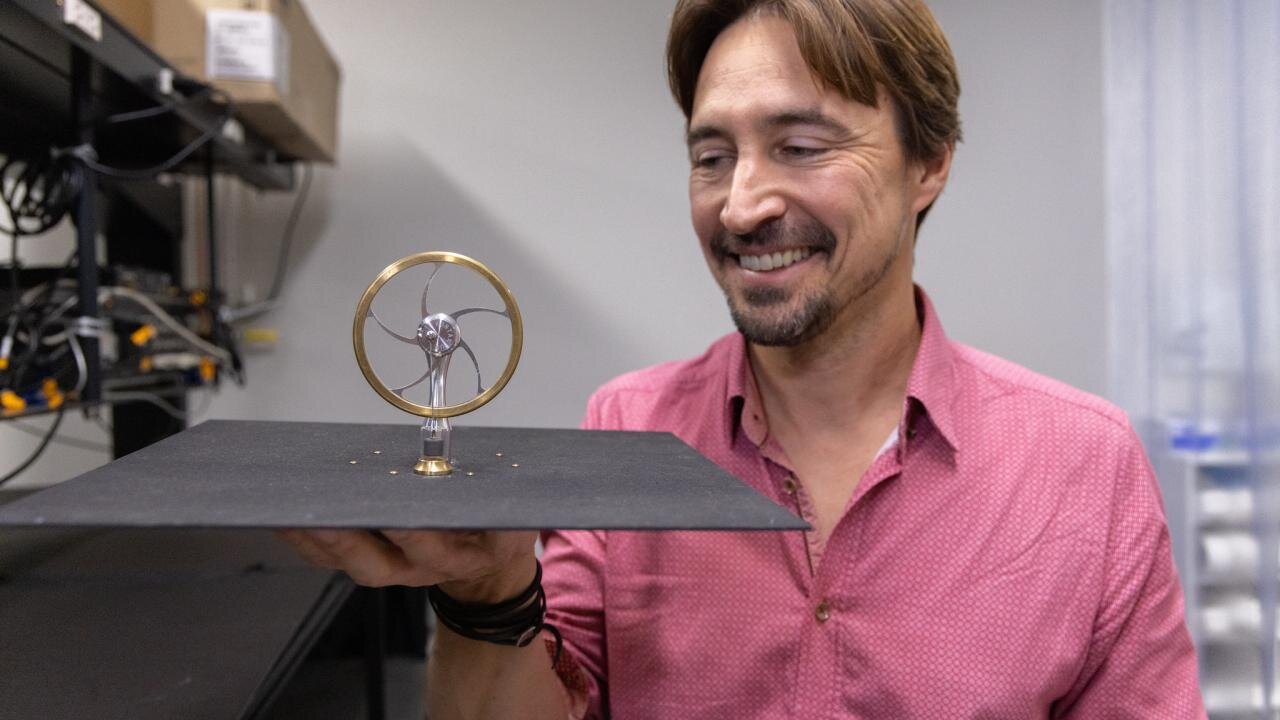
Engineers at the University of California, Davis, have invented a device that can generate mechanical power at night by linking the natural warmth around us to the cold depths of space. The invention could be used, for example, to ventilate greenhouses or other buildings. The work is described Nov. 12 in Science Advances.
The invention is a type of machine called a Stirling engine. Other machines such as internal combustion engines generate power from a large heat gradient, said Jeremy Munday, professor of electrical and computer engineering at UC Davis and co-author on the paper. In contrast, a Stirling engine can work based on a small difference in temperature, such as that between a hot cup of coffee and its surroundings.
“These engines are very efficient when only small temperature differences exist, whereas other types of engines work better with larger temperature differences and can produce more power,” Munday said.
Typically, a Stirling engine is directly connected to a heat source on one side and a cooler environment on the other side.
“If you just set it on the table, it’s not going to produce any power on its own because all sides are the same temperature,” Munday said.
One way to generate a temperature difference, of course, is to heat up one side by burning fuel. Munday and graduate student researcher Tristan Deppe wondered if instead they could connect the cold side to something very, very cold but also very far away: deep space.
“It doesn’t actually have to touch space physically, it can just interact radiatively with space,” Munday said.












Troubleshooting HDMI Audio: Essential Fixes & More Tips

Unveiling the Powerhouse: Mercedes-AMG GT Black Series with Dynamic Aero System Spotted at Nurburgring

iPhone 12 Pro Max Unboxing & Review!

European Commission Launches Investigation into Amazon Cloud Account Breach

Drama and Dollars: The Evolution of Soap Opera-TikTok Hybrids

Maximizing MacBook Battery Life: Tips for Charging Slowly and Setting Charge Limits

Lost Legacy: The Disappearance of AC Schnitzer and the Changing Automotive Landscape

Cyber Warfare: The Battlefront of the Digital Age

Monster Hunter Stories 3: The Challenge of Twisted Reflection

EU Takes Action Against Instagram and Facebook for Violating Illegal Content Rules

Warning: Facebook Creators Face Monetization Loss for Stealing and Reposting Videos

Facebook Compliance: ICE-tracking Page Removed After US Government Intervention

Facebook’s New Look: A Blend of Instagram’s Style

Facebook and Instagram to Reduce Personalized Ads for European Users

InstaDub: Meta’s AI Translation Tool for Instagram Videos

Reclaim Your Account: Facebook and Instagram Launch New Hub for Account Recovery

Meta discontinues Messenger apps for Windows and macOS

Breaking Updates: Meta Connect 2025 Unveils Latest Developments
iPhone 12 Pro Max Unboxing & Review!

iPhone 12 Pro Max vs Samsung Note 20 Ultra / Huawei Mate 40 Pro Camera Test Comparison.

iPhone 12 Pro Max vs Samsung Note 20 Ultra / Huawei / Xiaomi / OnePlus Battery Life DRAIN Test.

The BEST Smartphone of 2020 🏆

The Self-Healing Smartphones!

Apple is not what it used to be.

Smartphones are Boring now.

The Fastest Android Phone Ever.

Unboxing the $122,000 Smartphone. 🤯
-
 Facebook5 months ago
EU Takes Action Against Instagram and Facebook for Violating Illegal Content Rules
-
 Facebook6 months ago
Warning: Facebook Creators Face Monetization Loss for Stealing and Reposting Videos
-
 Facebook6 months ago
Facebook Compliance: ICE-tracking Page Removed After US Government Intervention
-
 Facebook4 months ago
Facebook’s New Look: A Blend of Instagram’s Style
-
 Facebook4 months ago
Facebook and Instagram to Reduce Personalized Ads for European Users
-
 Facebook6 months ago
InstaDub: Meta’s AI Translation Tool for Instagram Videos
-
 Facebook4 months ago
Reclaim Your Account: Facebook and Instagram Launch New Hub for Account Recovery
-
 Apple5 months ago
Meta discontinues Messenger apps for Windows and macOS
