
Tech News
Mastering Predictive Analytics in Finance: The Ultimate Handbook


The finance market is witnessing a significant shift towards predictive analytics, with a projected value of $27.51 billion by 2034. A research study from ResearchGate showcases the success story of GlobalTech, which achieved a 25% reduction in forecasting errors and a 20% increase in profitability within the first year of adopting predictive analytics. This highlights the transformative impact of predictive analytics in the financial sector.
Leading financial institutions like HSBC, Revolut, J.P. Morgan, and Danske Bank are leveraging predictive analytics to enhance their operations. The versatile applications of predictive analytics, including risk management, fraud detection, banking analytics, and lending analytics, offer benefits such as proactive decision-making, improved accuracy, efficiency, risk control, customer experience enhancement, and revenue growth.
From real-time detection of fraudulent transactions to accurate cash flow forecasting and personalized banking experiences, predictive analytics has become an indispensable tool for modern finance.
This article delves into the essence of predictive analytics in finance, elucidating its significance, operational mechanisms, key applications, and its role in shaping the future of the financial industry. It also delves into the challenges, solutions, and upcoming trends in the domain, empowering decision-makers to make informed choices while developing Fintech IT solutions for their financial institutions.
Key Takeaways
- Predictive analytics transforms finance from reactive to proactive decision-making by leveraging AI, machine learning, and real-time data to predict risks, customer behavior, and market trends.
- Various predictive models collaborate to empower financial insights, encompassing classification, clustering, time series, anomaly detection, and regression models for forecasting, risk management, and optimization.
- The applications of predictive analytics in finance span fraud prevention, credit scoring, personalized banking, investment analytics, and cash flow forecasting.
- Predictive analytics in finance delivers tangible benefits, aiding institutions in reducing losses and costs, enhancing efficiency and accuracy, improving customer experiences, and driving revenue growth.
- The sustainable integration of predictive analytics in finance demands transparency, security, and compliance, with a growing emphasis on explainable AI, robust data governance, regulatory alignment, and cybersecurity as predictive analytics evolves.
- The future trends of predictive analytics in finance encompass AI-driven real-time analytics & decision-making, integration with blockchain & decentralized finance, and more.
What Is the Role of Predictive Analytics in Finance?
Predictive analytics in finance epitomizes the utilization of AI, machine learning, historical & real-time data, and statistical techniques to prognosticate future financial outcomes, including market trends, customer behavior, and risks. While AI finds extensive applications in Fintech, predictive analytics empowers financial institutions to decipher answers to pivotal questions:
- What is the probable next course of events?
- Which customers are susceptible to default?
- How might market conditions evolve?
- Where are potential fraud risks emerging?
By delving deep into detailed insights across all spectrums, predictive analytics equips financial institutions to make informed decisions in credit scoring, fraud detection, portfolio management, and cash flow forecasting, transitioning from reactive to proactive financial strategies.
In straightforward terms, predictive analytics in finance, with its holistic view of futuristic data, empowers organizations to optimize investments, personalize services, avert defaults, and enhance overall efficiency by unearthing concealed patterns within intricate datasets.
Financial Data Analytics Market Statistics
The global financial analytics market is poised to reach an estimated $27.51 billion by 2034, surging from a mere $9.20 billion in 2024, expanding at an 11.57% CAGR from 2025 to 2034.
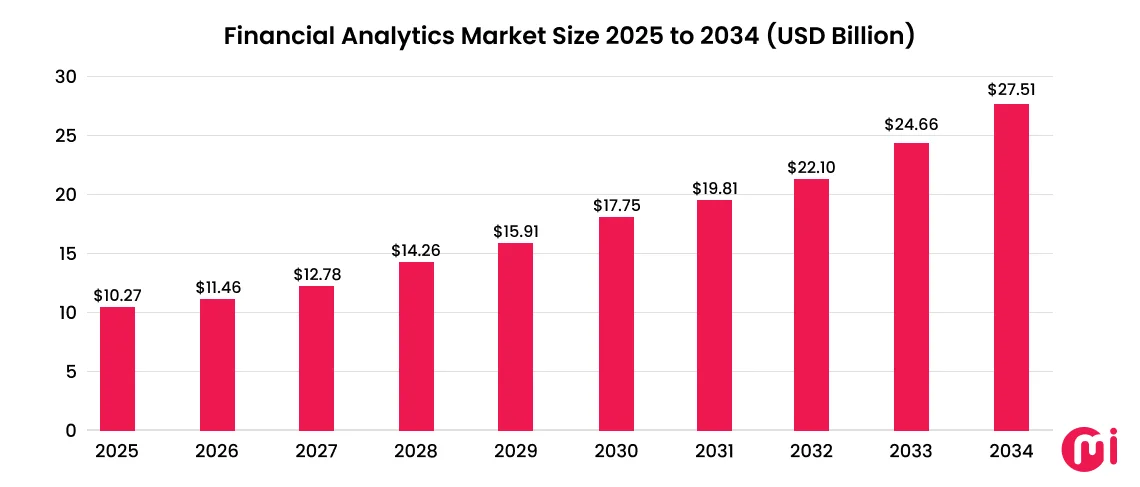
Another study from Mordor Intelligence corroborates this growth trajectory, projecting the financial analytics market to ascend to $21.27 billion by 2030, up from $12.49 billion in 2025, reflecting an 11.2% CAGR during the period.
Additionally, per Fortune Business Insights, the global financial analytics market is slated to hit $22.64 billion by 2032, having been valued at USD 9.68 billion in 2024 and $10.70 billion in 2025
- The growth trajectory will manifest a CAGR of 11.3% during the forecast period.
What Are the Key Predictive Analytics Models Used in Finance?
Key predictive analytics models in finance encapsulate classification models, clustering models, time series models, anomaly detection models, and regression models. These models harness historical data, scrutinize it, and furnish futuristic insights to assist organizations in making data-informed decisions for tasks encompassing risk management, fraud detection, investment optimization, and other critical domains.
Classification Models
Classification models allocate data points to predefined categories, such as binary or multiclass outcomes, predicated on their underlying features. Financial institutions deploy these models for rendering credit approval decisions, fraud detection, and customer churn prediction, with the objective of ascertaining the likelihood of a specific outcome, thereby streamlining financial decision-making.
Popular techniques encompass decision trees, logistic regression, and random forests.
Clustering Models
Clustering models group data points based on resemblances in their features without hinging on predefined labels. Financial institutions commonly leverage these models for customer segmentation, behavioral analysis, and portfolio grouping, facilitating them in unveiling patterns and tailoring strategies for disparate customer or asset cohorts.
Time Series Models
Time series models dissect data amassed over time to identify trends, seasonality, and patterns that financial institutions can leverage to forecast future values. In finance, these models find extensive application in stock price analysis, revenue forecasting, interest rate modeling, and volatility prediction, where understanding temporal dynamics is pivotal and bears significance for well-informed decision-making.
Anomaly Detection Models
Anomaly detection models pinpoint unconventional or unexpected patterns that deviate from normal behavior. In financial applications, these models play a pivotal role in fraud detection, anti-money laundering, and cybersecurity by flagging transactions or activities that may signify potential risks or fraudulent behavior.
Regression Model
Regression models gauge the relationship between one or more independent variables and a continuous target variable. In finance, they find application in predicting outcomes such as loan default probabilities, asset prices, revenue levels, and financial performance metrics, where precise numerical estimates are imperative.
What Are the Use Cases of Predictive Analytics in Finance?
The use cases of predictive analytics in finance span nearly every facet of the financial ecosystem, encompassing risk management, fraud detection & prevention, banking & lending analytics, cash flow & financial forecasting, and more. It empowers financial institutions to anticipate risks, bolster efficiency, and make astute decisions in an increasingly intricate environment. Here’s how:
Risk Management
Financial institutions leverage predictive analytics to identify, gauge, and mitigate credit, market, and liquidity risks. By parsing historical data and stress scenarios, predictive models aid in estimating potential losses and assessing financial stability, enabling banking organizations to fortify capital planning, enhance resilience, and diminish exposure to unforeseen market disruptions.
Fraud Detection & Prevention
Predictive analytics assumes a pivotal role in detecting fraud in the financial sector by scrutinizing transactions in real time, pinpointing unusual patterns and suspicious behavior that may indicate fraud or money laundering. Furthermore, as fraud methodologies evolve, predictive systems evolve in tandem, curbing false alerts while augmenting detection accuracy.
Investment & Trading Analytics
In investment and capital markets, predictive analytics is employed to forecast price movements, assess market trends, and optimize portfolios. Traders and asset managers rely on predictive signals to manage risk, identify opportunities, and make data-driven decisions. This approach aids these professionals and institutions in navigating market volatility and amplifying long-term investment performance.
Banking & Lending Analytics
Banks harness predictive analytics to assess creditworthiness, automate loan approvals, and predict borrower defaults. These models achieve this by scrutinizing customers’ financial behavior and historical repayment patterns to ameliorate lending decisions. The outcome is expedited processing, enhanced risk control, and more balanced loan portfolios.
Personalized Banking & Customer Analytics
Harnessing the capabilities of generative AI in Fintech, predictive analytics empowers banks to comprehend customer behavior, preferences, and financial requisites optimally. It enables organizations to prophesy churn, lifetime value, and product interest, facilitating them in furnishing personalized recommendations and targeted services to pertinent customers.
This culminates in heightened engagement, enhanced customer satisfaction, and heightened retention rates.
Cash Flow & Financial Forecasting
Accurate cash flow forecasting is pivotal for upholding liquidity and financial stability. Predictive analytics aids banking institutions in prognosticating revenue trends, expense patterns, and funding requisites. These insights bolster superior budgeting, scenario planning, and decision-making, especially during periods of economic unpredictability.
Regulatory & Compliance Analytics
Predictive analytics bolsters regulatory compliance by identifying high-risk activities and potential compliance breaches before their occurrence. Financial institutions leverage predictive models to refine transaction monitoring, enhance reporting accuracy, and fortify audit readiness, ensuring a proactive approach that aids in mitigating regulatory penalties and enhancing governance frameworks.
Insurance & Risk Underwriting
In the insurance domain, predictive analytics enriches underwriting and pricing by estimating risk with greater precision. Insurers leverage predictive models to prognosticate claim frequency, gauge policyholder risk, and detect fraudulent claims, leading to more competitive pricing, diminished losses, and enhanced overall profitability.
What Are the Benefits of Predictive Analytics in Finance?
Predictive analytics in finance proffers an array of measurable business benefits, ranging from proactive decision-making to heightened accuracy, efficiency, superior risk control, enhanced customer experiences, and bolstered financial performance.
Here’s how the utilization of AI in wealth management benefits the finance sector:
Proactive and Predictive Decision-Making
AI in decision-making plays a pivotal role. Fueled by AI, predictive analytics empowers financial institutions to transition from reactive decision-making to a proactive stance. By prophesying risks, market shifts, and customer behavior beforehand, organizations can take prompt action, diminish uncertainty, and respond more effectively to emerging opportunities and potential threats.
Higher Accuracy and Operational Efficiency
Automated predictive models dissect vast volumes of data with greater celerity and consistency than manual processes. These models reduce human fallibility, augment forecast accuracy, and streamline operations across realms such as lending, fraud detection, and financial planning, allowing teams to concentrate on higher-value strategic activities.
Diminished Financial Risk and Loss Exposure
By pinpointing potential credit defaults, fraudulent transactions, and market downturns early, predictive analytics assists institutions in minimizing losses. These insights enable better risk mitigation strategies, robust portfolio management, and more resilient financial operations, particularly in volatile or uncertain economic conditions.
Enhanced Customer Experience and Personalization
Predictive analytics enables financial institutions to comprehend customer requisites, preferences, and behavior. It empowers these organizations to furnish personalized products, expedited approvals, and pertinent recommendations, enhancing customer satisfaction, reinforcing loyalty, and fostering enduring relationships.
Data-Driven Strategic and Financial Planning
Executives and financial leaders leverage predictive insights to bolster long-term planning and strategic decision-making. Scenario analysis, forecasting, and predictive modeling aid these leaders in allocating capital more effectively, preparing for diverse market conditions, and aligning financial goals with business strategy.
Lower Operational Costs
Gains in efficiency realized through automation, improved risk detection, and streamlined processes lead to substantial cost reductions. Predictive analytics curtails manual intervention, minimizes fraud-related losses, and optimizes resource utilization across financial operations.
Augmented Revenue and Profitability
By enhancing targeting, pricing strategies, and investment decisions, predictive analytics directly contributes to revenue growth. Deeper insights into customer behavior and market trends enable financial institutions to unearth new opportunities, optimize margins, and amplify overall profitability.
Successful Examples of Predictive Analytics in Finance
A plethora of successful examples of predictive analytics in finance exists; however, standout instances include HSBC, Revolut, J.P. Morgan, and Danske Bank. Delve into the details below for a comprehensive overview of how these systems enable superior performance, efficiency in financial activities, and better outcomes for both customers and institutions:
HS













Exclusive Arrival: Cupra Born VZ Lands in Australia – But There’s a Twist!

iPhone 12 Pro Max vs Samsung Note 20 Ultra / Huawei Mate 40 Pro Camera Test Comparison.

ClickFix: The New Threat to macOS Security

Kingdom Come: Deliverance 2 – The Rise of Artificial Intelligence

Elon Musk’s Latest Venture Faces Uncertainty as Last Co-Founder Departs xAI

Apple Bids Farewell to the Mac Pro Tower: Is it Truly Dead?

Porsche 911 GT3 RS Facelift: Unveiling the 992.2 Model in August 2026

Bearlyfy Strikes Russian Companies with Unique GenieLocker Ransomware Attack

Innovative Ventures: The 8 Startups Investors Can’t Resist from YC Demo Day

EU Takes Action Against Instagram and Facebook for Violating Illegal Content Rules

Warning: Facebook Creators Face Monetization Loss for Stealing and Reposting Videos

Facebook Compliance: ICE-tracking Page Removed After US Government Intervention

Facebook’s New Look: A Blend of Instagram’s Style

Facebook and Instagram to Reduce Personalized Ads for European Users

InstaDub: Meta’s AI Translation Tool for Instagram Videos

Reclaim Your Account: Facebook and Instagram Launch New Hub for Account Recovery

Meta discontinues Messenger apps for Windows and macOS

Breaking Updates: Meta Connect 2025 Unveils Latest Developments
iPhone 12 Pro Max vs Samsung Note 20 Ultra / Huawei Mate 40 Pro Camera Test Comparison.

iPhone 12 Pro Max vs Samsung Note 20 Ultra / Huawei / Xiaomi / OnePlus Battery Life DRAIN Test.

The BEST Smartphone of 2020 🏆

The Self-Healing Smartphones!

Apple is not what it used to be.

Smartphones are Boring now.

The Fastest Android Phone Ever.

Unboxing the $122,000 Smartphone. 🤯

Are Linux Smartphones about to KILL Android?
-
 Facebook5 months ago
EU Takes Action Against Instagram and Facebook for Violating Illegal Content Rules
-
 Facebook5 months ago
Warning: Facebook Creators Face Monetization Loss for Stealing and Reposting Videos
-
 Facebook5 months ago
Facebook Compliance: ICE-tracking Page Removed After US Government Intervention
-
 Facebook4 months ago
Facebook’s New Look: A Blend of Instagram’s Style
-
 Facebook4 months ago
Facebook and Instagram to Reduce Personalized Ads for European Users
-
 Facebook6 months ago
InstaDub: Meta’s AI Translation Tool for Instagram Videos
-
 Facebook4 months ago
Reclaim Your Account: Facebook and Instagram Launch New Hub for Account Recovery
-
 Apple5 months ago
Meta discontinues Messenger apps for Windows and macOS
