
Tech News
Navigating the Future: AI Integration in Wealth Management

As per InsightAce Analytic, the global AI in the wealth management & financial planning market is projected to reach $129.6 billion by 2034, demonstrating its usability and rapid adoption in the finance industry. From financial data analytics to personalized portfolio management, operational efficiency, and risk management, AI is transforming wealth management.
The key AI use cases in wealth management include robo-advisors, advanced data analytics, and automation of back-office tasks, enabling human advisors to focus on strategic client relationships. Firms that leverage AI in wealth management are more likely to offer tailored financial strategies, manage risk more effectively, and provide seamless client experiences at scale.

This blog provides a comprehensive guide on the role of AI in wealth management. It includes how AI is redefining wealth management, its use cases, benefits for both clients and service providers, challenges, and what the future holds for financial institutions using AI. It helps you know and get appropriate AI development services to build the right wealth management solution.
Key Takeaways:
- AI is transforming how wealth managers analyze data, serve clients, and manage portfolios.
- While machine learning enables predictive insights for smarter investment decisions, Hyper-personalization is improving client satisfaction and retention.
- The benefits of AI tools in wealth management are streamlined compliance, operations, and customer relationship management.
- The future of wealth management lies in hybrid human-AI collaboration.
What Is AI in Wealth Management?
AI in wealth management refers to the use of AI-enabled systems that mimic human reasoning, learning, and decision-making in financial advisory and investment processes. Artificial intelligence and machine learning in wealth management help organizations predict market trends, automate tasks, analyze vast amounts of data, and offer more personalized investment advice.
These AI-powered systems leverage technologies like machine learning, natural language processing (NLP), predictive analytics, and automation to analyze market data, manage portfolios, detect fraud, and personalize client recommendations.
In essence, AI in wealth management enables managers to move beyond reactive decision-making toward proactive, data-driven strategies that anticipate market trends and customers’ needs. To understand how AI enhances wealth management and other financial services, explore our Fintech software development guide.
Use Cases of AI in Wealth Management
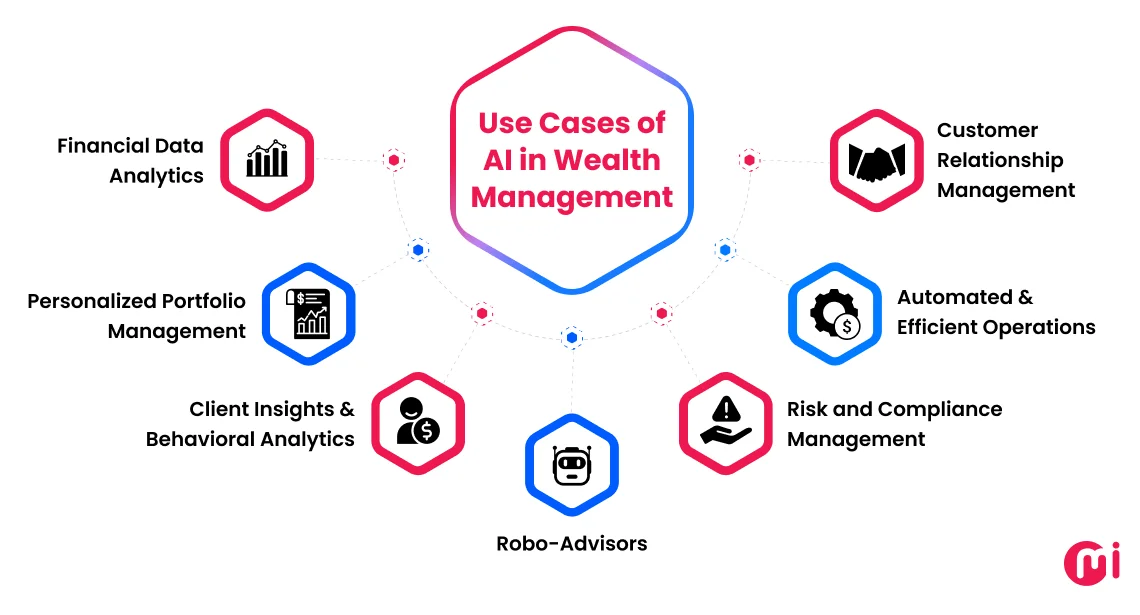
AI in wealth management has various use cases, starting from financial data analytics to personalized portfolio management, tailored client services through robo-advisors, and many more. AI agents are revolutionizing business processes in finance by automating routine accounting tasks, financial tasks, reminders & insight, providing personalized insights and so on. Here’s all about the applications of AI in banking, finance, and wealth management you should know:
1. Financial Data Analytics
AI-powered wealth management algorithms analyze a wide range of financial data, including historical trends, client transactions, and global market indicators, to generate insights in real time. These data help financial institutions know an individual’s financial situation, goals, risk tolerance, and market conditions to create and provide truly tailored solutions.
Predictive analytics helps firms identify emerging opportunities, assess risk exposure, and make well-informed investment decisions faster than traditional methods allow.
2. Personalized Portfolio Management
AI in portfolio management leverages data analytics, machine learning, NLP, deep learning algorithms, and predictive models, enabling wealth managers to deliver personalized investment strategies tailored to each client’s goals, risk tolerance, and behavioral data.
Machine learning & deep learning continuously refine these models, ensuring portfolios stay optimized even when markets evolve. Businesses can leverage deep learning development services to build a solution that ensures tailored wealth management.
For example, AI can automatically rebalance portfolios or recommend asset allocations according to the constantly evolving market conditions, helping customers achieve consistent performance with minimal manual intervention.
3. Client Insights & Behavioral Analytics
AI-enabled tools for wealth management help financial institutions analyze customers’ interactions, communication patterns, and historical preferences to identify behavioral trends.
“` Understanding a customer’s financial goals and decision-making patterns allows advisors to provide more relevant advice and engagement strategies, leading to meaningful relationships where clients feel understood, valued, and confident in their wealth management journey.
Robo-advisors, AI-powered digital platforms, automate wealth management and financial advice with minimal human intervention. They offer services such as risk assessment, asset allocation, and tax-loss harvesting, making investment management more accessible and efficient.
AI in wealth management enhances risk assessment by identifying patterns that may indicate fraud or vulnerabilities in portfolios. Compliance systems powered by AI monitor transactions in real time, detect anomalies, and generate reports aligned with regulatory standards, reducing risk and ensuring adherence to guidelines.
Automation in wealth management reduces manual workloads and enhances operational efficiency by automating routine tasks such as data entry, reconciliation, and reporting. AI technologies like NLP and RPA ensure consistency and accuracy in operations, ultimately reducing costs and democratizing access to financial services for a broader range of clients.
AI-powered CRM systems help financial firms anticipate customers’ needs, analyze behavioral and transactional data, recommend engagement strategies, and predict client churn, leading to strong, proactive customer relationships that grow with the scaling needs of organizations.
AI in wealth management offers benefits for both customers and financial institutions, including increased efficiency and automation, enhanced decision-making, streamlined lead generation, hyper-personalization, real-time information and service, and more. These advantages contribute to better business outcomes and improved customer experiences in the wealth management industry.
The Evolution of Morgan Stanley’s Offerings
Back in 2009, Morgan Stanley made a significant acquisition by purchasing Barclays Global Investors. This move allowed them to expand their offerings by introducing the popular iShares exchange-traded funds (ETFs) to their portfolio.
Morgan Stanley’s Innovative “Next Best Action” System
Morgan Stanley’s cutting-edge “Next Best Action” (NBA) system is a sophisticated AI-powered engine designed to assist financial advisors in engaging with their clients on a more personalized level. By analyzing a client’s data, preferences, behaviors, and market conditions, the system generates tailored recommendations such as portfolio rebalancing, product suggestions, and follow-up conversations. This dynamic approach enhances client engagement and retention significantly.
Over time, the system has transitioned from a rule-based system to one that leverages machine learning and, more recently, generative AI to provide enhanced support to advisors. The AI-driven system has proven to deliver substantial, measurable benefits, including:
- A 30% increase in client engagement with investment proposals
- Improved financial advisor productivity, enabling them to serve more clients without expanding headcount
- Reduced response times for client needs, offering proactive and timely insights
- Enhanced consistency and compliance in recommendations
Morgan Stanley’s CEO, Ted Pick, has hailed artificial intelligence as a “game changer” for their wealth business, surpassing its impact on other divisions within the bank.
The Future of AI in Wealth Management: Outlook and Challenges
As artificial intelligence continues to reshape the financial landscape, its role in wealth management is poised to deepen, driving increased automation, personalization, and insights. However, sustainable adoption of AI in this sector necessitates addressing emerging challenges related to ethics, transparency, and data governance. Here’s a comprehensive overview of the future outlook and challenges associated with AI in wealth management, encompassing a hybrid approach, risk mitigation, bias & governance, and more:
- Hybrid Approach: The future of wealth management is envisioned to be hybrid, combining AI automation with human expertise. Wealth management advisors will utilize AI insights to augment decision-making while upholding the empathy and trust valued by clients.
- Risk Mitigation: The predictive models of AI may occasionally misinterpret data or produce false positives. Hence, firms must establish robust oversight mechanisms and maintain transparency regarding algorithmic decisions to mitigate risks effectively.
- Bias and Governance: AI systems are only as unbiased as the data they are trained on. To ensure fairness and reliability, wealth management firms should embrace ethical AI governance frameworks and continuous model evaluation.
- Data Privacy & Cybersecurity Concerns: Given the sensitivity of financial data, financial institutions must invest in robust encryption, data governance policies, and regulatory compliance (e.g., GDPR and CCPA) to uphold client trust and security.
Harnessing the Power of AI in Wealth Management with MindInventory
For financial institutions seeking to stay ahead of the curve, leveraging AI in wealth management is imperative. At MindInventory, we specialize in providing customized AI/ML development services across various industries, including the finance sector and wealth management firms.
Our expertise spans from retail banking solutions to corporate banking solutions, cloud-based portfolio management & reporting solutions, robo-advisory platforms, intelligent risk management systems, and more. With a track record of partnering with numerous organizations, the next successful collaboration could be with you.
For instance, we developed a risk-aware investment platform called Sidepocket, utilizing core technologies such as Flask, AWS DynamoDB, Plaid, Stripe, APEX, and offering micro-service solutions, API development, and cloud infrastructure management.
Sidepocket experienced:
- Enhanced user-risk awareness
- Real-time portfolio management for immediate data access
- High-speed trade execution without bottlenecks
- Multi-layered security measures
Whether your goal is to automate back-office processes, personalize client interactions, or launch a next-generation investment platform, our AI development services can facilitate secure and scalable innovation.
Frequently Asked Questions (FAQs)
AI is transforming wealth management by enabling personalized services, automating repetitive tasks, and providing predictive insights for more informed investment strategies.
AI is utilized in wealth management for financial data analytics, portfolio optimization, client insights, robo-advisory services, fraud detection, compliance monitoring, and CRM automation.
AI enhances productivity, ensures compliance, identifies new opportunities, facilitates data-driven decision-making, and reduces operational costs for improved outcomes.
AI-powered wealth management tools offer clients personalized portfolios, quick service, enhanced transparency, and better financial results supported by data-driven insights.
No, robo-advisors are not replacing human wealth managers. The future entails hybrid advisory models where AI aids in data analysis while human advisors focus on tailored financial guidance.
Data is pivotal in AI-enabled wealth management as it fuels AI systems, enabling them to identify patterns, predict market trends, and offer personalized advice tailored to each client’s requirements.
AI boosts compliance and risk management in wealth management by automating transaction monitoring and flagging anomalies. This reduces compliance risks and ensures continual regulatory adherence.
Collaborating with a specialized AI/ML development company like MindInventory, with a proven track record in AI ML development, can facilitate the implementation of customized, secure, and scalable AI solutions aligned with your wealth management objectives.
Transform the following text to fit the given context.
Original text: “I can’t believe I forgot to bring my umbrella today.”
Transformed text: “I can’t believe I forgot to pack my sunscreen for the beach today.”













Balancing Act: The Decision to Shut Down Sora

Exclusive Arrival: Cupra Born VZ Lands in Australia – But There’s a Twist!

iPhone 12 Pro Max vs Samsung Note 20 Ultra / Huawei Mate 40 Pro Camera Test Comparison.

ClickFix: The New Threat to macOS Security

Kingdom Come: Deliverance 2 – The Rise of Artificial Intelligence

Elon Musk’s Latest Venture Faces Uncertainty as Last Co-Founder Departs xAI

Apple Bids Farewell to the Mac Pro Tower: Is it Truly Dead?

Porsche 911 GT3 RS Facelift: Unveiling the 992.2 Model in August 2026

Bearlyfy Strikes Russian Companies with Unique GenieLocker Ransomware Attack

EU Takes Action Against Instagram and Facebook for Violating Illegal Content Rules

Warning: Facebook Creators Face Monetization Loss for Stealing and Reposting Videos

Facebook Compliance: ICE-tracking Page Removed After US Government Intervention

Facebook’s New Look: A Blend of Instagram’s Style

Facebook and Instagram to Reduce Personalized Ads for European Users

InstaDub: Meta’s AI Translation Tool for Instagram Videos

Reclaim Your Account: Facebook and Instagram Launch New Hub for Account Recovery

Meta discontinues Messenger apps for Windows and macOS

Breaking Updates: Meta Connect 2025 Unveils Latest Developments
iPhone 12 Pro Max vs Samsung Note 20 Ultra / Huawei Mate 40 Pro Camera Test Comparison.

iPhone 12 Pro Max vs Samsung Note 20 Ultra / Huawei / Xiaomi / OnePlus Battery Life DRAIN Test.

The BEST Smartphone of 2020 🏆

The Self-Healing Smartphones!

Apple is not what it used to be.

Smartphones are Boring now.

The Fastest Android Phone Ever.

Unboxing the $122,000 Smartphone. 🤯

Are Linux Smartphones about to KILL Android?
-
 Facebook5 months ago
EU Takes Action Against Instagram and Facebook for Violating Illegal Content Rules
-
 Facebook5 months ago
Warning: Facebook Creators Face Monetization Loss for Stealing and Reposting Videos
-
 Facebook5 months ago
Facebook Compliance: ICE-tracking Page Removed After US Government Intervention
-
 Facebook4 months ago
Facebook’s New Look: A Blend of Instagram’s Style
-
 Facebook4 months ago
Facebook and Instagram to Reduce Personalized Ads for European Users
-
 Facebook6 months ago
InstaDub: Meta’s AI Translation Tool for Instagram Videos
-
 Facebook4 months ago
Reclaim Your Account: Facebook and Instagram Launch New Hub for Account Recovery
-
 Apple5 months ago
Meta discontinues Messenger apps for Windows and macOS
