
Security
Rampant MongoDB Vulnerabilities Exploited in Ongoing Data Extortion Campaigns


Exposed MongoDB Instances Targeted in Data Extortion Attacks
A cyber threat actor has been actively targeting vulnerable MongoDB instances in automated data extortion schemes, demanding small ransom payments from affected owners to restore their data.
The attacker specifically focuses on exploiting insecure databases that can be accessed without any restrictions due to misconfigurations. As a result, approximately 1,400 exposed servers have been compromised, with ransom demands averaging around $500 in Bitcoin.
Recent reports indicate a surge in these attacks, with thousands of databases being deleted and ransom requests made to recover the information. In some cases, databases were deleted without any monetary demands.

A recent penetration testing exercise conducted by cybersecurity experts from Flare revealed a continuation of these attacks, albeit on a smaller scale.
The researchers identified over 208,500 publicly exposed MongoDB servers, out of which 100,000 revealed operational details, and 3,100 were accessible without authentication.
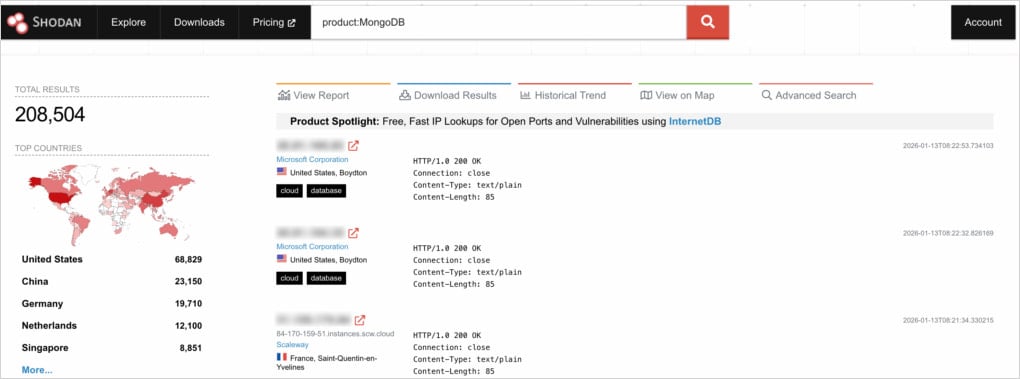
Source: Flare
Alarmingly, almost half of the unprotected servers had already fallen victim to attacks, resulting in data deletion and ransom demands.
Analysis of the ransom notes indicated a common demand of 0.005 BTC within a 48-hour window. However, there is no assurance that paying the ransom will guarantee data recovery or access to decryption keys.
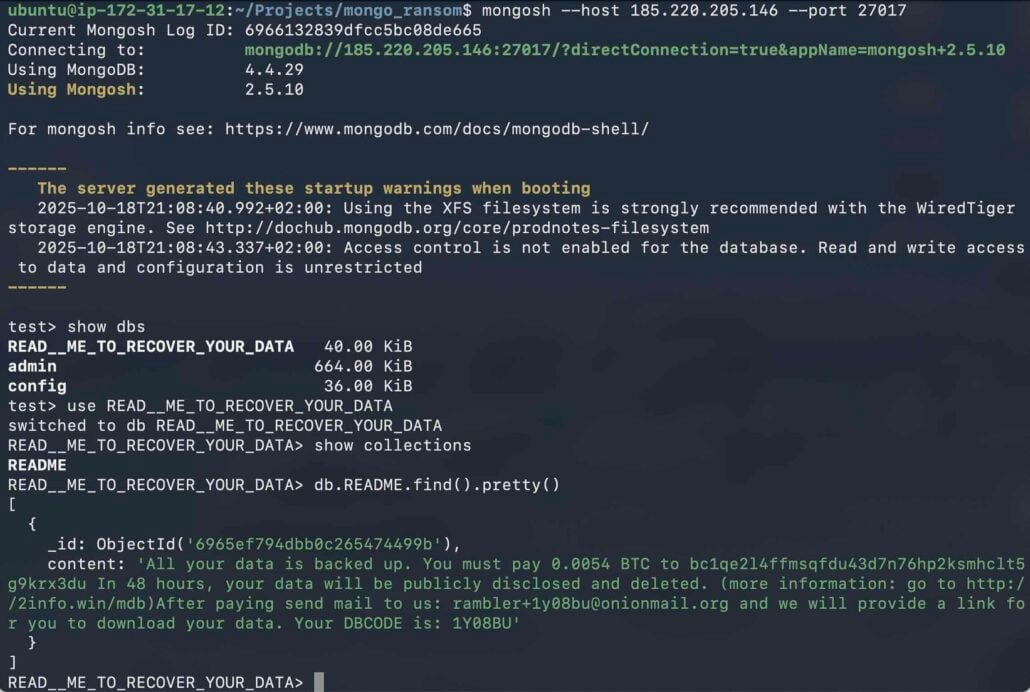
Source: Flare
Further investigation revealed only five unique wallet addresses across the ransom notes, with one address being predominant in nearly 98% of cases, indicating a single threat actor behind these malicious activities.
Flare also speculated that some exposed but untouched instances might have already paid ransoms to avoid being targeted by attackers.
In addition to weak authentication measures, researchers highlighted that almost 95,000 of the exposed MongoDB servers were running outdated versions vulnerable to known exploits. While most vulnerabilities led to denial-of-service risks, remote code execution threats were limited.

Source: Flare
Flare recommends that MongoDB administrators refrain from exposing instances publicly unless absolutely necessary, implement robust authentication protocols, enforce firewall rules, and utilize Kubernetes network policies to restrict access to trusted sources. They also advise against blindly copying configurations from deployment guides.
Regular updates should be applied to MongoDB installations, with continuous monitoring for potential exposure. In case of a breach, credentials must be changed, and logs should be reviewed for unauthorized activities.
Modern IT infrastructure evolves rapidly, outpacing manual workflows. Learn how to streamline operations, enhance reliability, and automate responses with Tines’ comprehensive guide.












Secure APK Sideloading: Harnessing the Power of Advanced Flow for Safe Android Installation

Gunvolt Chronicles: Luminous Avenger iX – The Complete Dual Collection

K2 Launches Groundbreaking High-Powered Satellite for Advanced Space Computing

The End of Security: iOS 13 and 14 Vulnerabilities in 2026

Exclusive Look: The 2027 Chevrolet Corvette Grand Sport Unleashed at Sebring

DON’T buy a Screen Protector before watching this.

Exploiting Vulnerable Drivers: How EDR Killers Use BYOVD to Disable Security

Alphabet’s X Unveils Innovative Spinout Targeting Costly Bureaucratic Challenges

Lawsuit: Halide co-founder accuses Sebastiaan de With of code theft for Apple

EU Takes Action Against Instagram and Facebook for Violating Illegal Content Rules

Warning: Facebook Creators Face Monetization Loss for Stealing and Reposting Videos

Facebook Compliance: ICE-tracking Page Removed After US Government Intervention

Facebook’s New Look: A Blend of Instagram’s Style

Facebook and Instagram to Reduce Personalized Ads for European Users

InstaDub: Meta’s AI Translation Tool for Instagram Videos

Reclaim Your Account: Facebook and Instagram Launch New Hub for Account Recovery

Meta discontinues Messenger apps for Windows and macOS

Breaking Updates: Meta Connect 2025 Unveils Latest Developments
DON’T buy a Screen Protector before watching this.

Beware of Fake Reviewers! ⚠️

Xiaomi Mi 11 Unboxing & Review.

The Galaxy S21 Ultra is Better than you think.

Samsung Galaxy S21 Ultra vs iPhone 12 Pro Max Camera Test Comparison.

Samsung S21 Ultra vs iPhone Battery Life Test!

The Truth about Xiaomi “Air Charging”

DON’T buy this Smartphone.

Galaxy S21 Ultra – Exynos vs Snapdragon.
-
 Facebook5 months ago
EU Takes Action Against Instagram and Facebook for Violating Illegal Content Rules
-
 Facebook5 months ago
Warning: Facebook Creators Face Monetization Loss for Stealing and Reposting Videos
-
 Facebook5 months ago
Facebook Compliance: ICE-tracking Page Removed After US Government Intervention
-
 Facebook3 months ago
Facebook’s New Look: A Blend of Instagram’s Style
-
 Facebook3 months ago
Facebook and Instagram to Reduce Personalized Ads for European Users
-
 Facebook5 months ago
InstaDub: Meta’s AI Translation Tool for Instagram Videos
-
 Facebook4 months ago
Reclaim Your Account: Facebook and Instagram Launch New Hub for Account Recovery
-
 Apple5 months ago
Meta discontinues Messenger apps for Windows and macOS
