
Cars
Revolutionary Carbon-Capture Technology: Mazda Stores CO2 in Tank from Exhaust Testing

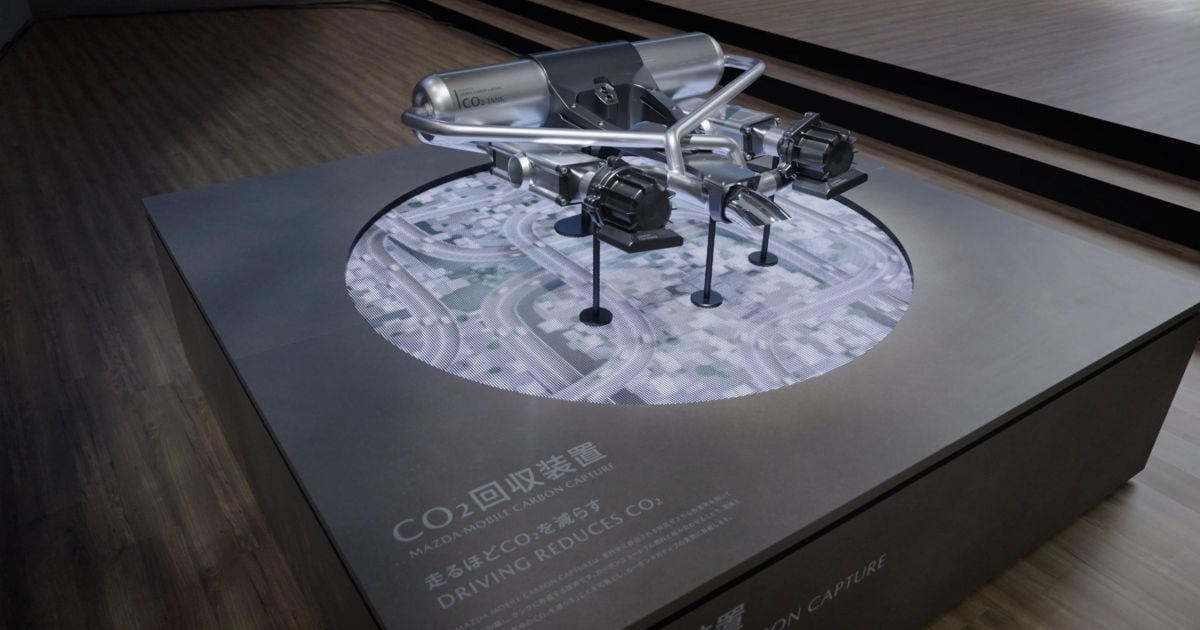
Mazda is currently exploring a carbon-capture system that has the potential to capture a portion of emissions directly from a running engine. This innovative technology aims to reduce emissions from combustion cars significantly, especially as electric vehicles continue to rely on power grids fueled by fossil fuels.
During the Tokyo motor show, Mazda’s CFO, Jeff Guyton, shared that the company has developed a prototype exhaust-mounted capture device capable of storing around 20% of a vehicle’s carbon dioxide output in a specialized tank. According to Mr. Guyton, the exhaust from an engine is rich in CO2, making it an ideal environment to extract carbon from.
The captured carbon can potentially be utilized, possibly through an exchange system where the carbon is stored in a tank and could be repurposed for various applications. Mazda plans to test this technology in an endurance racing car to collect data under full-load conditions before considering its scalability for road use.
The carbon-capture system works by drawing exhaust gases through a drying process and binding the carbon to a crystalline zeolite substrate, capturing approximately one-fifth of emitted CO2. This process allows for the retention of about 20% of the CO2 that would otherwise be emitted from the vehicle.
While Mazda has not specified a timeline for the production of this technology, the concept hints at a unique approach to reducing vehicle emissions. The captured CO2 can be stored onboard and potentially repurposed for recycled plastics or industrial processes, showcasing Mazda’s commitment to sustainability.
Mr. Guyton mentioned that Mazda’s work with carbon-based composite materials, as seen in the Vision X-Coupe concept, could align with this research. This approach reflects Mazda’s focus on incremental real-world benefits rather than making sweeping promises, considering the company’s limited resources to pursue every new technology simultaneously.
In Australia, where Mazda is a top-selling brand with limited electrification options, this development reinforces the company’s approach to zero-emissions motoring. Mazda’s “Multi-Solution Strategy” includes plug-in hybrids, rotary-range extenders, and biofuels experiments, aiming to reduce net emissions for existing vehicles, not just new EVs.
The next challenge for Mazda will be ensuring that the carbon-capture system can function reliably in mass-market cars without adding excessive cost or weight. While still an ambitious experiment, this technology reflects Mazda’s commitment to integrating internal-combustion technology into a cleaner future, rather than abandoning it due to regulations.
Overall, Mazda’s innovative approach to reducing emissions through carbon capture demonstrates a unique direction in the automotive industry, emphasizing sustainability and environmental responsibility.













European Commission Launches Investigation into Amazon Cloud Account Breach

Drama and Dollars: The Evolution of Soap Opera-TikTok Hybrids

Maximizing MacBook Battery Life: Tips for Charging Slowly and Setting Charge Limits

Lost Legacy: The Disappearance of AC Schnitzer and the Changing Automotive Landscape

Cyber Warfare: The Battlefront of the Digital Age

Monster Hunter Stories 3: The Challenge of Twisted Reflection

Revolutionizing Cash-Pay Clinic Prescribing: VITL Secures $7.5M Amid GLP-1 Boom

Balancing Act: The Decision to Shut Down Sora

Exclusive Arrival: Cupra Born VZ Lands in Australia – But There’s a Twist!

EU Takes Action Against Instagram and Facebook for Violating Illegal Content Rules

Warning: Facebook Creators Face Monetization Loss for Stealing and Reposting Videos

Facebook Compliance: ICE-tracking Page Removed After US Government Intervention

Facebook’s New Look: A Blend of Instagram’s Style

Facebook and Instagram to Reduce Personalized Ads for European Users

InstaDub: Meta’s AI Translation Tool for Instagram Videos

Reclaim Your Account: Facebook and Instagram Launch New Hub for Account Recovery

Meta discontinues Messenger apps for Windows and macOS

Breaking Updates: Meta Connect 2025 Unveils Latest Developments

iPhone 12 Pro Max vs Samsung Note 20 Ultra / Huawei Mate 40 Pro Camera Test Comparison.

iPhone 12 Pro Max vs Samsung Note 20 Ultra / Huawei / Xiaomi / OnePlus Battery Life DRAIN Test.

The BEST Smartphone of 2020 🏆

The Self-Healing Smartphones!

Apple is not what it used to be.

Smartphones are Boring now.

The Fastest Android Phone Ever.

Unboxing the $122,000 Smartphone. 🤯

Are Linux Smartphones about to KILL Android?
-
 Facebook5 months ago
EU Takes Action Against Instagram and Facebook for Violating Illegal Content Rules
-
 Facebook5 months ago
Warning: Facebook Creators Face Monetization Loss for Stealing and Reposting Videos
-
 Facebook6 months ago
Facebook Compliance: ICE-tracking Page Removed After US Government Intervention
-
 Facebook4 months ago
Facebook’s New Look: A Blend of Instagram’s Style
-
 Facebook4 months ago
Facebook and Instagram to Reduce Personalized Ads for European Users
-
 Facebook6 months ago
InstaDub: Meta’s AI Translation Tool for Instagram Videos
-
 Facebook4 months ago
Reclaim Your Account: Facebook and Instagram Launch New Hub for Account Recovery
-
 Apple5 months ago
Meta discontinues Messenger apps for Windows and macOS
