
Inovation
Revolutionary Electrolyte Breakthrough Propels All-Solid-State Batteries Past 5 V Stability Barrier

All-Solid-State Batteries: Enhancing Stability with New Electrolyte
All-solid-state batteries (ASSBs) represent a promising advancement in rechargeable battery technology by replacing conventional liquid electrolytes with solid materials. These batteries offer high energy densities while being safer and more stable than those using flammable liquid electrolytes.
Enhancing Energy Density with Solid Electrolytes
The energy density of batteries depends on various factors, including the voltage of the electrolytes they utilize. While liquid electrolytes can operate up to around 4.5 V, their stability diminishes beyond this limit. In contrast, solid electrolytes can remain stable at higher voltages, enabling batteries to store more energy.
A team of researchers from Yonsei University, Dongguk University, KAIST, and other institutions has developed a new fluoride-based solid electrolyte that exhibits stability at unprecedented voltages exceeding 5 V.
Published in Nature Energy, the research combines lithium chloride (LiCl) with lithium titanium fluoride Li2TiF6.
“This project began with a fundamental question: why not push battery chemistry beyond 5 V?” explained senior author Yoon Seok Jung. “Increasing the operational voltage is a straightforward way to enhance energy density, yet solid electrolytes in ASSBs were not sufficiently stable at such high voltages. Particularly, 5 V spinel cathodes like LiNi0.5Mn1.5O4 showed poor performance.”
Exploring Fluoride-Based Solid Electrolytes
Recent studies have highlighted the potential of chloride-based solid electrolytes in enhancing battery cycling stability, especially when combined with nickel, cobalt, and manganese-based cathode materials operating at 4 V. However, these electrolytes faced challenges when paired with high-voltage spinel systems.
This led Jung and the team to investigate fluoride-based solid electrolytes, known for their oxidation resistance but less explored in solid-state electrolyte applications.
“We wanted to test their capability to overcome this challenge, and the results surpassed our expectations,” Jung stated. “ASSBs replace flammable liquid electrolytes with inorganic solid ones, allowing Li+ to move through solid phases instead of liquids.
“This architecture not only enhances safety but also increases energy density by enabling alternative electrodes like Li-metal anodes. However, high-voltage cathodes like spinel materials often trigger conventional solid electrolyte decomposition.”
To address these challenges, the researchers designed a new electrolyte with a protective fluoride-based shielding layer, based on the material LiCl–4Li2TiF6, applied to a spinel cathode surface.
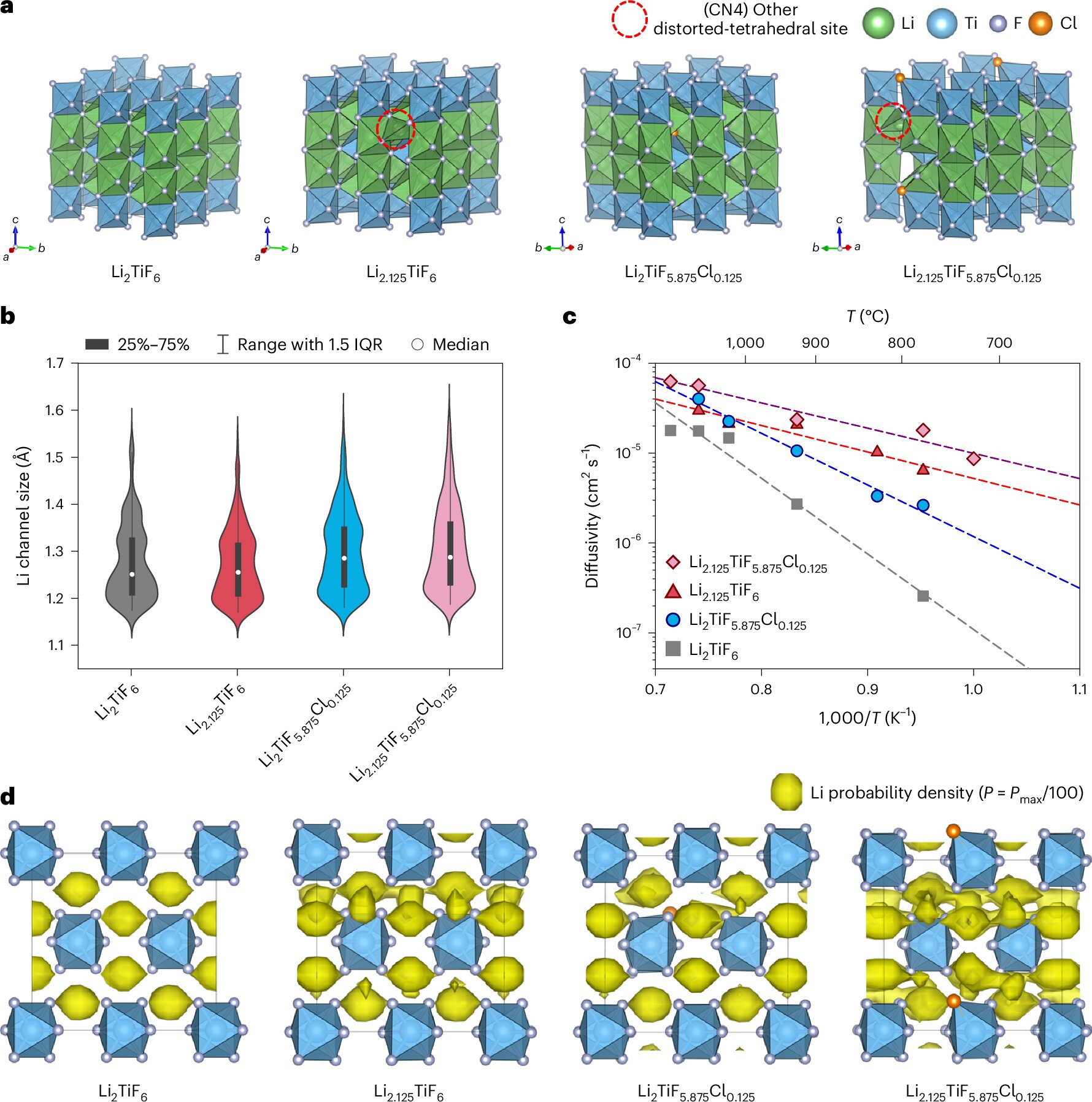
“During synthesis, this material forms a Li-rich interface with atomic rearrangements, creating fast Li+ pathways,” Jung explained. “This combination enables stable operation at voltages above 5.5 V with high ionic conductivity, protecting the interface for smooth ion transport even under extreme conditions.”

Unprecedented Stability with New Electrolyte
The researchers validated the electrolyte’s ability to conduct lithium ions and operate at high voltages. When combined with spinel cathodes, their electrolyte demonstrated safe operation above 5 V, a milestone not achieved with other electrolytes.
“For the first time, we experimentally showed that 5 V chemistry, including spinel cathodes, can succeed in ASSBs using a fluoride-based solid electrolyte,” Jung highlighted. “This breakthrough surpasses the long-standing 5 V stability barrier, paving the way for designing high-voltage ASSBs for various cathode materials.”
In initial tests, a battery with their fluoride-based electrolyte and a spinel system exhibited significantly higher capacity than cells with conventional electrolytes, maintaining 75.2% capacity after 500 cycles at high voltages.
“We achieved high areal capacities exceeding 35 mAh cm-2 and demonstrated pouch-cell operation, crucial steps towards practical commercialization,” Jung added. “Amid safety concerns with NCM–sulfide systems, our results suggest a spinel–fluoride combination as a safer, energy-dense option for future electric vehicles and energy storage.”
Advancing Solid-State Battery Technology
The research team’s work is poised to inspire further exploration of fluoride-based solid electrolytes, potentially accelerating the deployment of high-energy ASSBs for electric vehicles and electronics.
“Our focus is on enhancing solid-state battery energy density by increasing mass loading,” Jung noted. “The spinel system offers ample room for exploration and engineering in the ASSB field.”
Future studies will delve into developing cost-effective, high-voltage cathodes as alternatives to spinel systems, including LiFe0.5Mn1.5O4, tested in a solid-state battery for the first time.
“This material, composed of earth-abundant elements, offers high energy density, making it practical,” Jung outlined. “We aim to explore new fluoride-based solid electrolytes with enhanced ionic conductivities to introduce next-generation, safe, and high-energy ASSBs.”
This article was written by our author Ingrid Fadelli, edited by Sadie Harley, and fact-checked and reviewed by Robert Egan. Your support keeps independent science journalism alive. If you value this reporting, please consider a donation (especially monthly) for an ad-free account.
© 2025 Science X Network













iPhone 12 Pro Max vs Samsung Note 20 Ultra / Huawei Mate 40 Pro Camera Test Comparison.

ClickFix: The New Threat to macOS Security

Kingdom Come: Deliverance 2 – The Rise of Artificial Intelligence

Elon Musk’s Latest Venture Faces Uncertainty as Last Co-Founder Departs xAI

Apple Bids Farewell to the Mac Pro Tower: Is it Truly Dead?

Porsche 911 GT3 RS Facelift: Unveiling the 992.2 Model in August 2026

Bearlyfy Strikes Russian Companies with Unique GenieLocker Ransomware Attack

Innovative Ventures: The 8 Startups Investors Can’t Resist from YC Demo Day

The Future of iPhone Cameras: Is a 200 MP Lens Coming Soon?

EU Takes Action Against Instagram and Facebook for Violating Illegal Content Rules

Warning: Facebook Creators Face Monetization Loss for Stealing and Reposting Videos

Facebook Compliance: ICE-tracking Page Removed After US Government Intervention

Facebook’s New Look: A Blend of Instagram’s Style

Facebook and Instagram to Reduce Personalized Ads for European Users

InstaDub: Meta’s AI Translation Tool for Instagram Videos

Reclaim Your Account: Facebook and Instagram Launch New Hub for Account Recovery

Meta discontinues Messenger apps for Windows and macOS

Breaking Updates: Meta Connect 2025 Unveils Latest Developments
iPhone 12 Pro Max vs Samsung Note 20 Ultra / Huawei Mate 40 Pro Camera Test Comparison.

iPhone 12 Pro Max vs Samsung Note 20 Ultra / Huawei / Xiaomi / OnePlus Battery Life DRAIN Test.

The BEST Smartphone of 2020 🏆

The Self-Healing Smartphones!

Apple is not what it used to be.

Smartphones are Boring now.

The Fastest Android Phone Ever.

Unboxing the $122,000 Smartphone. 🤯

Are Linux Smartphones about to KILL Android?
-
 Facebook5 months ago
EU Takes Action Against Instagram and Facebook for Violating Illegal Content Rules
-
 Facebook5 months ago
Warning: Facebook Creators Face Monetization Loss for Stealing and Reposting Videos
-
 Facebook5 months ago
Facebook Compliance: ICE-tracking Page Removed After US Government Intervention
-
 Facebook4 months ago
Facebook’s New Look: A Blend of Instagram’s Style
-
 Facebook4 months ago
Facebook and Instagram to Reduce Personalized Ads for European Users
-
 Facebook5 months ago
InstaDub: Meta’s AI Translation Tool for Instagram Videos
-
 Facebook4 months ago
Reclaim Your Account: Facebook and Instagram Launch New Hub for Account Recovery
-
 Apple5 months ago
Meta discontinues Messenger apps for Windows and macOS
