
Inovation
Revolutionary Resin: Advancing 3D Printing through Addition and Subtraction

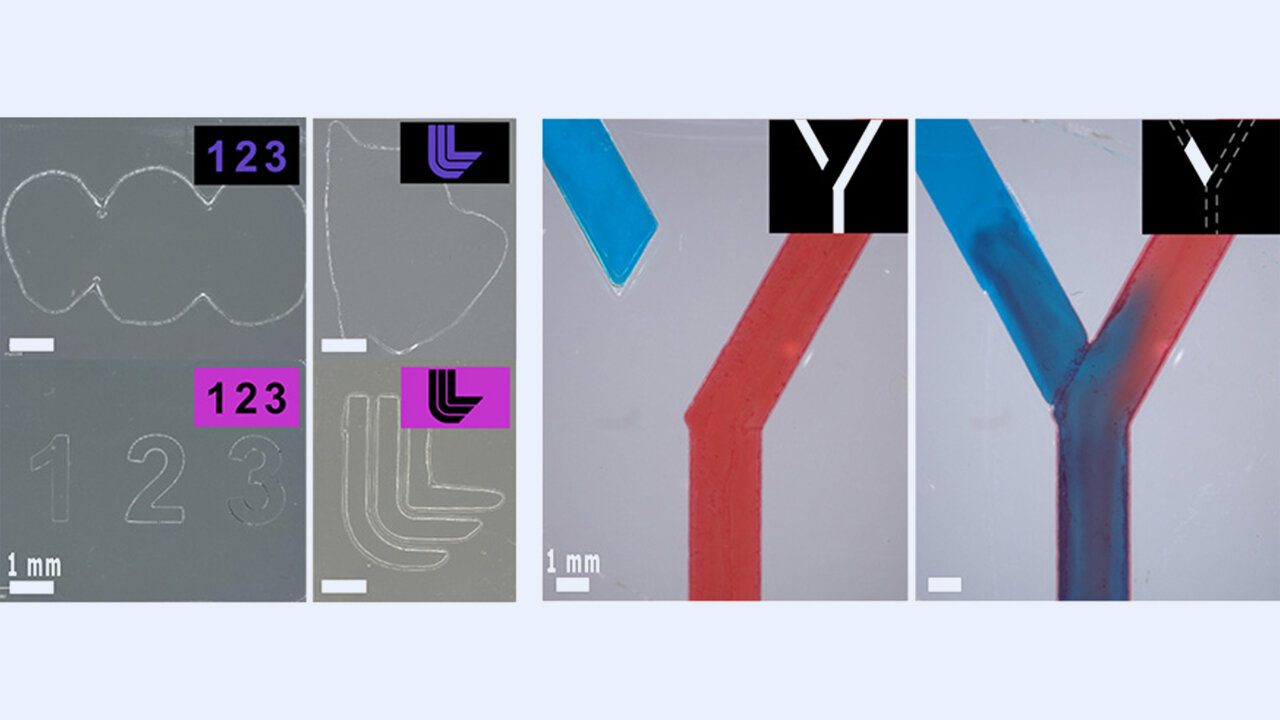
Additive manufacturing, commonly known as 3D printing, typically follows a one-way process. However, researchers at Lawrence Livermore National Laboratory have introduced a new resin that allows for reversible 3D printing. This innovative resin enhances traditional 3D printing by enabling corrective manufacturing, improved print resolution, and the ability to recycle parts.
New Resin Revolutionizing 3D Printing
In a recent study published in Advanced Materials Technologies, the team at LLNL developed a hybrid additive and subtractive manufacturing system using a unique resin that exhibits dual-wavelength behavior. This resin can cure and harden under blue light, and degrade back into a liquid under ultraviolet light. This breakthrough technology enables post-print corrections and modifications to existing 3D printed parts, reducing waste and increasing efficiency.
For instance, the researchers successfully connected two separated channels in a fluidic device post-printing using the degradation response of the resin, showcasing the adaptability and versatility of this new resin.
Commercialization and Technical Advancements
The patented resin technology developed by LLNL is now available for commercialization, offering advanced manufacturing companies the opportunity to enhance their 3D printing capabilities. This unique resin allows for intricate part creation, error correction, and the addition and removal of temporary support structures, ultimately saving time and materials costs.
The resin’s chemistry has been meticulously optimized to respond to both blue and ultraviolet light, ensuring a balance between stability and degradability. This fine-tuned resin formulation allows for quick hardening and degradation, facilitating easy corrections and modifications.
Future of Adaptive Manufacturing
The LLNL scientists are actively exploring ways to further enhance this hybrid manufacturing process by integrating on-machine metrology and feedback control systems. This advancement will enable automatic error corrections during the printing process, leading to true adaptive manufacturing capabilities.
Author and LLNL scientist Liliana Dongping Terrel-Perez envisions expanding this technology beyond DLP printing to volumetric additive and subtractive manufacturing, allowing for the fabrication of 3D parts in a single step using light.
The collaborative effort led by Liliana Dongping Terrel-Perez involved researchers Benjamin Alameda, Johanna Schwartz, Holden Howard, Martin De Beer, and Magi Yassa.
Citation:
Unique resin allows 3D-printing method to add and subtract (2025, November 14)
retrieved 16 November 2025
from https://techxplore.com/news/2025-11-unique-resin-3d-method.html
This document is subject to copyright. Apart from any fair dealing for the purpose of private study or research, no
part may be reproduced without the written permission. The content is provided for information purposes only.













iPhone 12 Pro Max Unboxing & Review!

European Commission Launches Investigation into Amazon Cloud Account Breach

Drama and Dollars: The Evolution of Soap Opera-TikTok Hybrids

Maximizing MacBook Battery Life: Tips for Charging Slowly and Setting Charge Limits

Lost Legacy: The Disappearance of AC Schnitzer and the Changing Automotive Landscape

Cyber Warfare: The Battlefront of the Digital Age

Monster Hunter Stories 3: The Challenge of Twisted Reflection

Revolutionizing Cash-Pay Clinic Prescribing: VITL Secures $7.5M Amid GLP-1 Boom

Balancing Act: The Decision to Shut Down Sora

EU Takes Action Against Instagram and Facebook for Violating Illegal Content Rules

Warning: Facebook Creators Face Monetization Loss for Stealing and Reposting Videos

Facebook Compliance: ICE-tracking Page Removed After US Government Intervention

Facebook’s New Look: A Blend of Instagram’s Style

Facebook and Instagram to Reduce Personalized Ads for European Users

InstaDub: Meta’s AI Translation Tool for Instagram Videos

Reclaim Your Account: Facebook and Instagram Launch New Hub for Account Recovery

Meta discontinues Messenger apps for Windows and macOS

Breaking Updates: Meta Connect 2025 Unveils Latest Developments
iPhone 12 Pro Max Unboxing & Review!

iPhone 12 Pro Max vs Samsung Note 20 Ultra / Huawei Mate 40 Pro Camera Test Comparison.

iPhone 12 Pro Max vs Samsung Note 20 Ultra / Huawei / Xiaomi / OnePlus Battery Life DRAIN Test.

The BEST Smartphone of 2020 🏆

The Self-Healing Smartphones!

Apple is not what it used to be.

Smartphones are Boring now.

The Fastest Android Phone Ever.

Unboxing the $122,000 Smartphone. 🤯
-
 Facebook5 months ago
EU Takes Action Against Instagram and Facebook for Violating Illegal Content Rules
-
 Facebook5 months ago
Warning: Facebook Creators Face Monetization Loss for Stealing and Reposting Videos
-
 Facebook6 months ago
Facebook Compliance: ICE-tracking Page Removed After US Government Intervention
-
 Facebook4 months ago
Facebook’s New Look: A Blend of Instagram’s Style
-
 Facebook4 months ago
Facebook and Instagram to Reduce Personalized Ads for European Users
-
 Facebook6 months ago
InstaDub: Meta’s AI Translation Tool for Instagram Videos
-
 Facebook4 months ago
Reclaim Your Account: Facebook and Instagram Launch New Hub for Account Recovery
-
 Apple5 months ago
Meta discontinues Messenger apps for Windows and macOS
