
Inovation
Revolutionizing High-Power Terahertz Technologies with Diode Chains

Terahertz radiation, falling between microwave and infrared light frequencies, is essential for various technologies like imaging tools and wireless communication systems. However, generating strong and continuous terahertz signals using current electronics is a significant challenge.
Engineers often resort to frequency multipliers, electronic circuits that distort input signals to produce desired output frequencies, to reliably generate terahertz signals. Some of these circuits use Schottky barrier diodes, which are metal-semiconductor junction devices providing one-way electrical contact.
While frequency multipliers based on Schottky barrier diodes have shown promise, individual diodes have energy limitations. To enhance energy handling, engineers often use diode chains. However, uneven electromagnetic field distribution between diodes in a chain can be a drawback.
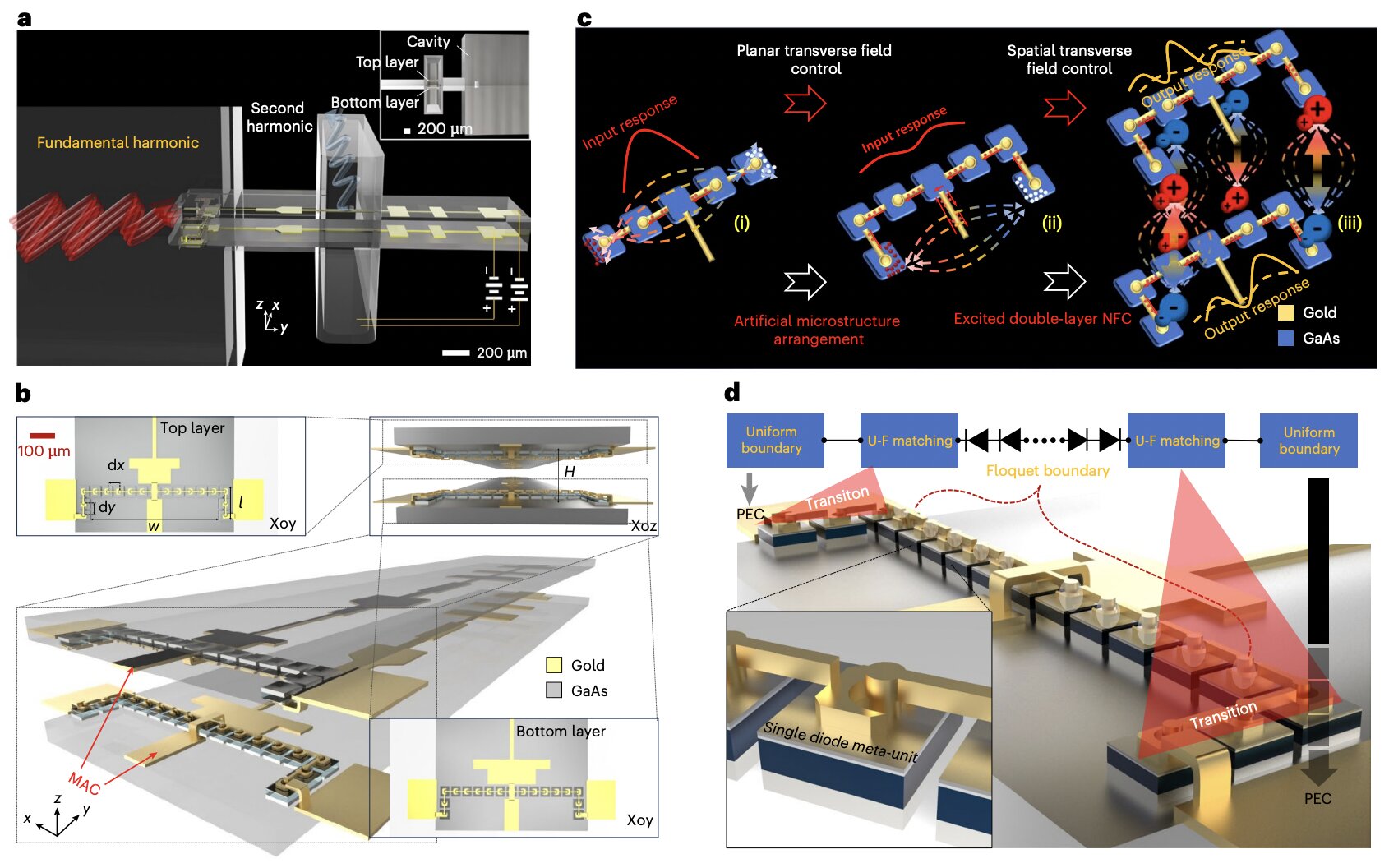
Recently, researchers at the University of Electronic Science and Technology introduced a new diode chain design that addresses this limitation by reshaping local electromagnetic fields for more uniform distribution along the chain. This asymmetric C-shaped diode chain demonstrated higher frequency multiplication efficiency compared to existing diode-based frequency multipliers.
The new design features diodes arranged in an asymmetric double-layer C-shaped chain to improve electromagnetic field flow between diodes. Simulations and lab tests confirmed its high terahertz frequency-doubling efficiency, making it a promising frequency multiplier.
The researchers’ innovative diode chain structure achieved a frequency doubling efficiency of 38%, with an output exceeding 300 mW at 170 GHz. This breakthrough could lead to the development of more compact terahertz wave transmitters, enabling advanced imaging, sensing, and communication systems.
Written by Ingrid Fadelli, edited by Gaby Clark, and fact-checked by Robert Egan. Your support keeps independent science journalism thriving. Consider donating for ad-free access.
© 2025 Science X Network













Celebrating the First iX3 Delivery at BMW’s Debrecen Factory

iPhone 12 Pro Max vs Samsung Note 20 Ultra / Huawei / Xiaomi / OnePlus Battery Life DRAIN Test.

Stealthy Malware: The Hidden Threat Within Telnyx PyPI Package

Harvest of Suspicion: Grave Seasons Murder Mystery Farming Sim Arrives in August

Tech Giants Clash: OpenAI Halts Sora as Meta Faces Legal Setback

Apple’s AI Playlist Playground: Where Music Goes to Die

Beyond the Stars: For All Mankind Season 5 Unveiled in Liminal Film Expose

Top 10 Fuel-Efficient Cars for Less Than $50,000

The Illusionists: Mastering Deception in Hacking and ArtForgery

EU Takes Action Against Instagram and Facebook for Violating Illegal Content Rules

Warning: Facebook Creators Face Monetization Loss for Stealing and Reposting Videos

Facebook Compliance: ICE-tracking Page Removed After US Government Intervention

Facebook’s New Look: A Blend of Instagram’s Style

Facebook and Instagram to Reduce Personalized Ads for European Users

InstaDub: Meta’s AI Translation Tool for Instagram Videos

Reclaim Your Account: Facebook and Instagram Launch New Hub for Account Recovery

Meta discontinues Messenger apps for Windows and macOS

Breaking Updates: Meta Connect 2025 Unveils Latest Developments
iPhone 12 Pro Max vs Samsung Note 20 Ultra / Huawei / Xiaomi / OnePlus Battery Life DRAIN Test.

The BEST Smartphone of 2020 🏆

The Self-Healing Smartphones!

Apple is not what it used to be.

Smartphones are Boring now.

The Fastest Android Phone Ever.

Unboxing the $122,000 Smartphone. 🤯

Are Linux Smartphones about to KILL Android?

15 Smartphone FAILS to ruin your day 😂
-
 Facebook5 months ago
EU Takes Action Against Instagram and Facebook for Violating Illegal Content Rules
-
 Facebook5 months ago
Warning: Facebook Creators Face Monetization Loss for Stealing and Reposting Videos
-
 Facebook5 months ago
Facebook Compliance: ICE-tracking Page Removed After US Government Intervention
-
 Facebook4 months ago
Facebook’s New Look: A Blend of Instagram’s Style
-
 Facebook4 months ago
Facebook and Instagram to Reduce Personalized Ads for European Users
-
 Facebook5 months ago
InstaDub: Meta’s AI Translation Tool for Instagram Videos
-
 Facebook4 months ago
Reclaim Your Account: Facebook and Instagram Launch New Hub for Account Recovery
-
 Apple5 months ago
Meta discontinues Messenger apps for Windows and macOS
