
AI
Simulating the Future: Creating Physical AI through Virtual Data Analysis

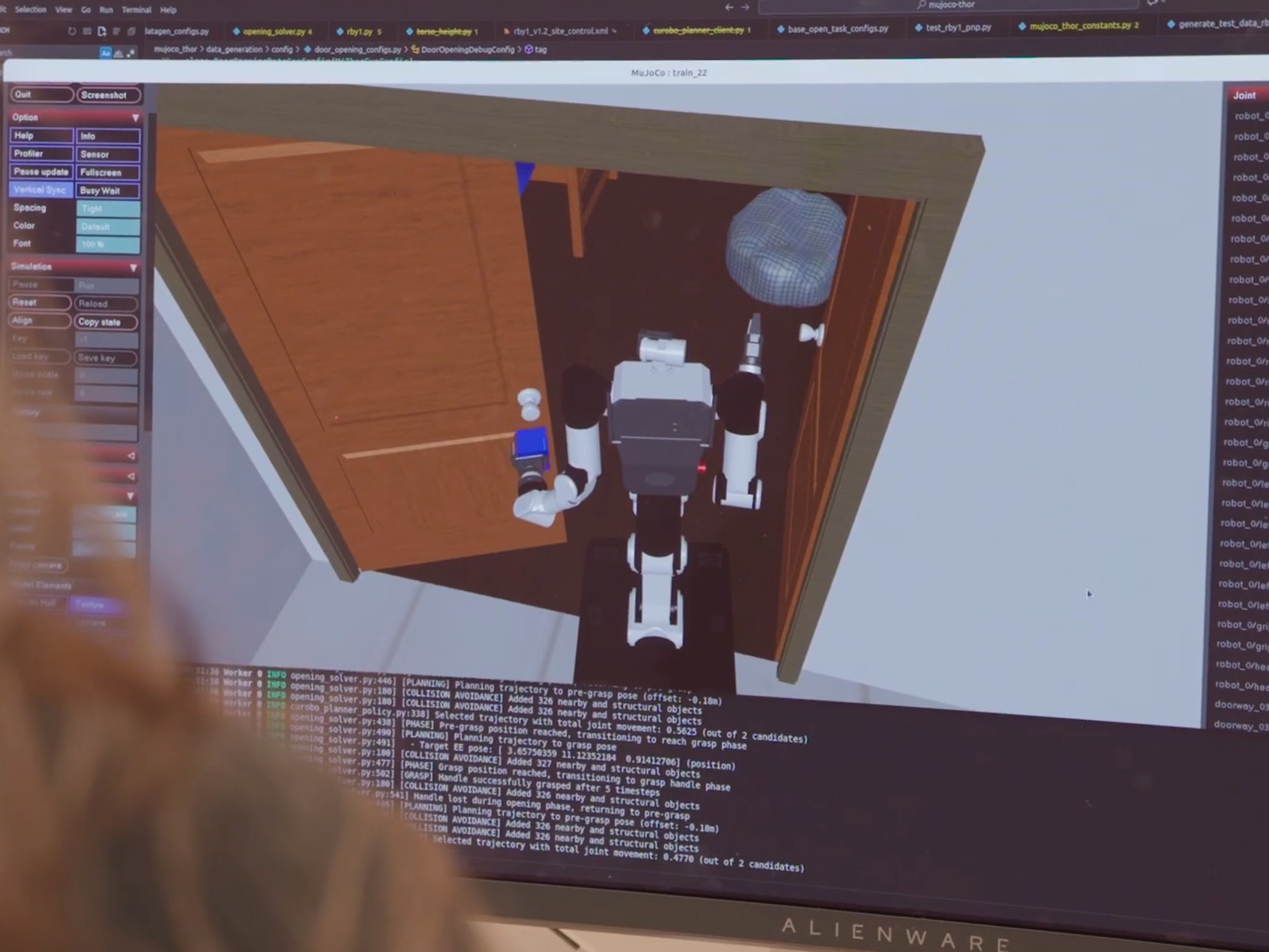
Driving the Development of Physical AI with Virtual Simulation Data
The realm of corporate environments is witnessing a significant transformation driven by virtual simulation data, particularly in the field of physical AI. Leading the charge in this evolution is Ai2’s MolmoBot initiative, which is paving the way for innovative advancements.
Traditionally, instructing hardware to interact with the physical world has been a costly and labor-intensive process, relying heavily on manually-collected demonstrations. Technology providers focusing on building versatile manipulation agents have typically emphasized extensive real-world training as the foundation for such systems.
Projects like DROID and Google DeepMind’s RT-1 exemplify the resource-intensive nature of real-world data collection, with tens of thousands of episodes and hours of human effort dedicated to training. This reliance on proprietary manual data gathering not only inflates research budgets but also limits capabilities to a select few well-resourced industrial laboratories.
Ali Farhadi, CEO of Ai2, emphasizes the organization’s mission to advance science and broaden the horizons of human discovery through AI. He envisions robotics as a crucial scientific tool that can expedite research processes and unlock new avenues of exploration. To achieve this vision, it is imperative to develop AI systems that can adapt to real-world scenarios and foster collaborative innovation within the global research community.
The researchers at the Allen Institute for AI (Ai2) are taking a novel economic approach with MolmoBot, an open robotic manipulation model suite trained exclusively on synthetic data. By leveraging procedural generation within MolmoSpaces, the team circumvents the need for human teleoperation.
The MolmoBot-Data dataset, comprising 1.8 million expert manipulation trajectories, is a testament to the effectiveness of this synthetic training approach. By combining the MuJoCo physics engine with domain randomization techniques, the dataset features a diverse range of object interactions, viewpoints, lighting conditions, and dynamics.
Ranjay Krishna, Director of the PRIOR team at Ai2, highlights the team’s strategy of expanding the diversity of simulated environments to bridge the sim-to-real gap. Rather than relying on more real-world data, Ai2’s approach focuses on creating richer virtual environments to enhance robotic learning capabilities.
Generating Virtual Simulation Data for Physical AI
Using advanced technology like 100 Nvidia A100 GPUs, the MolmoBot pipeline efficiently generates a high volume of episodes, providing over 130 hours of robot experience per GPU-hour. This accelerated data throughput significantly boosts project ROI by expediting deployment timelines.
Compared to traditional real-world data collection methods, this approach offers nearly four times the data throughput, thereby enhancing the efficiency of AI training processes.
The MolmoBot suite encompasses three distinct policy classes evaluated on two platforms: the Rainbow Robotics RB-Y1 mobile manipulator and the Franka FR3 tabletop arm. The primary model, built on a Molmo2 vision-language architecture, processes RGB observations and language instructions to drive actions.
Hardware Flexibility with Ai2’s MolmoBot
For edge computing environments with resource constraints, Ai2 provides MolmoBot-SPOC, a lightweight transformer policy with fewer parameters. Additionally, MolmoBot-Pi0, based on the PaliGemma backbone, enables seamless performance comparisons with Physical Intelligence’s π0 model.
During physical testing, these policies showcase zero-shot transfer capabilities to real-world tasks involving unfamiliar objects and environments without the need for fine-tuning.
In tabletop pick-and-place scenarios, the primary MolmoBot model achieves an impressive success rate of 79.2%. This outperforms traditional models trained on extensive real-world data, highlighting the efficacy of Ai2’s approach. Mobile manipulation tasks such as approaching, grasping, and manipulating doors are executed with precision.
By offering diverse policy architectures, Ai2 enables organizations to integrate robust physical AI systems without being tied to a single vendor or extensive data collection infrastructure. This flexibility promotes innovation and scalability in AI applications.
The open release of the complete MolmoBot stack, including training data, generation pipelines, and model architectures, empowers users to audit and adapt the system internally. This openness fosters collaboration and knowledge sharing in the realm of physical AI development.
Ali Farhadi emphasizes the importance of shared infrastructure and collaborative research in advancing physical AI. By providing open tools and resources, Ai2 aims to catalyze progress and innovation in the field.
For more insights into AI and big data, consider attending the AI & Big Data Expo events hosted by TechEx in various global locations.
AI News is brought to you by TechForge Media. Explore upcoming enterprise technology events and webinars here.
Transform the following:
“Life is like a rollercoaster, full of ups and downs.”
Life resembles a rollercoaster, complete with peaks and valleys.











Stryker’s Response to Cyber Attack: How the Medtech Giant is Strengthening Cybersecurity Measures

Embark on a Wild Adventure: Sign up for the Grow Wild Playtest and Learn About Real-Life Rewilding

Lost Your Smartphone? Here’s How to Recover Your Accounts

The Ripple Effect: How Payment Delays Can Cripple Your Business

Simulating the Future: Creating Physical AI through Virtual Data Analysis

Clear Temptations: A Review of the Nothing Phone (4a)

Discovering the Shades of Blush and Indigo

Revolutionizing Safety: Groundbreaking Collaboration Brings Smart Robots to Hazardous Work Environments

2026 Zeekr 7X Black Special Edition: The Ultimate Model Y Rival with a Sleek Blacked-Out Look

EU Takes Action Against Instagram and Facebook for Violating Illegal Content Rules

Warning: Facebook Creators Face Monetization Loss for Stealing and Reposting Videos

Facebook Compliance: ICE-tracking Page Removed After US Government Intervention

Facebook’s New Look: A Blend of Instagram’s Style

InstaDub: Meta’s AI Translation Tool for Instagram Videos

Facebook and Instagram to Reduce Personalized Ads for European Users

Reclaim Your Account: Facebook and Instagram Launch New Hub for Account Recovery

Meta discontinues Messenger apps for Windows and macOS

Breaking Updates: Meta Connect 2025 Unveils Latest Developments

The Thinnest Smartphone in the World.

Mi 11 Ultra Review – Xiaomi just KILLED Samsung!?

15 Smartphone Gadgets that’ll SHOCK you! ⚠️

The $200,000 Smartphone Unboxing 💀

20 Next-Level Inventions you didn’t think were Possible.

How THIS instagram story kills your phone.

Zenfone 8 – The most boring INCREDIBLE phone ever.

The BEST Smartphones of 2021! (Mid Year)

I bought the SMALLEST Tech in the world.
-
 Facebook5 months ago
EU Takes Action Against Instagram and Facebook for Violating Illegal Content Rules
-
 Facebook5 months ago
Warning: Facebook Creators Face Monetization Loss for Stealing and Reposting Videos
-
 Facebook5 months ago
Facebook Compliance: ICE-tracking Page Removed After US Government Intervention
-
 Facebook3 months ago
Facebook’s New Look: A Blend of Instagram’s Style
-
 Facebook5 months ago
InstaDub: Meta’s AI Translation Tool for Instagram Videos
-
 Facebook3 months ago
Facebook and Instagram to Reduce Personalized Ads for European Users
-
 Facebook3 months ago
Reclaim Your Account: Facebook and Instagram Launch New Hub for Account Recovery
-
 Apple5 months ago
Meta discontinues Messenger apps for Windows and macOS
