
Security
Stealthy Cyber Threat: Unveiling the Malicious MoltBot’s Password-Stealing Tactics


Over 230 Malicious Skills Target OpenClaw Users with Data-Stealing Malware
Recently, more than 230 malicious packages have surfaced for OpenClaw, an AI assistant previously known as Moltbot and ClawdBot. These packages, known as skills, are posing as legitimate tools but are actually delivering malware designed to extract sensitive data such as API keys, wallet private keys, SSH credentials, and browser passwords.
Originally named ClawdBot and undergoing a rapid rebranding to Moltbot and now OpenClaw within a month, this open-source AI assistant is designed to operate locally with persistent memory and integration capabilities with various resources. However, improper configuration of the assistant can introduce significant security vulnerabilities.
Skills are add-on plugins for OpenClaw that enhance its functionality or provide specific instructions for specialized tasks. However, security researcher Jamieson O’Reilly recently highlighted the presence of numerous misconfigured OpenClaw admin interfaces exposed on the public web.
Between January 27th and February 1st, a significant number of malicious skills were published on ClawHub, the official registry for the assistant, and on GitHub. These skills masquerade as legitimate utilities like cryptocurrency trading automation and financial tools but secretly inject information-stealing malware onto users’ systems.
According to a report from OpenSourceMalware, a large-scale campaign is currently leveraging these skills to distribute information-stealing malware to OpenClaw users. Many of these malicious skills are identical clones with randomized names, with some achieving widespread popularity and being downloaded thousands of times.
Each deceptive skill comes with detailed documentation to appear legitimate, often referencing a supposed essential tool called ‘AuthTool.’ However, AuthTool is, in reality, a malware delivery mechanism disguised as a necessary component for the skill to function correctly.

Source OpenSourceMalware
Operating systems like macOS and Windows are both targeted by this malware. On macOS, the malware manifests as a variant of NovaStealer, capable of bypassing Gatekeeper by removing quarantine attributes and gaining broad file system read access. It targets various sensitive data, including cryptocurrency keys, browser passwords, SSH credentials, and more.
Another report from Koi Security identified 341 malicious skills on ClawHub, attributing them to a single malicious campaign. Additionally, they found 29 typosquatting instances targeting common misspellings of ClawHub’s name.
To assist users in staying safe, Koi Security released a free online scanner where users can input a skill’s URL to receive a safety report.
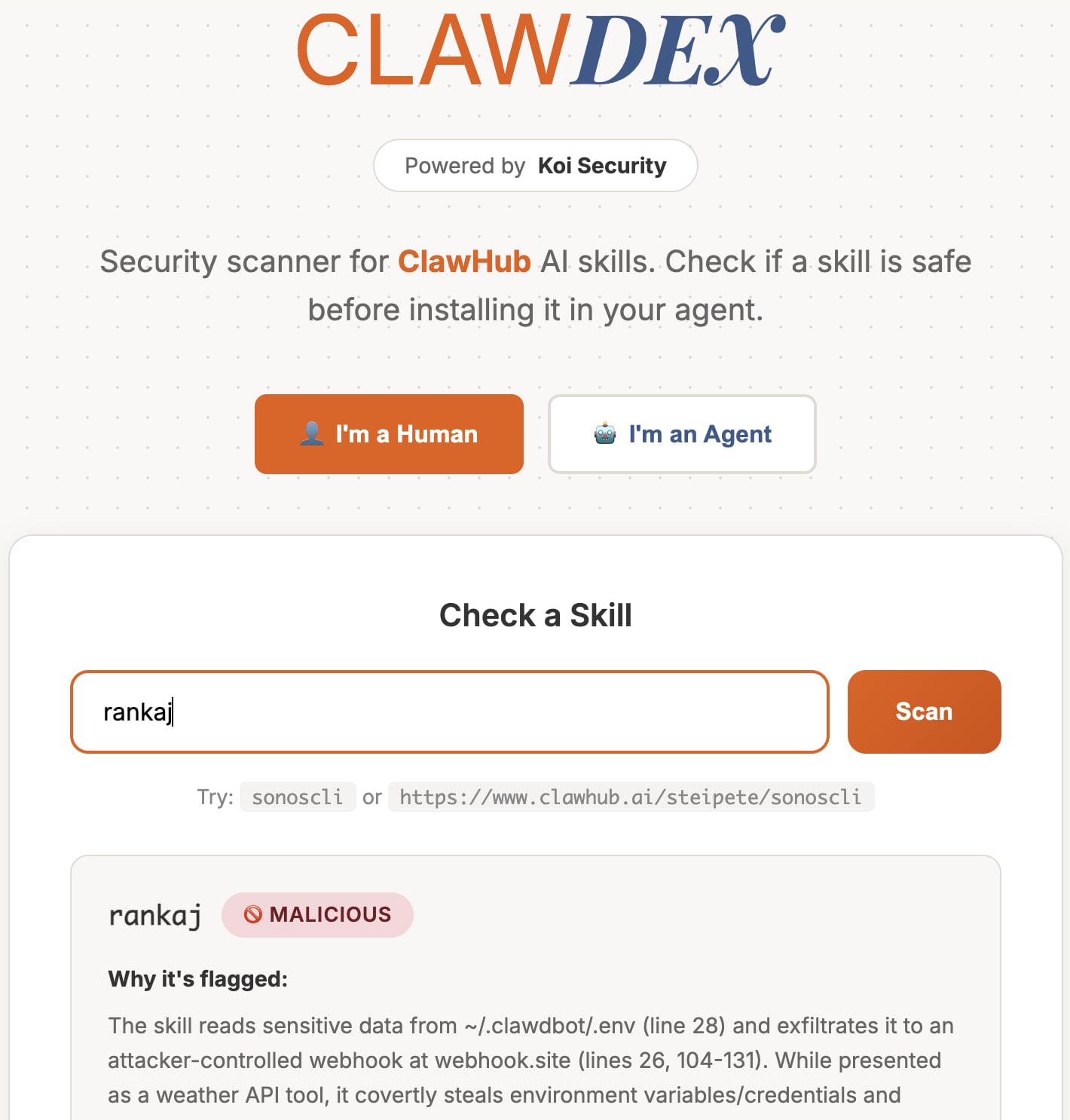
Source: Koi Security
Peter Steinberger, the creator of OpenClaw, acknowledged the challenge of reviewing the vast number of skill submissions received by the platform, emphasizing the user’s responsibility to verify the safety of their skills before deployment.
Given OpenClaw’s extensive system access, users are advised to implement a multi-layered security approach, including isolating the AI assistant in a virtual machine, restricting its permissions, and securing remote access.

Modern IT infrastructure evolves rapidly beyond manual workflows. Learn how to reduce delays, enhance reliability, and build intelligent workflows with the Tines guide.













DON’T buy a Screen Protector before watching this.

Exploiting Vulnerable Drivers: How EDR Killers Use BYOVD to Disable Security

Alphabet’s X Unveils Innovative Spinout Targeting Costly Bureaucratic Challenges

Lawsuit: Halide co-founder accuses Sebastiaan de With of code theft for Apple

Previewing the Next Level: Apple Unveils iOS 26.4 RC for iPhone with Exciting New Features

Revamped Design: BMW’s Modern Makeover for the i3 Sedan

GitHub Actions Exploited in Trivy Vulnerability Scanner Breach, Infostealer Unleashed

Minecraft Dungeons II: The Battle Continues

Feeding Frenzy: How AI Startups are Revolutionizing the Venture Industry with Impressive Returns

EU Takes Action Against Instagram and Facebook for Violating Illegal Content Rules

Warning: Facebook Creators Face Monetization Loss for Stealing and Reposting Videos

Facebook Compliance: ICE-tracking Page Removed After US Government Intervention

Facebook’s New Look: A Blend of Instagram’s Style

Facebook and Instagram to Reduce Personalized Ads for European Users

InstaDub: Meta’s AI Translation Tool for Instagram Videos

Reclaim Your Account: Facebook and Instagram Launch New Hub for Account Recovery

Meta discontinues Messenger apps for Windows and macOS

Breaking Updates: Meta Connect 2025 Unveils Latest Developments
DON’T buy a Screen Protector before watching this.

Beware of Fake Reviewers! ⚠️

Xiaomi Mi 11 Unboxing & Review.

The Galaxy S21 Ultra is Better than you think.

Samsung Galaxy S21 Ultra vs iPhone 12 Pro Max Camera Test Comparison.

Samsung S21 Ultra vs iPhone Battery Life Test!

The Truth about Xiaomi “Air Charging”

DON’T buy this Smartphone.

Galaxy S21 Ultra – Exynos vs Snapdragon.
-
 Facebook5 months ago
EU Takes Action Against Instagram and Facebook for Violating Illegal Content Rules
-
 Facebook5 months ago
Warning: Facebook Creators Face Monetization Loss for Stealing and Reposting Videos
-
 Facebook5 months ago
Facebook Compliance: ICE-tracking Page Removed After US Government Intervention
-
 Facebook3 months ago
Facebook’s New Look: A Blend of Instagram’s Style
-
 Facebook3 months ago
Facebook and Instagram to Reduce Personalized Ads for European Users
-
 Facebook5 months ago
InstaDub: Meta’s AI Translation Tool for Instagram Videos
-
 Facebook4 months ago
Reclaim Your Account: Facebook and Instagram Launch New Hub for Account Recovery
-
 Apple5 months ago
Meta discontinues Messenger apps for Windows and macOS
