
Security
Stealthy Tactics: Ransomware Gangs Utilize Shanya EXE Packer to Evade Detection


Ransomware Gangs Embrace Shanya EXE Packer to Conceal EDR Killer Payloads
Numerous ransomware groups have turned to a packer-as-a-service platform known as Shanya to facilitate the deployment of payloads that incapacitate endpoint detection and response (EDR) solutions on targeted systems.
Packer services offer cybercriminals specialized tools to package their malicious payloads in a manner that obscures the malicious code, enabling them to evade detection by most conventional security tools and antivirus engines.
The Shanya packer operation surfaced in late 2024 and has since gained significant traction, with malware instances utilizing it detected in various countries including Tunisia, the UAE, Costa Rica, Nigeria, and Pakistan, according to telemetry data from Sophos Security.
Confirmed ransomware groups leveraging the service include Medusa, Qilin, Crytox, and Akira, with the latter being the most frequent user of the packer service.

Source: Sophos
Understanding the Functionality of Shanya
Threat actors submit their malicious payloads to Shanya, which in turn provides a “packed” version with a custom wrapper utilizing encryption and compression techniques.
The service emphasizes the uniqueness of the resulting payloads, highlighting features such as “non-standard module loading into memory” and “wrapper over the system loaderStub uniqueization,” ensuring each customer receives a relatively unique stub with a distinct encryption algorithm upon purchase.

Source: Sophos
The payload is inserted into a memory-mapped copy of the Windows DLL file ‘shell32.dll,’ which appears valid and normal but has its header and .text section overwritten with the decrypted payload.
While the payload remains encrypted within the packed file, it is decrypted and decompressed entirely in memory and then inserted into the ‘shell32.dll’ copy file without touching the disk.
Sophos researchers discovered that Shanya conducts checks for endpoint detection and response (EDR) solutions by invoking the ‘RtlDeleteFunctionTable’ function in an invalid context, triggering an unhandled exception or crash to disrupt automated analysis before the payload’s full execution.
Disabling Endpoint Detection and Response Solutions
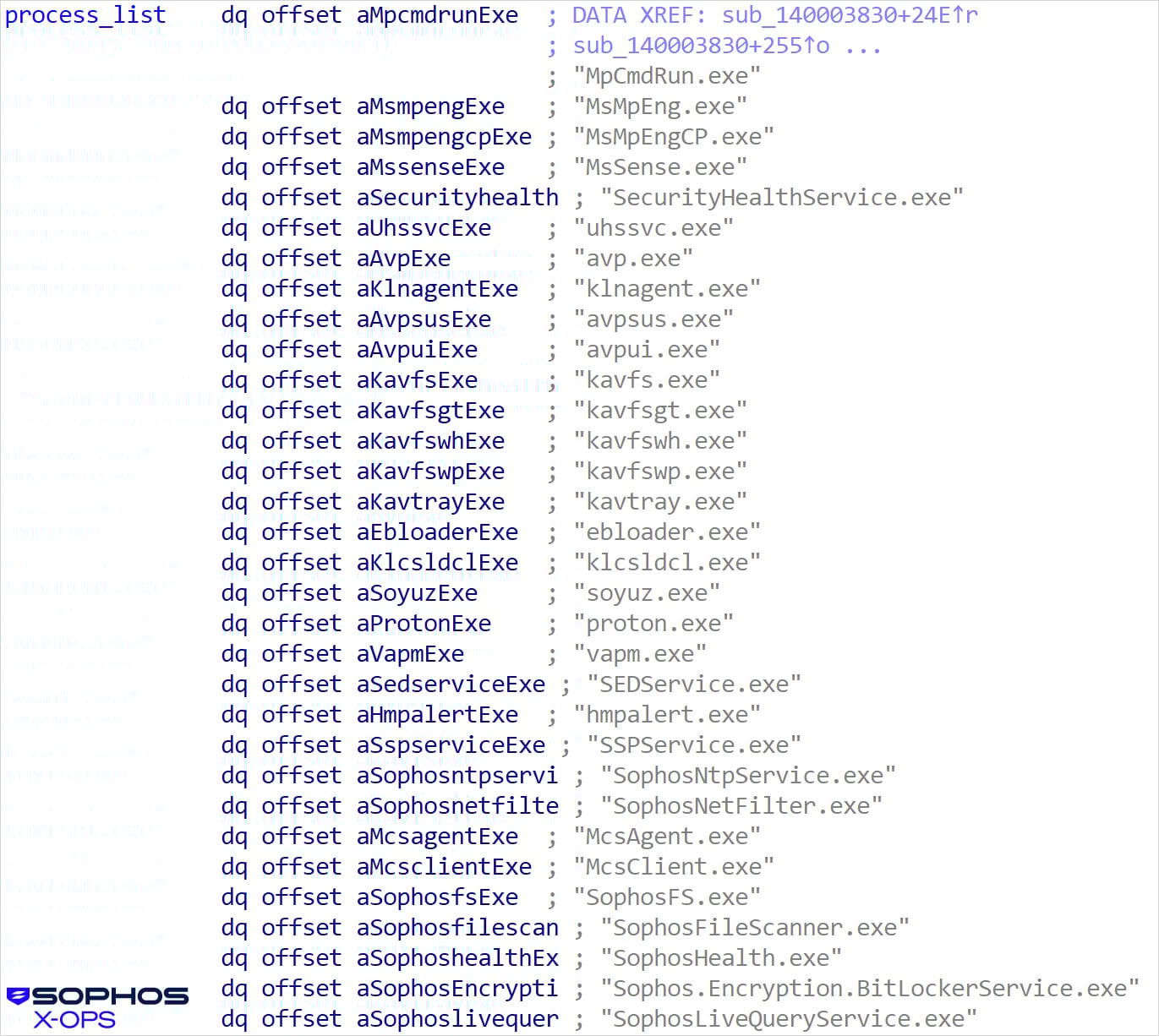
Ransomware groups typically aim to disable EDR tools on the target system before proceeding with data theft and encryption phases of the attack.
The execution commonly involves DLL side-loading, combining a legitimate Windows executable like ‘consent.exe’ with a Shanya-packed malicious DLL such as msimg32.dll, version.dll, rtworkq.dll, or wmsgapi.dll.
According to Sophos’ analysis, the EDR killer drops two drivers: the legitimately signed ThrottleStop.sys (rwdrv.sys) from TechPowerUp, which contains a vulnerability allowing arbitrary kernel memory writing, and the unsigned hlpdrv.sys.
The signed driver facilitates privilege escalation, while hlpdrv.sys disables security products based on commands received from user mode.
Source: Sophos
In addition to ransomware operators focusing on EDR disabling, Sophos has observed recent ClickFix campaigns utilizing the Shanya service to package the CastleRAT malware.
Sophos highlights that ransomware groups often rely on packer services to prepare EDR killers for deployment without detection.
The researchers offer a detailed technical analysis of some of the payloads packed with Shanya, along with indicators of compromise (IoCs) linked to Shanya-powered campaigns.













Exclusive Look: The 2027 Chevrolet Corvette Grand Sport Unleashed at Sebring

DON’T buy a Screen Protector before watching this.

Exploiting Vulnerable Drivers: How EDR Killers Use BYOVD to Disable Security

Alphabet’s X Unveils Innovative Spinout Targeting Costly Bureaucratic Challenges

Lawsuit: Halide co-founder accuses Sebastiaan de With of code theft for Apple

Previewing the Next Level: Apple Unveils iOS 26.4 RC for iPhone with Exciting New Features

Revamped Design: BMW’s Modern Makeover for the i3 Sedan

GitHub Actions Exploited in Trivy Vulnerability Scanner Breach, Infostealer Unleashed

Minecraft Dungeons II: The Battle Continues

EU Takes Action Against Instagram and Facebook for Violating Illegal Content Rules

Warning: Facebook Creators Face Monetization Loss for Stealing and Reposting Videos

Facebook Compliance: ICE-tracking Page Removed After US Government Intervention

Facebook’s New Look: A Blend of Instagram’s Style

Facebook and Instagram to Reduce Personalized Ads for European Users

InstaDub: Meta’s AI Translation Tool for Instagram Videos

Reclaim Your Account: Facebook and Instagram Launch New Hub for Account Recovery

Meta discontinues Messenger apps for Windows and macOS

Breaking Updates: Meta Connect 2025 Unveils Latest Developments
DON’T buy a Screen Protector before watching this.

Beware of Fake Reviewers! ⚠️

Xiaomi Mi 11 Unboxing & Review.

The Galaxy S21 Ultra is Better than you think.

Samsung Galaxy S21 Ultra vs iPhone 12 Pro Max Camera Test Comparison.

Samsung S21 Ultra vs iPhone Battery Life Test!

The Truth about Xiaomi “Air Charging”

DON’T buy this Smartphone.

Galaxy S21 Ultra – Exynos vs Snapdragon.
-
 Facebook5 months ago
EU Takes Action Against Instagram and Facebook for Violating Illegal Content Rules
-
 Facebook5 months ago
Warning: Facebook Creators Face Monetization Loss for Stealing and Reposting Videos
-
 Facebook5 months ago
Facebook Compliance: ICE-tracking Page Removed After US Government Intervention
-
 Facebook3 months ago
Facebook’s New Look: A Blend of Instagram’s Style
-
 Facebook3 months ago
Facebook and Instagram to Reduce Personalized Ads for European Users
-
 Facebook5 months ago
InstaDub: Meta’s AI Translation Tool for Instagram Videos
-
 Facebook4 months ago
Reclaim Your Account: Facebook and Instagram Launch New Hub for Account Recovery
-
 Apple5 months ago
Meta discontinues Messenger apps for Windows and macOS
