
Cars
Taking Charge: Insights from Responsibility Days 2025

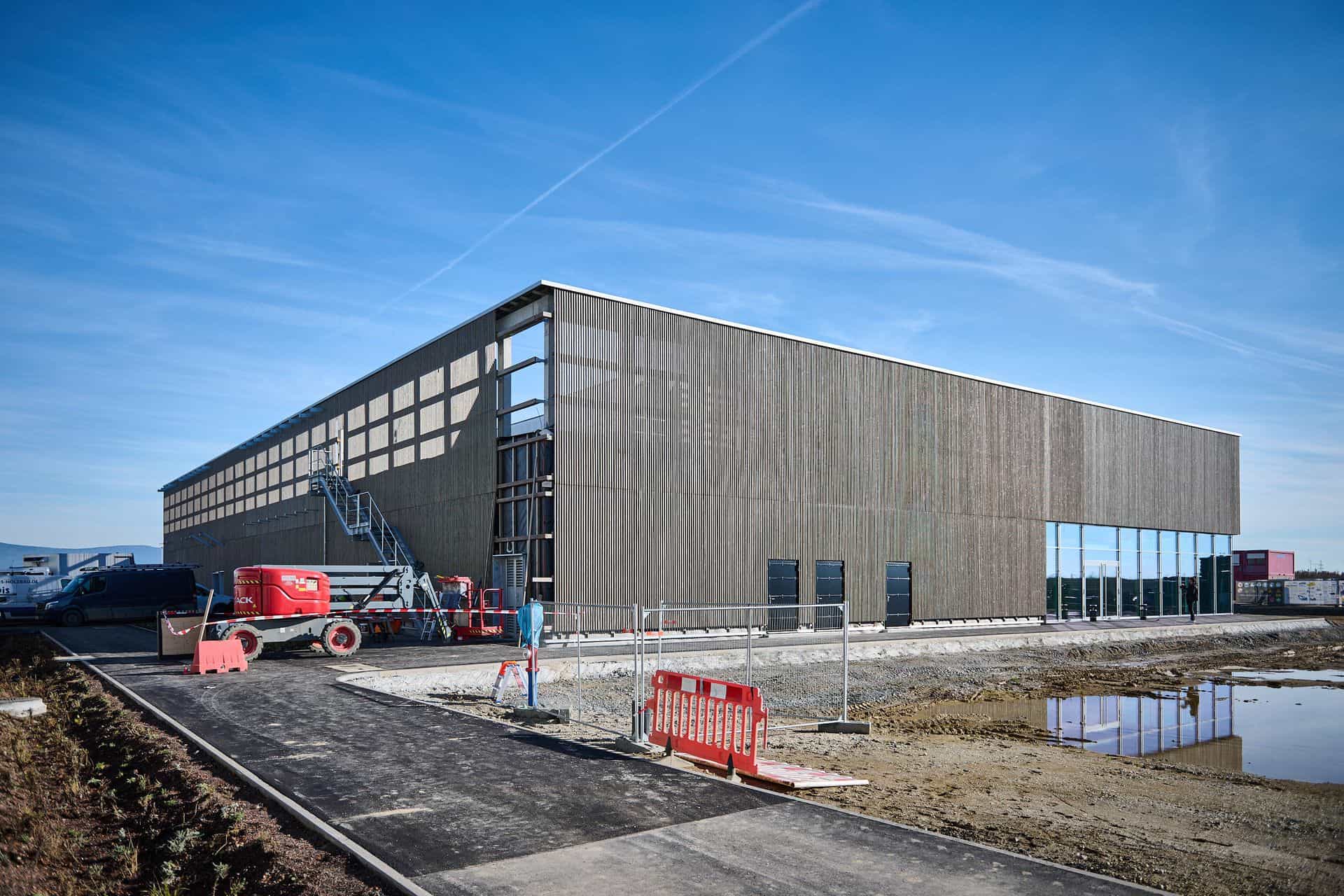
Day 2 of BMW Responsibility Days 2025 shifted from strategic presentations to the operational reality behind the company’s next phase of electrification. The tour took us from Munich to Straßkirchen and Irlbach—two small communities in Lower Bavaria where BMW is building one of its most important facilities—before continuing to Landshut to talk about supplier readiness, AI integration, and more.
A High-Voltage Battery Plant in Rural Bavaria

The new Irlbach–Straßkirchen plant is situated in the middle of flat Gäuboden farmland, directly adjacent to a village of only a few thousand residents. Despite the rural setting, the scale is unmistakably industrial: a 500-meter-long, 300-meter-wide assembly hall, an energy center, logistics corridors, and a newly built fire station already equipped with six vehicles. Altogether, the site spans 105 hectares, with dedicated inbound and outbound logistics zones, new road connections, and a large-scale parking and loading infrastructure sized for over 1,000 employees and intensive daily truck movements.
By late 2026, the site is expected to produce 1,000 sixth-generation high-voltage battery packs per day, supplying BMW’s Munich, Dingolfing, and Regensburg plants as Neue Klasse production ramps up. At full workforce levels by 2028, the plant will employ around 1,600 people, supported by 540 truck movements per weekday, a 23,000 m² inbound storage facility, and a 32,500 m² supply center.

The production process follows BMW’s six-step Gen6 battery assembly logic—cell inspection, clustering, welding, foaming and sealing, energy master assembly, and end-of-line testing—supported by digital twins of all major machinery and real-time quality control.
Construction progress reflects an unusually compressed timeline for Germany. After a public permitting process that generated more than 6,000 pages of documentation, BMW received approval in April 2024. Just 19 months later, the core structures are standing, machinery is being installed, and more than 1,000 workers enter the site daily.
While BMW executives have referred to this rapid pace as “Bavarian speed,” the comparison often made internally is China—where such industrial projects can move even faster. For Bavaria, this is as close as it gets. The company now openly refers to Straßkirchen as a flagship for its iFACTORY principles: lean, green, digital, and people-focused.
Local Politics and a Difficult Referendum

As expected with large-scale industrial projects in Germany, this plant was not pushed through quietly. A citizen group mobilized significant local resistance. Concerns centered on land consumption, traffic, noise, and the fear that a village known for agriculture would be transformed into an industrial corridor.
Their efforts triggered a referendum in 2023. Turnout reached 75 percent, and two-thirds of voters ultimately approved the BMW project. The campaign left social marks that are still visible: some banners remain, and some residents continue to oppose the development. But the economic impact is undeniable.
Straßkirchen’s municipal budget has tripled. Long-requested infrastructure investments—including a bypass road—are now moving forward. Childcare funding, sewage upgrades, and several local businesses have benefited directly from the plant. The mayor openly admits the project has “changed the trajectory of the municipality.”
Several board members acknowledged that BMW had to conduct an unusually intense charm offensive: information pavilions, public Q&A sessions, and direct conversations in local restaurants like “Jedermann,” where executives answered questions late into the evening. The company made concessions on traffic routing, water management, and environmental compensation zones, including 500 newly planted trees and more than 3,000 bushes.
In short: the factory has created winners and dissenters, but it has also brought a scale of economic activity the region has not seen before.
Technical Foundations: BMW’s Sixth-Generation Battery Architecture

Inside the main hall, BMW is installing production equipment for its sixth-generation battery packs. These will use 46 mm cylindrical cells supplied by CATL and EVE from Hungary, reflecting a mixed sourcing strategy influenced by both cost and geopolitical considerations.
The shift from prismatic to cylindrical cells is central to BMW’s next EV architecture. The new batteries promise:
- 30% more range,
- 30% faster charging, and
- up to 50% lower production costs compared with current packs.
At cell level, energy density improves by around 20%, while pack-level costs fall thanks to a move toward cell-to-pack construction, eliminating modules entirely. The Gen6 pack also supports BMW’s upcoming pack-to-open-body integration, where the vehicle structure becomes an active element of the battery housing.












Cyber Warfare: The Battlefront of the Digital Age

Monster Hunter Stories 3: The Challenge of Twisted Reflection

Revolutionizing Cash-Pay Clinic Prescribing: VITL Secures $7.5M Amid GLP-1 Boom

Balancing Act: The Decision to Shut Down Sora

Exclusive Arrival: Cupra Born VZ Lands in Australia – But There’s a Twist!

iPhone 12 Pro Max vs Samsung Note 20 Ultra / Huawei Mate 40 Pro Camera Test Comparison.

ClickFix: The New Threat to macOS Security

Kingdom Come: Deliverance 2 – The Rise of Artificial Intelligence

Elon Musk’s Latest Venture Faces Uncertainty as Last Co-Founder Departs xAI

EU Takes Action Against Instagram and Facebook for Violating Illegal Content Rules

Warning: Facebook Creators Face Monetization Loss for Stealing and Reposting Videos

Facebook Compliance: ICE-tracking Page Removed After US Government Intervention

Facebook’s New Look: A Blend of Instagram’s Style

Facebook and Instagram to Reduce Personalized Ads for European Users

InstaDub: Meta’s AI Translation Tool for Instagram Videos

Reclaim Your Account: Facebook and Instagram Launch New Hub for Account Recovery

Meta discontinues Messenger apps for Windows and macOS

Breaking Updates: Meta Connect 2025 Unveils Latest Developments
iPhone 12 Pro Max vs Samsung Note 20 Ultra / Huawei Mate 40 Pro Camera Test Comparison.

iPhone 12 Pro Max vs Samsung Note 20 Ultra / Huawei / Xiaomi / OnePlus Battery Life DRAIN Test.

The BEST Smartphone of 2020 🏆

The Self-Healing Smartphones!

Apple is not what it used to be.

Smartphones are Boring now.

The Fastest Android Phone Ever.

Unboxing the $122,000 Smartphone. 🤯

Are Linux Smartphones about to KILL Android?
-
 Facebook5 months ago
EU Takes Action Against Instagram and Facebook for Violating Illegal Content Rules
-
 Facebook5 months ago
Warning: Facebook Creators Face Monetization Loss for Stealing and Reposting Videos
-
 Facebook5 months ago
Facebook Compliance: ICE-tracking Page Removed After US Government Intervention
-
 Facebook4 months ago
Facebook’s New Look: A Blend of Instagram’s Style
-
 Facebook4 months ago
Facebook and Instagram to Reduce Personalized Ads for European Users
-
 Facebook6 months ago
InstaDub: Meta’s AI Translation Tool for Instagram Videos
-
 Facebook4 months ago
Reclaim Your Account: Facebook and Instagram Launch New Hub for Account Recovery
-
 Apple5 months ago
Meta discontinues Messenger apps for Windows and macOS
