
Security
The Future of IT Security: Embracing Cloud-native Patching


Revolutionizing Endpoint Management: The Shift from Legacy Tools to Cloud-Native Patching
Written by: Gene Moody, Field CTO at Action1
In the realm of IT leadership, the signs of change have been slowly emerging: devices falling out of compliance, patch cycles stretching beyond acceptable thresholds, and IT administrators grappling with the adaptation of on-premises tools to accommodate a hybrid workforce.
Once revered as the pinnacle of Windows endpoint management, System Center Configuration Manager (SCCM) has dutifully served organizations since the 1990s. However, as workforces dispersed and cyber threats escalated, the traditional model it was built upon—reliant on local networks, VPNs, and servers—transformed from a cornerstone into a bottleneck.
The advent of hybrid work has ushered in a new era, yet many teams persist with architectures that rely on a perimeter that no longer holds.
1. Overcoming the VPN Dilemma: The Inadequacy of Legacy Tools
The contemporary hybrid workforce lays bare the limitations of systems hinged on corporate network connectivity. SCCM and Windows Server Update Services (WSUS) necessitate endpoints to connect via LAN or VPN.
Consequently, if a remote device fails to establish a connection, it remains unpatched—an all too common scenario for many organizations.
One enterprise disclosed that, before embracing modernization, a third of remote endpoints languished for 30 days or more without receiving a single update due to inconsistent VPN usage.
Essentially, SCCM and WSUS are contingent on VPN connectivity. When users disconnect, so does your patch compliance.
2. The Impending Obsolescence of WSUS
Exacerbating the situation is the deprecation of WSUS, the engine underpinning SCCM’s patch orchestration, which has now been officially phased out. Bereft of innovation, lacking modern security integration, and plagued by a growing list of maintenance challenges.
IT administrators continue to grapple with WSUS re-indexing issues, database corruption, and synchronization failures. A breakdown in WSUS operations halts remedial actions altogether, heightening exposure at the most inopportune moment.
Essentially, SCCM’s reliance on WSUS shackles organizations to a fragile, end-of-life patching system.
3. Embracing Cloud-Native Patch Management: Tailored for the Hybrid Work Environment
Cloud-native patch management represents a paradigm shift in the equation.
Unlike antiquated systems, Software as a Service (SaaS) tools like Action1 operate independently of the corporate network. Endpoints securely check-in via the internet, irrespective of user location—be it home Wi-Fi, hotel broadband, or the office network.
Patches follow the user, not the VPN. Content is sourced from global delivery networks that eliminate congestion and the fragility of on-premises repositories. The outcome: consistent patching, reduced latency, and fewer blind spots.
Essentially, cloud-native patching eradicates the VPN bottleneck, ensuring updates reach devices wherever they are situated.

4. Tangible Outcomes in the Real World
Organizations that modernize their patching practices witness quantifiable and replicable benefits:
- One mid-sized enterprise slashed its time to achieve 95% patch compliance from 12 days to a mere 48 hours following the transition from SCCM + WSUS.
- Another client halved their vulnerability window by eliminating VPN dependency from the patching process.
Shorter patch cycles directly diminish the likelihood of breaches, reduce cyber-insurance premiums, and enhance compliance metrics. Concurrently, eliminating reliance on VPNs ensures remote systems remain segregated from critical infrastructure while upholding complete control.
Essentially, modern patching expedites remediation, mitigates risk, and fortifies compliance.
5. The Price of Clinging to Legacy Systems
The expense of maintaining SCCM and WSUS is not attributed to licensing fees but rather the ecosystem around them.
Servers. SQL databases. Distribution points. VPN troubleshooting. Constant purging of WSUS metadata or resolving stuck clients.
Each layer consumes budget and administrative hours that could be better allocated to enhancing security protocols rather than upkeeping infrastructure. Cloud-native solutions alleviate most of this overhead burden. No on-premises servers. No synchronization glitches. No more waiting for machines to reconnect to receive updates.
Ultimately, legacy patching tools may appear cost-effective upfront, but their hidden costs accumulate rapidly.
6. Harmonizing IT and Security Objectives
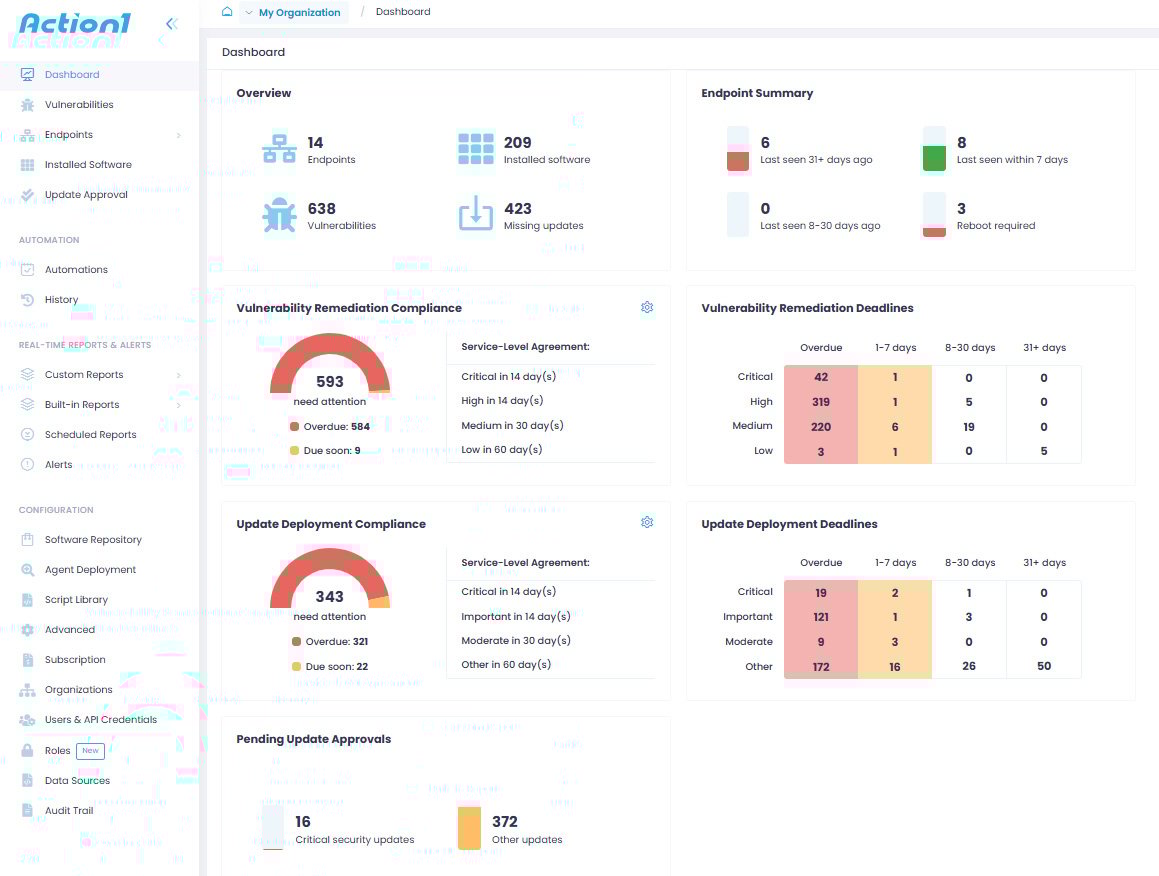
Contemporary Chief Information Security Officers (CISOs) and IT directors crave tangible outcomes, not abstract sophistication. Action1 furnishes automation, real-time visibility, and comprehensive coverage across dispersed environments to deliver these outcomes.
By obviating the necessity for VPNs or internal networks, patch compliance becomes foreseeable. Timely endpoint updates lead to enhancements across all facets of your security framework—diminished vulnerability windows, expedited incident response, and seamless audit preparedness.
Ultimately, predictable patching yields predictable security outcomes.
7. Anticipating What Lies Ahead
Hybrid work has transcended the realm of exception to become the norm. Yet, many organizations remain reliant on architectures tailored for an era where every endpoint resided behind a firewall.
While SCCM and WSUS fade into obsolescence, the risks persist. Cloud-native solutions like Action1 have been purpose-built for contemporary connectivity, automation, and compliance oversight.
In a landscape defined by perpetual flux, organizations that prosper are those that modernize proactively, rather than reactively following an incident.
Ultimately, the transition from SCCM and WSUS to cloud-native patching embodies a risk-mitigation strategy, not merely an upgrade.
The Key Insight
For IT leaders contemplating the next phase in endpoint management strategy, the message is resoundingly clear: the hybrid workforce is an established reality. Legacy architectures tethered to on-premises boundaries and outdated patching mechanisms struggle to keep pace.
Cloud-native, automated solutions like Action1 are already remedying these challenges, reducing overhead, enhancing compliance, and bolstering security postures for distributed organizations worldwide.
Experience the efficacy of modern patch management with a complimentary trial today.
Presented and sponsored by Action1.












if smartphone commercials were honest.

Unprotected: The Vulnerability of Over 14,000 F5 BIG-IP APM Instances to Remote Code Execution Attacks

Garry’s Mod 2: The Evolution of Creativity

Exploring the Benefits and Drawbacks of Android Desktop Mode: A Comprehensive Review

The Future of Sales: Essential Strategies for Competitive Teams in 2026

Avatar: The Last Airbender Season 2: Exciting Updates on Cast and Release Date

Exploring the Latest Apple Music Features: Playlist Playground and Beyond

The Electrifying Transformation of BMW’s Munich Plant: A $700M Journey to All-Electric Production by 2027

CrystalRAT Evolution: A Deadly Combination of RAT, Stealer, and Prankware

EU Takes Action Against Instagram and Facebook for Violating Illegal Content Rules

Warning: Facebook Creators Face Monetization Loss for Stealing and Reposting Videos

Facebook Compliance: ICE-tracking Page Removed After US Government Intervention

Facebook’s New Look: A Blend of Instagram’s Style

Facebook and Instagram to Reduce Personalized Ads for European Users

InstaDub: Meta’s AI Translation Tool for Instagram Videos

Reclaim Your Account: Facebook and Instagram Launch New Hub for Account Recovery

Meta discontinues Messenger apps for Windows and macOS

Breaking Updates: Meta Connect 2025 Unveils Latest Developments
if smartphone commercials were honest.

iPhone 12 – What were Apple thinking?

OnePlus 8T vs Google Pixel 5 – The Brutal Truth.

iPhone 12 / 12 Pro Unboxing – ft MKBHD!

iPhone 12 Pro vs iPhone 12 vs iPhone 11 Pro Camera Test Comparison.

Huawei Mate 40 Pro Unboxing – WHAT.

iPhone 12 vs iPhone 12 Pro / 11 Pro Max / 11 Pro / 11 / XR / SE Battery Life DRAIN Test.

19 Smartphone Gadgets that Blew me Away.

iPhone 12 Pro Max Unboxing & Review!
-
 Facebook5 months ago
EU Takes Action Against Instagram and Facebook for Violating Illegal Content Rules
-
 Facebook6 months ago
Warning: Facebook Creators Face Monetization Loss for Stealing and Reposting Videos
-
 Facebook6 months ago
Facebook Compliance: ICE-tracking Page Removed After US Government Intervention
-
 Facebook4 months ago
Facebook’s New Look: A Blend of Instagram’s Style
-
 Facebook4 months ago
Facebook and Instagram to Reduce Personalized Ads for European Users
-
 Facebook6 months ago
InstaDub: Meta’s AI Translation Tool for Instagram Videos
-
 Facebook4 months ago
Reclaim Your Account: Facebook and Instagram Launch New Hub for Account Recovery
-
 Apple5 months ago
Meta discontinues Messenger apps for Windows and macOS
