
Security
Tool Blocks: Unmasking Imposter Attacks in Disguise


A New Tool Blocks Imposter Attacks Disguised as Safe Commands
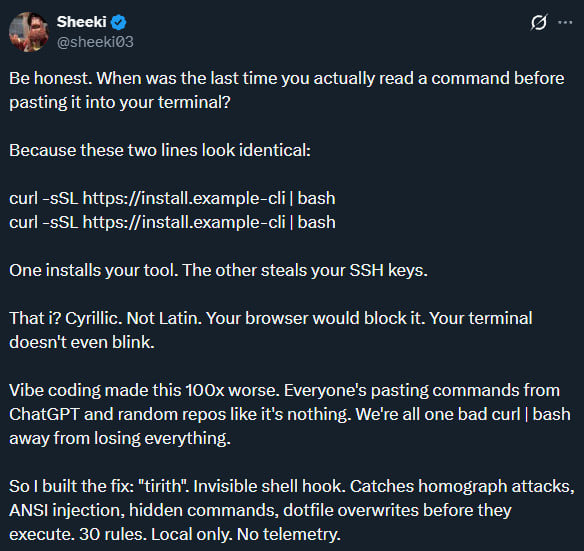
In the realm of cybersecurity, a groundbreaking open-source and cross-platform tool known as Tirith has emerged. This innovative tool is designed to combat homoglyph attacks within command-line environments by scrutinizing URLs in typed commands to prevent malicious executions.
Accessible on GitHub and as an npm package, Tirith operates by integrating into the user’s shell, whether it’s zsh, bash, fish, or PowerShell. It meticulously inspects each command the user enters for potential execution.
Source: GitHub
The primary objective of Tirith is to thwart deceptive attacks that exploit URLs containing symbols from varying alphabets, creating an illusion of similarity to the user but registering as distinct characters to the computer. These types of attacks, known as homoglyph attacks, can be detrimental if undetected.

Attackers leverage homoglyph attacks to fabricate domain names that mimic those of legitimate brands but incorporate characters from different alphabets. While appearing genuine to the human eye, these domains can resolve to servers controlled by malicious entities, posing a severe threat.
Despite browsers fortifying their defenses against such attacks, terminals remain vulnerable to rendering Unicode, ANSI escapes, and invisible characters, as highlighted by Tirith’s creator, Sheeki.
According to Sheeki, Tirith is adept at detecting and thwarting various attack vectors, including homograph attacks, terminal injections, pipe-to-shell patterns, dotfile hijacking, insecure transport, supply-chain risks, and credential exposure.
Instances of Unicode homoglyph characters being exploited in URLs to lure users into malicious websites have been documented. Notably, phishing campaigns like the one impersonating Booking.com have underscored the urgency of combating such threats.
Hidden characters in commands are prevalent in ClickFix attacks, a favored tactic among cybercriminals. Tirith’s capabilities could offer significant protection in supported PowerShell sessions.
It’s important to note that Tirith does not integrate with Windows Command Prompt (cmd.exe), frequently utilized in ClickFix attacks instructing users to execute malicious commands.
Sheeki assures users that Tirith operates with minimal latency, ensuring instantaneous checks and swift termination upon completion. The tool’s features include analyzing commands without execution, evaluating a URL’s trustworthiness, conducting byte-level Unicode scrutiny, and auditing executed scripts with SHA-256.
Tirith’s analysis is conducted locally without any network requests, ensuring user commands remain unaltered and maintaining a non-intrusive presence. The tool operates independently of cloud services, accounts, or API keys, with a commitment to data privacy.
Tirith is compatible with Windows, Linux, and macOS, with installation options through various package managers like Homebrew, apt/dnf, npm, Cargo, Nix, Scoop, Chocolatey, and Docker.
While BleepingComputer has not conducted formal testing of Tirith against specified attack scenarios, the project’s rapid traction on GitHub, with 46 forks and nearly 1,600 stars within a week of publication, indicates its potential efficacy.

Modern IT infrastructure outpaces manual workflows, leading to inefficiencies. Discover how Tines can streamline your processes, enhance reliability through automation, and scale intelligent workflows seamlessly.












Stealthy Malware: The Hidden Threat Within Telnyx PyPI Package

Harvest of Suspicion: Grave Seasons Murder Mystery Farming Sim Arrives in August

Tech Giants Clash: OpenAI Halts Sora as Meta Faces Legal Setback

Apple’s AI Playlist Playground: Where Music Goes to Die

Beyond the Stars: For All Mankind Season 5 Unveiled in Liminal Film Expose

Top 10 Fuel-Efficient Cars for Less Than $50,000

The Illusionists: Mastering Deception in Hacking and ArtForgery

PUBG: Blindspot Shuts Down Early Despite Record Revenues

The High Stakes of AI: OpenAI’s Bold Move to Kill Sora

EU Takes Action Against Instagram and Facebook for Violating Illegal Content Rules

Warning: Facebook Creators Face Monetization Loss for Stealing and Reposting Videos

Facebook Compliance: ICE-tracking Page Removed After US Government Intervention

Facebook’s New Look: A Blend of Instagram’s Style

Facebook and Instagram to Reduce Personalized Ads for European Users

InstaDub: Meta’s AI Translation Tool for Instagram Videos

Reclaim Your Account: Facebook and Instagram Launch New Hub for Account Recovery

Meta discontinues Messenger apps for Windows and macOS

Breaking Updates: Meta Connect 2025 Unveils Latest Developments

The BEST Smartphone of 2020 🏆

The Self-Healing Smartphones!

Apple is not what it used to be.

Smartphones are Boring now.

The Fastest Android Phone Ever.

Unboxing the $122,000 Smartphone. 🤯

Are Linux Smartphones about to KILL Android?

15 Smartphone FAILS to ruin your day 😂

World’s Biggest Smartphone Collection?
-
 Facebook5 months ago
EU Takes Action Against Instagram and Facebook for Violating Illegal Content Rules
-
 Facebook5 months ago
Warning: Facebook Creators Face Monetization Loss for Stealing and Reposting Videos
-
 Facebook5 months ago
Facebook Compliance: ICE-tracking Page Removed After US Government Intervention
-
 Facebook4 months ago
Facebook’s New Look: A Blend of Instagram’s Style
-
 Facebook4 months ago
Facebook and Instagram to Reduce Personalized Ads for European Users
-
 Facebook5 months ago
InstaDub: Meta’s AI Translation Tool for Instagram Videos
-
 Facebook4 months ago
Reclaim Your Account: Facebook and Instagram Launch New Hub for Account Recovery
-
 Apple5 months ago
Meta discontinues Messenger apps for Windows and macOS
