
Tech News
Top Digital Twin Solutions for Enterprise Success

The digital twin market is growing rapidly and is projected to reach $240.3 billion by 2035, with a CAGR of 30.54%. This growth is driven by increased infrastructure spending, industrial transformation, and enterprise software budgets all moving in the same direction simultaneously.
Digital twin technology is no longer just an experimental concept; it is now being deployed in real business scenarios. Companies in various sectors such as manufacturing, healthcare, smart infrastructure, and energy are utilizing digital twin services to simulate operations, monitor assets in real-time, and make better operational decisions.
Building a reliable digital twin system goes beyond just collecting IoT data. It requires the right platform or engine that can model assets, process live data streams, run simulations, and visualize outcomes on a large scale.
The digital twin ecosystem is diverse and fragmented. Some platforms specialize in industrial simulation, while others focus on 3D environments, IoT integration, or AI-driven predictive modeling. Choosing the right platform is crucial to avoid costly architecture rework in the future.
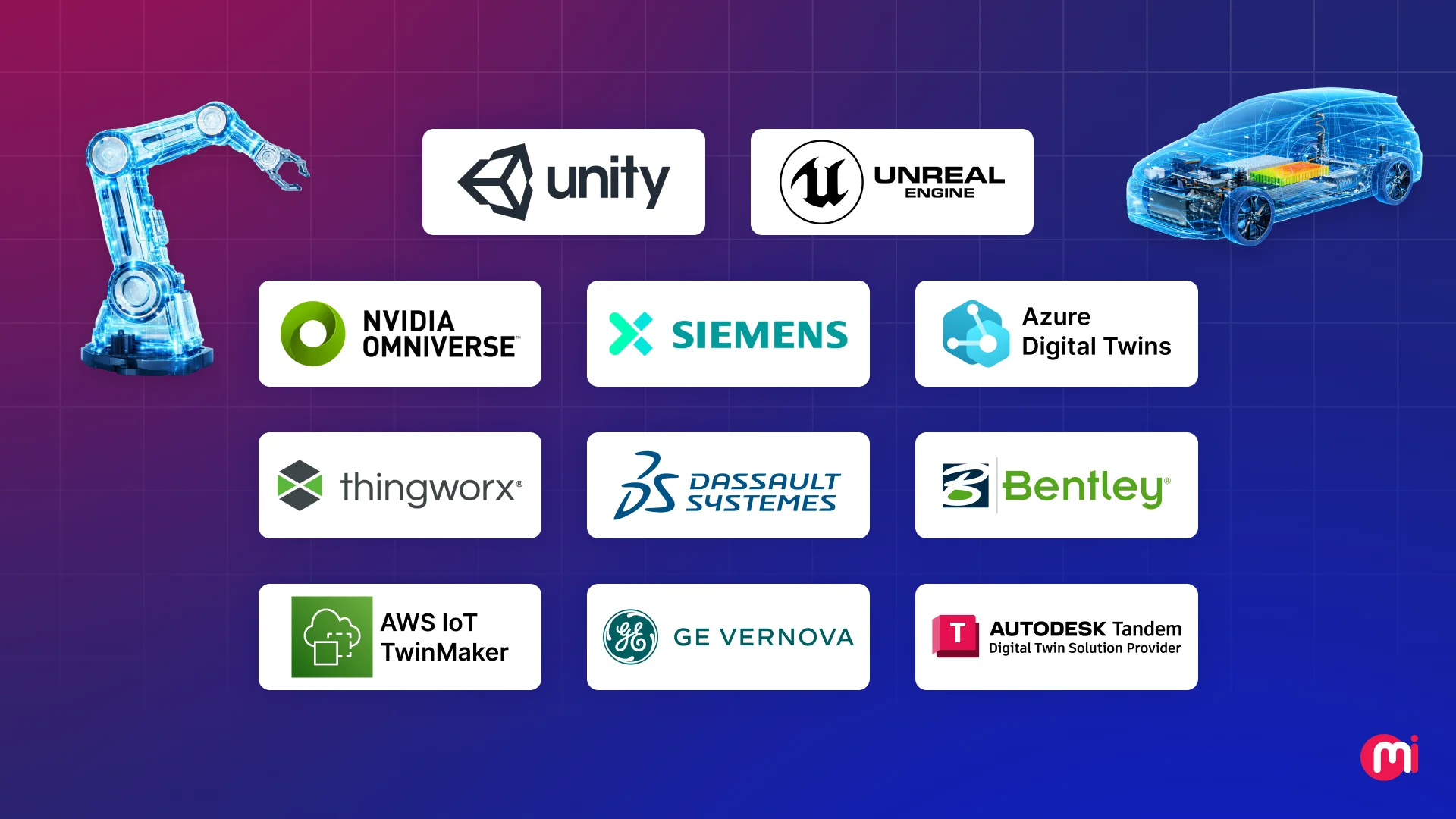
There are several top digital twin platforms and engines available today, each with its unique strengths and use cases. These platforms include Microsoft Azure Digital Twins, Siemens Xcelerator, GE Vernova, PTC ThingWorx, Unity, Unreal Engine, and NVIDIA Omniverse.
Enterprise digital twin platforms enable virtual replication of physical assets, processes, and systems for simulation, prediction, and optimization. The leading digital twin platforms in 2026 cater to different enterprise needs and include Microsoft Azure Digital Twins, Siemens Xcelerator, GE Vernova, PTC ThingWorx, and others.
Best digital twin development engines include Unity, Unreal Engine, and NVIDIA Omniverse. Choosing the right platform depends on factors such as industry, existing tech stack, simulation complexity, and scaling requirements. Cloud-native platforms offer faster deployment and scalability, while on-premises solutions provide greater control over sensitive data.
When it comes to digital twin platforms vs. digital twin engines, the primary difference lies in their focus. A digital twin platform is an end-to-end environment that handles everything from data ingestion to visualization to analytics to lifecycle management. On the other hand, a digital twin engine specializes in a specific layer such as simulation, physics modeling, or real-time 3D rendering.
In conclusion, selecting the right digital twin platform requires careful consideration of your specific use case, data maturity, and operational workflows. It’s essential to involve the teams who will be using the platform daily and validate decisions with real-world deployments at your scale. By starting with your use case and aligning with your existing data and workflows, you can choose the platform that best suits your needs.











The Rise of Black Market AI Accounts: A Lucrative Underground Trade

Google TV Users Unlock Free Gemini Upgrade for Enhanced Viewing Experience

Arinna Secures $4 Million in Seed Funding to Revolutionize Space Power Solutions

Get the Apple Watch SE 3 for $50 off – An Easy Choice!

Revolutionizing Automobile Technology: Android Automotive Takes Control at the Core of Vehicles

Top Digital Twin Solutions for Enterprise Success

Latest iOS Update: New Emoji, Enhanced Security, and More Features

The Future of Banking: AI Agents Take on Key Roles at Bank of America

Mercedes-Maybach S-Class Facelift: A Luxurious Blend of V8 and V12 Power

EU Takes Action Against Instagram and Facebook for Violating Illegal Content Rules

Warning: Facebook Creators Face Monetization Loss for Stealing and Reposting Videos

Facebook Compliance: ICE-tracking Page Removed After US Government Intervention

Facebook’s New Look: A Blend of Instagram’s Style

Facebook and Instagram to Reduce Personalized Ads for European Users

InstaDub: Meta’s AI Translation Tool for Instagram Videos

Reclaim Your Account: Facebook and Instagram Launch New Hub for Account Recovery

Meta discontinues Messenger apps for Windows and macOS

Breaking Updates: Meta Connect 2025 Unveils Latest Developments

Unboxing the $122,000 Smartphone. 🤯

Are Linux Smartphones about to KILL Android?

15 Smartphone FAILS to ruin your day 😂

World’s Biggest Smartphone Collection?

I switched to iPhone – This is what I found out.

What happened to Beats by Dre?

DON’T buy a Screen Protector before watching this.

Beware of Fake Reviewers! ⚠️

Xiaomi Mi 11 Unboxing & Review.
-
 Facebook5 months ago
EU Takes Action Against Instagram and Facebook for Violating Illegal Content Rules
-
 Facebook5 months ago
Warning: Facebook Creators Face Monetization Loss for Stealing and Reposting Videos
-
 Facebook5 months ago
Facebook Compliance: ICE-tracking Page Removed After US Government Intervention
-
 Facebook4 months ago
Facebook’s New Look: A Blend of Instagram’s Style
-
 Facebook4 months ago
Facebook and Instagram to Reduce Personalized Ads for European Users
-
 Facebook5 months ago
InstaDub: Meta’s AI Translation Tool for Instagram Videos
-
 Facebook4 months ago
Reclaim Your Account: Facebook and Instagram Launch New Hub for Account Recovery
-
 Apple5 months ago
Meta discontinues Messenger apps for Windows and macOS
