
Security
Uncovering the Secret: How Hackers Conceal Credit Card Theft with Pixel-Large SVG Tricks


Hackers Conceal Credit Card Stealer in Pixel-Sized SVG Image
A significant cyber campaign affecting nearly 100 online stores utilizing the Magento e-commerce platform has been uncovered. The campaign involves concealing code designed to steal credit card information within a small Scalable Vector Graphics (SVG) image.
Upon clicking the checkout button, victims are presented with a convincing overlay that can verify card details and billing information.
The campaign was detected by Sansec, an eCommerce security company. Researchers at Sansec believe that the attacker likely exploited the PolyShell vulnerability, which was disclosed in mid-March, to gain access.
PolyShell affects all Magento Open Source and Adobe Commerce stable version 2 installations, enabling unauthenticated code execution and account takeover.
Sansec has cautioned that more than half of the vulnerable stores were targeted in PolyShell attacks. In some instances, attackers deployed payment card skimmers using WebRTC for discreet data exfiltration.
In the latest campaign, researchers found that the malware is injected as a 1×1-pixel SVG element with an ‘onload’ handler into the target website’s HTML.
Sansec explains, “The onload handler contains the entire skimmer payload, base64-encoded inside an atob() call and executed via setTimeout. This technique avoids creating external script references that security scanners typically flag. The entire malware lives inline, encoded as a single string attribute.”
When unsuspecting buyers click checkout on compromised stores, a malicious script intercepts the click and displays a fake “Secure Checkout” overlay that includes card details fields and a billing form.
Payment data submitted on this page is validated in real time using the Luhn verification and exfiltrated to the attacker in an XOR-encrypted, base64-obfuscated JSON format.
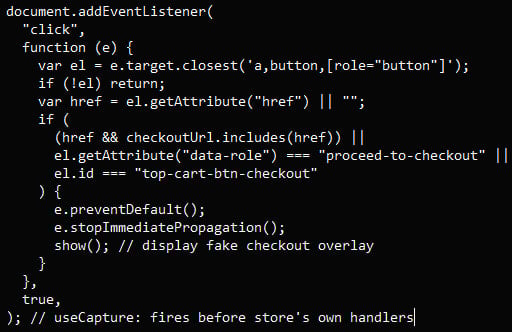
Source: Sansec
Sansec has identified six exfiltration domains, all hosted at IncogNet LLC (AS40663) in the Netherlands, each receiving data from 10 to 15 confirmed victims.
To defend against this campaign, Sansec recommends the following measures:
- Identify hidden SVG tags with an onload attribute using atob() and remove them from your site files
- Check for the existence of the _mgx_cv key in browser localStorage, as it indicates potential theft of payment data
- Monitor and block requests to /fb_metrics.php or any unfamiliar analytics-like domains
- Block all traffic to the IP address 23.137.249.67 and associated domains
As of now, Adobe has yet to release a security update addressing the PolyShell flaw in production versions of Magento. The fix is currently available in the pre-release version 2.4.9-alpha3+.
Furthermore, Adobe has not responded to inquiries regarding this matter.
Website owners and administrators are advised to implement all available mitigations and, if feasible, upgrade Magento to the latest beta release.

Automated pentesting demonstrates the existence of vulnerabilities. BAS determines whether your controls can prevent them. Many teams conduct one without the other.
This whitepaper outlines six validation surfaces, identifies coverage gaps, and offers three diagnostic questions for any tool assessment.











Revolutionary BMW iX5 Hydrogen: Enhanced Flat Tank System for Unprecedented Range of 750 km

Revving Up for the Next Generation: Unleashing Forza Horizon 6 on Xbox

Uncovering the Secret: How Hackers Conceal Credit Card Theft with Pixel-Large SVG Tricks

Surviving the Alien Onslaught: PUBG’s PvE Mode

OnePlus GamePad: The Next-Level Handheld Console Unveiled

Texting AI Agents with Poke: The Easiest Way to Interact

Unboxing the iPhone Air: My First Impression

Gemini’s Guide to Project Organization: A Notebook System for Success

Google Pixel and Android 16: Latest Updates for April

EU Takes Action Against Instagram and Facebook for Violating Illegal Content Rules

Warning: Facebook Creators Face Monetization Loss for Stealing and Reposting Videos

Facebook Compliance: ICE-tracking Page Removed After US Government Intervention

Facebook’s New Look: A Blend of Instagram’s Style

Facebook and Instagram to Reduce Personalized Ads for European Users

InstaDub: Meta’s AI Translation Tool for Instagram Videos

Reclaim Your Account: Facebook and Instagram Launch New Hub for Account Recovery

Meta discontinues Messenger apps for Windows and macOS

Breaking Updates: Meta Connect 2025 Unveils Latest Developments

I bought the cheapest smartphones EVER.

Xiaomi Mi 10 Ultra – Unboxing and Review.

Galaxy Note 20 Ultra Review.

I bought every Galaxy Note ever.

Samsung and Google are at War.

OnePlus 7 Pro in 2020 – Wow.

Poco X3 – The Shady Truth.

Huawei is replacing Android.

14 MEGA Smartphone Fails we’ll never forget.
-
 Facebook6 months ago
EU Takes Action Against Instagram and Facebook for Violating Illegal Content Rules
-
 Facebook6 months ago
Warning: Facebook Creators Face Monetization Loss for Stealing and Reposting Videos
-
 Facebook6 months ago
Facebook Compliance: ICE-tracking Page Removed After US Government Intervention
-
 Facebook4 months ago
Facebook’s New Look: A Blend of Instagram’s Style
-
 Facebook4 months ago
Facebook and Instagram to Reduce Personalized Ads for European Users
-
 Facebook6 months ago
InstaDub: Meta’s AI Translation Tool for Instagram Videos
-
 Facebook4 months ago
Reclaim Your Account: Facebook and Instagram Launch New Hub for Account Recovery
-
 Apple6 months ago
Meta discontinues Messenger apps for Windows and macOS
