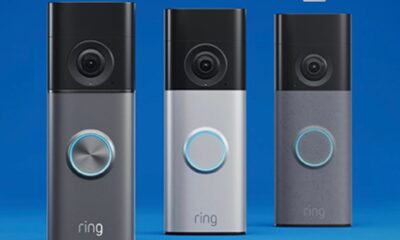
Today I’m talking with Jamie Siminoff, founder of Ring, the video doorbell and security company. Jamie actually wouldn’t let me call him the CEO. He says his title is and always has been chief inventor, so obviously, we talked about that a little bit.
Jamie just published a book about his experiences launching and leading Ring. It’s called Ding-Dong: How Ring Went from Shark Tank Reject to Everyone’s Front Door. And I have to admit that it is a great title for a doorbell company.
Verge subscribers, don’t forget you get exclusive access to ad-free Decoder wherever you get your podcasts. Head here. Not a subscriber? You can sign up here.
The last time I interviewed Jamie was all the way back in 2018, right after he’d sold Ring to Amazon, and when we were piloting Decoder on The Vergecast with some sneaky backdoor interviews.
Since then, Jamie left Ring and Amazon, both started and sold another company, and he’s only recently returned to Amazon to lead Ring once again. In that time, we also started Decoder, so it felt like the perfect opportunity to talk to Jamie about why he left, why he came back, and what’s next for Ring.
Jamie’s mission with Ring has always been to make the world safer, and he has an expansive view of what that means. Seriously, you’re gonna hear him mention Ring’s new AI-powered Search Party feature that helps find lost dogs a lot during this conversation, but his goals and his vision for safety are enormous. He told Verge reporter Jennifer Tuohy in an interview last month that he thought Ring could almost “zero out crime” in the average neighborhood within the next year.
That’s a big promise, right on the face of it. It’s also potentially a very troubling one as we face more and more erosion of privacy and a surveillance panopticon that seems to only ever expand. Sure, Ring is a private company, as are many others, but public entities like police, immigration enforcement, and other agencies use private companies’ data all the time in all kinds of ways. They can just go buy it like anyone else, or sometimes they get it for free if they ask.
Ring’s various partnerships with police departments were pretty controversial when they first spun up, especially against the background of the Black Lives Matter protest movement in 2020. Amazon stepped back a little bit from working directly with the police after Jamie left the company, but now that he’s back, Ring is once again very gung-ho about police partnerships.
But here in 2025, the combination of surveillance and public safety is more controversial than ever. There are federal authorities snatching people off the streets in many cities simply because they look like they could be immigrants and building giant biometric databases of everyone’s faces. This is scary stuff.
There’s also the question of what safety really means. You’ll hear me push Jamie on this throughout this conversation, as he lays out his vision of an ideal neighborhood. To him, it’s one where constant monitoring erases crime. His model is one of constant pervasive security forces, which is not really mine, and we went back and forth on this a few times.
Of course, we also talked about Ring’s technology itself, and I definitely asked Jamie when Ring would support new smart home standards like Matter and Thread. There’s a lot in this one, and Jamie was game for all of it.
Okay, Jamie Siminoff, founder and chief inventor of Ring. Here we go.
This interview has been lightly edited for length and clarity.
Jamie Siminoff, you are the founder, the former CEO, now you’re back at Amazon, and you are the chief inventor of Ring. You’re also the author of a new book called Ding Dong — a great title — How Ring Went from Shark Tank Reject to Everyone’s Front Door. Welcome to Decoder.
I’m excited to talk to you. I’ve interviewed you before when we were secretly piloting Decoder on the Vergecast feed in 2018. You and I did a great interview, which was right after you’d sold the company to Amazon. Since then, you left Amazon, and you’ve come back as chief inventor of Ring; that’s a big deal. There’s a lot there that I want to unpack, but let’s just start with the basics. Why’d you go, why’d you come back?
I actually did stay for five years, so it was a fairly long time; I didn’t just sell and leave. I built it literally from my garage to when I sold it to Amazon. We had gone from 3 million, $30 million, 170, 480, so it was crazy. Then we got to Amazon and we almost 10X the revenue there, got it profitable.
I was overwhelmed for many years, to the point where I realized I wasn’t the best leader for the business. I could feel myself burning out. So, in 2022 and 2023, I had conversations with leadership at Amazon who were supportive and encouraged me to explore other options. I decided to step back and reset. However, during my time away, I realized that my true passion lies with Ring.
I love Ring, its mission, and what we do. Fortunately, I was able to return after taking almost two years off. I dabbled in other things during that time, but nothing compared to the satisfaction I feel when working on Ring. As the chief inventor of Ring, I wake up excited and eager to get to the office every day. It’s where I want to be, and it’s been a fulfilling journey.
The grind of starting the company, appearing on Shark Tank, facing challenges like a lawsuit from ADT, and experiencing setbacks like the whiteboard incident where the team saw our financial struggles – all of these were part of the journey. But Ring has evolved into a market leader and a renowned tech brand. It means a lot to many people now, and it’s beyond my initial expectations.
Leaving Ring allowed me to see the impact and significance of the company from a different perspective. I returned with a newfound respect and understanding of our mission and a clear vision for making a greater impact on our customers, whom we call neighbors.
One of the core beliefs of Ring has always been about enhancing safety by having cameras everywhere. This belief has remained consistent throughout the years. I firmly believe that by deploying our products widely, we can significantly improve safety. I recently mentioned to one of your reporters that with proper implementation of AI, we could potentially reduce crime to zero. This underscores the importance of our mission.
The changes at Amazon during my absence, with new leadership and a shifting ecosystem, have been positive overall. Every year at Ring brings new challenges and opportunities for growth. Working with Panos Panay and the team has been exciting, and we’ve been collaborating on innovative projects. At our fall launch event, we introduced Alexa Plus greetings, familiar faces, and other new products. Bringing these brands together under Amazon is a smart idea, especially with AI technology. I believe we can maximize our potential by leveraging our resources collectively.
The process of my return to Ring was not as dramatic as one might expect. After leaving and reconnecting with the team, I realized the advancements in AI technology since my departure. Seeing the potential for innovation, I expressed my desire to be part of Ring’s next chapter. My passion for Ring and its mission to make neighborhoods safer drove me to return and see through the vision we started years ago in a garage.
While cameras play a significant role in Ring’s ecosystem, the central focus remains on enhancing neighborhood safety. Integrating third-party cameras and forming partnerships can accelerate our mission. The integration of Blink cameras, for example, offers a unique customer experience without compromising the individual brands’ identities.
We are actively working on integrating Blink cameras into our network, ensuring that all components work seamlessly together to enhance neighborhood safety. Despite the challenges of merging separate companies under Amazon’s umbrella, we are committed to delivering innovative solutions for our customers. They both experienced rapid growth upon their arrival, making it challenging to integrate smoothly. It was a matter of choosing between fast growth or integration. Both brands, especially Blink, achieved significant success through rapid expansion.
The strategy Dave implemented before leaving was to have Alexa everywhere, creating an ambient computing platform with microphones and speakers in various locations. This approach led to the development of Alexa and other innovative ideas.
Dave was known for launching products quickly, while Panos, who I have known for years, has a different approach. Panos focuses on creating a single, standout product and presenting it effectively. He brings everything together seamlessly and effectively.
When discussing Amazon’s AI strategy and consumer ecosystem with Panos, the emphasis is on integration. Balancing the success of individual brands, like Ring, within the larger Amazon ecosystem requires thoughtful integration for a better customer experience.
The collaboration between Panos, myself, and other team members is driving a cohesive approach to integrating products like Alexa, Fire TV, and eero. The goal is to create a seamless home experience with Alexa at the center of it all.
Upon returning to Ring, I restructured the organization to address existing issues and improve efficiency. This restructuring led to a rapid deployment of new products and a renewed focus on innovation and team collaboration.
The realignment of teams, strategic pushes, and renewed energy have brought about positive changes at Ring. With a clear vision and focused approach, we have been able to launch products quickly and efficiently.
One example of a structural change I made was streamlining processes to accelerate product development and improve overall efficiency. This approach has allowed us to innovate faster and bring new ideas to market more effectively. The PDP process is streamlined now, with a focus on efficiency and speed. Instead of getting caught up in bureaucratic processes and three-letter words, the team is now focused on getting products out quickly. By breaking down the process and removing unnecessary steps, a product that would have taken 18 months to ship was completed in just six months. This change in approach has led to increased excitement and energy within the team.
When it comes to Amazon’s culture, some aspects have been valuable in the real world, such as the focus on structure and reporting. However, the reliance on memos and PowerPoints can be frustrating for someone who has been immersed in Amazon’s document-driven culture. The ability to learn and process information at your own pace through documents is a valuable skill that can be lost when transitioning to a more traditional meeting format. After reflecting on it, I’ve come to the realization that the concept of one-way doors and two-way doors is indeed powerful. However, it has been overused to the point where it’s too easy to label something as a one-way door. Therefore, I’ve concluded that while there are one-way doors, they should not be easily broken down with a hammer. So, unless something truly qualifies as a one-way door, don’t classify it as such.
For those unfamiliar, two-way door decisions are reversible and relatively simple to make, while one-way door decisions are irreversible and have a significant impact. People tend to lean towards treating decisions as one-way doors, even when they are not. It’s important to understand the sensitivity of each decision and appropriately categorize them.
When making decisions, I value speed and efficiency. I believe in making quick decisions, especially for less impactful matters. However, it’s crucial to identify and treat real one-way doors as such.
As for the ability to move fast, I believe it is not only a luxury of being a market leader like Amazon but also a privilege of being a founder. The founder’s mindset allows for quicker and more decisive actions compared to someone who joins as a high-level executive.
Regarding titles within Amazon, I have always held the title of Chief Inventor and Founder, even during my time at Ring. While I may have the authority of a CEO within Amazon’s structure, I purposely choose not to hold that title. I feel empowered to lead and make decisions within my domain, regardless of the official title. I believe Nick feels like he has that connection with eero, and that’s why… It’s not just a title, it’s about giving people what they need to stay. At Amazon and Ring, we have the power to make decisions and build things, which is what Nick and other founders love to do. We miss being able to make things happen at scale, like launching the Dog Search Party. The sheer number of dogs on our neighbor’s app is mind-blowing, and being able to impact people on that scale is incredibly fulfilling.
Speaking of technology bets, eero’s bet on Thread radios is significant. As technology evolves, there may be opportunities to pivot and align with larger industry standards, like the Thread network that Apple is adopting. Making decisions on protocols like Z-Wave and Sidewalk can feel like one-way doors, but there are still opportunities to adapt and pivot in the long term.
Ultimately, the ability to innovate and create new solutions, whether it’s with existing products like Ring cameras or new protocols like Sidewalk, is what drives us as inventors and founders. The journey of overcoming challenges and making strategic decisions is what shapes our path towards success. There is a lot of potential for innovation in the smart home industry, especially with the integration of AI and cloud technology. By leveraging these technologies, we can enhance the capabilities of our products and provide more value to our customers. The balance between building our own ecosystem and leveraging existing platforms like Amazon’s Alexa Plus is crucial for our growth and success. Moving everything to the cloud allows for flexibility and scalability, but also raises privacy concerns, which we address by giving customers control over their data. Our partnership with law enforcement agencies aims to improve public safety while respecting individual privacy rights, and we strive to provide a transparent and secure process for accessing video footage. Overall, we are excited about the potential of AI to analyze data from various sensors in the home and provide valuable insights to users. It’s fascinating to see how technologies like Sora are being used to create synthetic footage that mimics real-life scenarios, such as Ring video doorbell footage. This raises concerns about the authenticity of video evidence and the need for content credentials to verify its validity. As AI continues to advance, the source of truth will likely need to come from secure servers to ensure the integrity of the footage.
In light of these developments, decisions regarding standards like Thread and C2PA, as well as privacy considerations, become increasingly complex. The challenge lies in balancing the need for authenticated evidence with user privacy and control over their own video content. Collaboration between companies, law enforcement, and government entities will be essential to navigate these issues and establish reliable evidentiary systems. You can ascertain the origin, creation, and digital fingerprint of the content. It is crucial to verify the authenticity of videos and photos shared, as the ease of creating fake content has changed the landscape. Utilizing AI for research and verification is essential in this evolving digital era. The goal of reducing crime to near zero using Ring cameras and AI is ambitious but worth pursuing. The concept of AI enhancing neighborhood security by simulating the knowledge and vigilance of dedicated security personnel is intriguing. However, the idea of a neighborhood with constant surveillance may raise concerns about privacy and freedom. It is important to strike a balance between safety and individual rights in the pursuit of a secure community. If you want, I can take you to a neighborhood where people live in fear and have to lock their doors as soon as they get home from school. In this neighborhood, private cops are everywhere, and everyone is so afraid that crime is not profitable. The model is based on creating safer neighborhoods where kids can grow up in a better environment and focus on important things. The goal is to have intelligence in the neighborhood that can alert residents to potential threats without constantly bombarding them with notifications. However, connecting various databases, especially those with facial recognition technology, raises privacy concerns and the potential for abuse. There is a fine line between using AI to enhance safety and creating a dystopian environment. It is essential to build products responsibly and strike a balance between efficiency and privacy. For example, features like Familiar Faces on Ring cameras aim to provide convenience without compromising privacy. The increasing use of surveillance footage raises important questions about the implications of widespread data collection and facial recognition technology. And I’m not suggesting that Ring is involved in this scenario, I’m simply providing an example. ICE has implemented facial recognition systems, and they are claiming that a positive match in their facial recognition system is a definitive determination of someone’s immigration status. That’s quite extreme. I don’t believe you are advocating for that.
But you could potentially progress to a point where facial recognition and evidence from Ring cameras are utilized for enhanced safety measures, transitioning from passive surveillance to active surveillance. This is what the studies indicate. The cameras could potentially identify criminals by their faces and alert law enforcement of suspicious activities, ultimately reducing crime to zero.
There are certainly risks associated with these advancements. However, if I follow the logic of your argument, it leads to the idea that criminals would be deterred from coming to certain areas due to the surveillance systems in place. Do you agree with this concept?
I also believe that the cameras could notify individuals in a manner that enhances safety. The original Ring system provided a sense of presence at home, deterring potential burglars. By receiving motion alerts when someone approaches the door, homeowners could engage with visitors remotely, creating a presence even when absent. This concept of anomaly detection and neighborhood awareness, rather than real-time surveillance, can significantly impact security levels in communities.
I don’t think the situation is as dystopian as you suggest, and it’s certainly not the direction we are heading in. I believe we can make significant improvements in neighborhood security without resorting to extreme measures. By leveraging AI and collaborative efforts with multiple Ring devices, such as the Dog Search Party initiative, we can positively impact community safety.
Regarding the issue of hallucinations in this context, Google recently introduced Gemini, a platform that can analyze data from various Nest cameras. However, reports indicate instances where the system falsely identified individuals or objects in homes. While Google’s models are cutting-edge, they still have limitations in accurately interpreting data.
In contrast, our smart video descriptions have been in use for some time and have shown reliability. The objective is to guide human decision-making rather than autonomously generate conclusions. While occasional errors may occur, such as hallucinating about a deer in the living room, these serve as prompts for further human investigation.
As for the adequacy of the models for our intended purposes, the rapid advancements in AI technology are unprecedented. The pace at which new developments occur continually surprises us, demonstrating the potential for further improvements.
In terms of building new features, the models may be sufficiently capable, but the processing costs could be a limiting factor. While the technology exists, the expenses associated with implementing certain features may not be feasible at present. For instance, the Dog Search Party initiative would have been prohibitively expensive to develop a few years ago, whereas today, it is a more viable option.
When discussing the goal of eliminating crime in a neighborhood, the presence of illuminated Ring signs in yards could serve as a deterrent. The awareness created by these signs, coupled with the knowledge that faces will be captured on video and analyzed by AI, could dissuade potential criminals. However, additional measures may be necessary to enhance security further and deter criminal activity effectively. I believe there are ways to utilize lighting as well in achieving this goal. Using lighting to accomplish tasks is a significant aspect of it. For example, if someone steps outside due to an anomaly, that can play a crucial role. It doesn’t have to be something extravagant; these small actions can collectively contribute to making it effective.
When considering how to reduce crime in a neighborhood, it’s important to think about the steps involved in achieving this. Perhaps everyone in the neighborhood could install Ring cameras, and the platform could handle the rest. Or maybe catching one criminal could lead to a chain reaction where word spreads among their incarcerated friends. It’s about bringing neighbors together for a common purpose.
AI, in my opinion, serves as a co-pilot in this process, assisting individuals in making sense of vast amounts of data. It can help provide better information for making decisions and collaborating effectively. It’s about using AI to enhance our capabilities.
On the other hand, integrating AI into smart home systems like Amazon Alexa, Google, and Apple’s platforms poses challenges. These companies are still working on perfecting the orchestration between different devices and services. It’s a complex task that requires a seamless integration that hasn’t been fully achieved yet. But there is hope that advancements in AI will lead to more efficient and intuitive smart home systems in the future. “You didn’t notice it.” Or, “Oh, you’re correct, I forgot to feed the dog.”
I think what we desire is assistance. I am more focused on the concept of security assistance for your home and neighborhood with Ring. On the other hand, you are discussing how to get assistance inside your home, within the four walls if necessary.
It seems that we are producing a significantly larger amount of video footage than ever before, along with an increased number of sensors. LLM appears to be a capable tool for managing this data and extracting human-readable information from it.
While I understand the argument and the interest in this technology, I am uncertain if the current LLM technology can fully achieve the level of intelligence needed to connect and control various systems in a home.
I believe that all the necessary technology pieces are currently available, but some challenges may arise in integrating them efficiently. The roadmap for Alexa suggests that we will eventually have always-on intelligence that can perform a wide range of tasks, from simple ones like turning on lights to more complex actions like reminding you about garbage day.
I look forward to your return when these advancements come to fruition and the inevitable introduction of Thread-powered Ring cameras.
We can call them NP cameras.
I was promised a seven-month development cycle for these cameras.
I’ll aim for four months. I need to work faster.
The book titled “Ding Dong: How Ring Went from Shark Tank Reject to Everyone’s Front Door” offers an intriguing insight into the hardware development process and the journey of starting a company. It is highly recommended for those interested in such topics.
What’s next for Ring? We have just launched our new 4K cameras, and Search Party for Dogs will be live soon. There are many exciting developments on the horizon, and I am eager to showcase them.
Thank you for being on Decoder. We want to assure you that we carefully go through each and every email we receive! Our commitment to reading and responding to your messages is unwavering. Your feedback, questions, and suggestions are valuable to us, and we appreciate the time you take to reach out to us.
If you enjoy thought-provoking discussions and innovative ideas, you might be interested in our podcast, “Decoder with Nilay Patel.” This podcast, presented by The Verge, delves into significant concepts and challenges that shape our world today. Subscribe now to stay updated on the latest episodes!
Additionally, you can follow specific topics and authors related to this article to personalize your homepage feed and receive email updates. By following topics like AI, Amazon, Business, Decoder, Podcasts, Privacy, and Tech, you can explore more content that aligns with your interests.
We value your engagement with our content and aim to provide you with a tailored experience that caters to your preferences. Your participation in following topics and authors allows us to deliver relevant information directly to your inbox and homepage feed.
Thank you for being a part of our community and for your continued support. We look forward to continuing our dialogue with you through emails, podcasts, and engaging content on our platform. “Can you please pass me the salt?”
to
“Could you pass the salt, please?” Transform the following sentence: “The cat is sleeping on the couch.”
Answer: “On the couch is where the cat is sleeping.” Transform the following:
Original: The weather was so nice that we decided to go for a walk in the park.
Transformed: The pleasant weather prompted us to take a stroll in the park. Transform the following sentence into the active voice:
“The book was read by John.”
John read the book.