
Tech News
Unlocking the Power of AI: A Comprehensive Guide to Understandable Use Cases and Examples


Artificial intelligence has moved beyond a futuristic concept to become a significant driving force behind innovation and modern businesses. AI’s capabilities are expanding, from personalized customer experiences to diagnosing complex diseases. However, as AI becomes more sophisticated, its internal workings can become so complex that it operates like a black box, making it challenging for developers to trace specific conclusions.
This is where explainable AI (XAI) comes in. XAI aims to build trust and maintain transparency in AI systems. In this article, we will explore what explainable AI is, its core benefits, key use cases, and its transformative impact on various industries.
The growth of AI is undeniable. The global artificial intelligence market size was estimated at USD 279.22 billion in 2024 and is projected to reach USD 3,497.26 billion in 2033, with a CAGR of 31.5% from 2025 to 2033.
With the exponential growth of AI, businesses face a critical challenge. As AI models are integrated into core operations, the need for transparency and accountability becomes crucial. XAI addresses this need for transparency.
Accountability is essential when businesses rely on AI for decision-making. They cannot afford to rely on systems whose reasoning is a mystery. XAI makes AI in Software Development more responsible and reliable by providing transparency.

Key Takeaways
- Explainable AI (XAI) transforms opaque AI systems into transparent models.
- XAI builds user trust and confidence in AI systems.
- In regulated fields like healthcare, XAI is crucial for safety, accountability, and regulatory compliance.
Understanding Explainable AI (XAI)
Explainable artificial intelligence (XAI) helps users understand the results provided by AI/ML algorithms. XAI is a crucial component for fairness, accountability, and transparency in AI systems. It ensures that as businesses deploy advanced AI, they do so responsibly. This is essential for organizations implementing robust AI development services.
With XAI, organizations can build trust and confidence when deploying AI models. It promotes a responsible approach to AI development.
As AI becomes more advanced, understanding how algorithms arrive at results becomes challenging. The complex calculations are often referred to as “black boxes,” making them hard to interpret. Even data scientists or engineers may struggle to explain what happens inside these AI models or how specific results are reached.
Understanding AI systems has several benefits, leading to various outputs. With explainability, developers gain insight into the system to ensure it functions as expected.
Key Advantages of Explainable AI
Explainable AI provides transparent and interpretable machine learning models that can be understood and trusted by humans. This transparency offers numerous benefits across different domains and applications.
Let’s explore some of the key advantages of explainable AI.
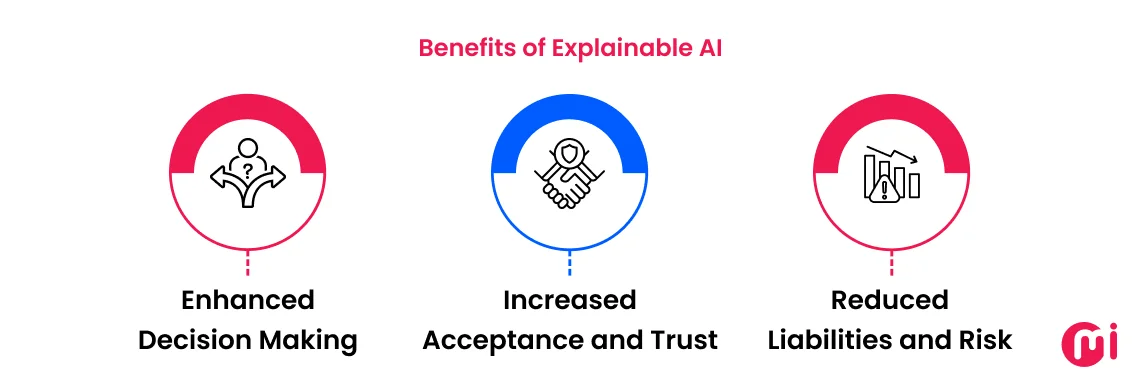
1. Improved Decision Making
Explainable AI provides valuable insights that support and enhance decision-making in businesses. It offers insights into factors influencing a model’s prediction, helping prioritize strategies and actions for desired outcomes.
2. Enhanced Trust and Acceptance
Explainable AI builds trust and acceptance of machine learning models by providing transparency. This transparency overcomes the limitations of traditional opaque models, improving adoption and deployment across various applications.
3. Reduced Liabilities and Risks
Explainable AI reduces the liabilities and risks associated with machine learning models. It addresses regulatory and ethical considerations, reducing the potential impacts and consequences of machine learning.
Functioning of Explainable AI
Explainable AI comprises three main components that work together to provide transparency and insights into AI models. These components play a vital role in understanding how explainable AI operates.
1. Machine Learning Model
The machine learning model is a fundamental component of explainable AI, representing the algorithms used to make predictions from data. Various machine learning techniques, such as supervised, unsupervised, or reinforcement learning, can be applied in different applications like medical imaging and natural language processing.
2. Explanation Algorithm
An explanation algorithm is used to provide insights into factors influencing the model’s predictions. This algorithm employs various AI explainable approaches like attribution, feature importance, and visualization to offer deep insights into how machine learning models function.
3. Interface
The interface component of explainable AI presents the information generated by the explanation algorithm in a user-friendly manner. It utilizes technologies like mobile apps and web applications to deliver insights and information, making it easy for users to interact with and understand AI-generated insights.
Factors to Consider with Explainable AI
When implementing explainable AI, it is essential to consider certain factors to achieve desirable outcomes. These considerations play a crucial role in the successful deployment of explainable AI.
Fairness and Debiasing
Monitor and manage fairness to identify and address potential biases in AI deployment.
Model Drift Mitigation
Scrutinize models to recommend logical outcomes and address deviations from intended results.
Model Risk Management
Quantify and mitigate model risk to ensure optimal performance and address potential issues in machine learning models.
Lifecycle Automation
Automate model building, management, and monitoring to ensure seamless integration and operation of AI models.
Multicloud Readiness
Deploy AI projects across hybrid clouds to ensure integration across platforms, promoting trust and confidence in explainable AI.
Applications of Explainable AI
Explainable AI has been adopted across various industries where accountability is critical. Let’s explore some use cases of explainable AI in different sectors.
Explainable AI in Healthcare
In healthcare, explainable AI enhances diagnosis, medical imaging, and resource optimization. It improves transparency in decision-making for patient care and streamlines the pharmaceutical approval process.
Explainable AI in Financial Services
In the financial sector, XAI enhances customer experience by providing a transparent loan and credit approval process. It aids in credit risk analysis, fraud detection, and wealth management, improving trust in pricing and investment services.
Explainable AI in Criminal Justice
Explainable AI in the criminal justice sector enhances risk assessment, crime forecasting, and analysis. It speeds up resolutions using AI-driven techniques like DNA analysis, ensuring fairness and transparency in decision-making.

Illustrations of Explainable AI
Explainable AI is vital in various high-stakes industries, providing transparency, building trust, and making powerful algorithms reliable. Let’s explore examples of explainable AI applications across different sectors.
1. Autonomous Vehicles
Explainable AI plays a critical role in autonomous vehicles by clarifying decision-making processes that impact safety. XAI provides real-time explanations for vehicle maneuvers, making the car’s reasoning transparent for safety, debugging, and public acceptance.
2. Healthcare Sector
Explainable AI in healthcare ensures transparency in AI models to avoid diagnostic errors. XAI techniques highlight suspicious areas in medical scans, allowing radiologists to validate AI findings and reduce diagnostic errors.
3. Financial Services
Explainable AI aids in credit risk assessment and fraud detection in financial services. It provides clear explanations for decisions like loan approvals, increasing customer trust and transparency in financial transactions.
4. Manufacturing Industry
Explainable AI optimizes processes, quality control, and predictive maintenance in the manufacturing sector, ensuring transparent decision-making. XAI provides insights into the reasoning behind AI-driven decisions, enhancing safety, efficiency, and compliance.
Conclusion
As AI advances, the demand for accountability and transparency in AI systems grows. Explainable AI transforms opaque AI into trustworthy tools for human decision-making, prioritizing clarity, fairness, and verifiability. Choosing a reliable partner for this journey is crucial to building responsible and transparent AI solutions.
At MindInventory, we offer expertise in AI ML development, delivering secure, scalable, and future-proof AI solutions. Partner with us to turn your AI ideas into reality.
FAQs on Explainable AI
While these terms are often used interchangeably, there is a subtle difference between explainability and interpretability. Interpretability refers to simple, easy-to-understand white-box models, while explainability involves post-hoc techniques like LIME or SHAP to provide insights into black-box models.
When evaluating an AI/ML development company, consider their technical expertise in XAI methods, industry-specific experience, case studies, data security practices, model governance, and post-launch support for a successful partnership.
Explainable AI may sacrifice accuracy for interpretability, oversimplify explanations, be computationally expensive, and struggle to provide tailored explanations for different audiences, posing challenges in achieving optimal transparency.
Explainable AI is essential for ethical AI practices as it provides transparency to check for fairness and bias. By explaining AI decisions, XAI allows developers and auditors to ensure equitable outcomes and non-discrimination in AI models.













Balancing Act: The Decision to Shut Down Sora

Exclusive Arrival: Cupra Born VZ Lands in Australia – But There’s a Twist!

iPhone 12 Pro Max vs Samsung Note 20 Ultra / Huawei Mate 40 Pro Camera Test Comparison.

ClickFix: The New Threat to macOS Security

Kingdom Come: Deliverance 2 – The Rise of Artificial Intelligence

Elon Musk’s Latest Venture Faces Uncertainty as Last Co-Founder Departs xAI

Apple Bids Farewell to the Mac Pro Tower: Is it Truly Dead?

Porsche 911 GT3 RS Facelift: Unveiling the 992.2 Model in August 2026

Bearlyfy Strikes Russian Companies with Unique GenieLocker Ransomware Attack

EU Takes Action Against Instagram and Facebook for Violating Illegal Content Rules

Warning: Facebook Creators Face Monetization Loss for Stealing and Reposting Videos

Facebook Compliance: ICE-tracking Page Removed After US Government Intervention

Facebook’s New Look: A Blend of Instagram’s Style

Facebook and Instagram to Reduce Personalized Ads for European Users

InstaDub: Meta’s AI Translation Tool for Instagram Videos

Reclaim Your Account: Facebook and Instagram Launch New Hub for Account Recovery

Meta discontinues Messenger apps for Windows and macOS

Breaking Updates: Meta Connect 2025 Unveils Latest Developments
iPhone 12 Pro Max vs Samsung Note 20 Ultra / Huawei Mate 40 Pro Camera Test Comparison.

iPhone 12 Pro Max vs Samsung Note 20 Ultra / Huawei / Xiaomi / OnePlus Battery Life DRAIN Test.

The BEST Smartphone of 2020 🏆

The Self-Healing Smartphones!

Apple is not what it used to be.

Smartphones are Boring now.

The Fastest Android Phone Ever.

Unboxing the $122,000 Smartphone. 🤯

Are Linux Smartphones about to KILL Android?
-
 Facebook5 months ago
EU Takes Action Against Instagram and Facebook for Violating Illegal Content Rules
-
 Facebook5 months ago
Warning: Facebook Creators Face Monetization Loss for Stealing and Reposting Videos
-
 Facebook5 months ago
Facebook Compliance: ICE-tracking Page Removed After US Government Intervention
-
 Facebook4 months ago
Facebook’s New Look: A Blend of Instagram’s Style
-
 Facebook4 months ago
Facebook and Instagram to Reduce Personalized Ads for European Users
-
 Facebook6 months ago
InstaDub: Meta’s AI Translation Tool for Instagram Videos
-
 Facebook4 months ago
Reclaim Your Account: Facebook and Instagram Launch New Hub for Account Recovery
-
 Apple5 months ago
Meta discontinues Messenger apps for Windows and macOS
