
Security
Urgent Warning: Protect Your Trezor and Ledger Accounts from Crypto-Theft Attacks

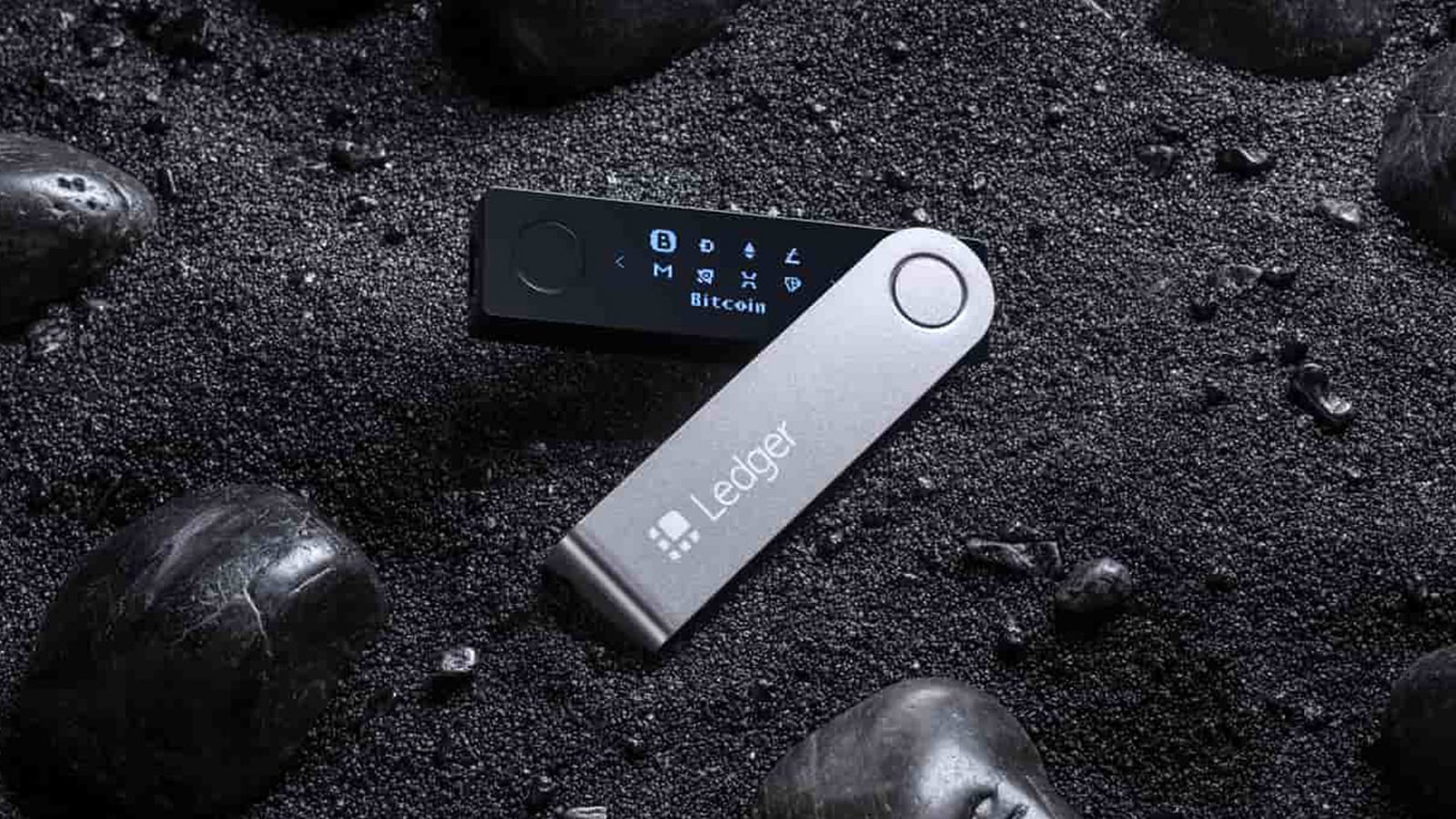
There has been a recent surge in physical letter phishing attacks targeting users of Trezor and Ledger, two renowned cryptocurrency hardware wallet manufacturers. These threat actors are using deceptive tactics to trick individuals into revealing their recovery phrases, leading to potential crypto theft.
The fraudulent letters claim that recipients must urgently complete an “Authentication Check” or “Transaction Check” to prevent the loss of wallet functionality. This sense of urgency is designed to coerce victims into scanning QR codes that direct them to malicious websites.
Emergence of Snail Mail QR Code Crypto Scams
Users of hardware wallets have reported receiving physical letters that impersonate official communications from the security and compliance teams of Trezor and Ledger. These letters are printed on letterheads to enhance their credibility.

It remains unclear how these letters are targeted, but both Trezor and Ledger have experienced data breaches in recent years that exposed customer contact details.
One such letter impersonating Trezor, as received by cybersecurity expert Dmitry Smilyanets, warns users about the mandatory implementation of an “Authentication Check” by February 15, 2026. The letter instructs users to scan a QR code with their mobile device to enable the feature.
The fake Trezor letter states, “To avoid any disruption to your Trezor Suite access, please scan the QR code with your mobile device and follow the instructions on our website to enable Authentication Check by February 15th, 2026.”
Similarly, a Ledger-themed letter shared online notifies users about a mandatory “Transaction Check” that must be completed by October 15, 2025, to prevent disruptions. Victims who scan the QR codes are directed to phishing sites that mimic official Trezor and Ledger setup pages, including:
- https://trezor.authentication-check[.]io/
- https://ledger.setuptransactioncheck[.]com/
As of now, the Ledger phishing domain is offline, while the Trezor phishing site is flagged by Cloudflare as a phishing site.
The Trezor phishing page urges users to complete the Authentication Check setup by February 15, 2026, with a specific note for users who purchased certain Trezor models after November 30, 2025. The phishing site emphasizes the importance of completing the process to avoid potential disruptions.
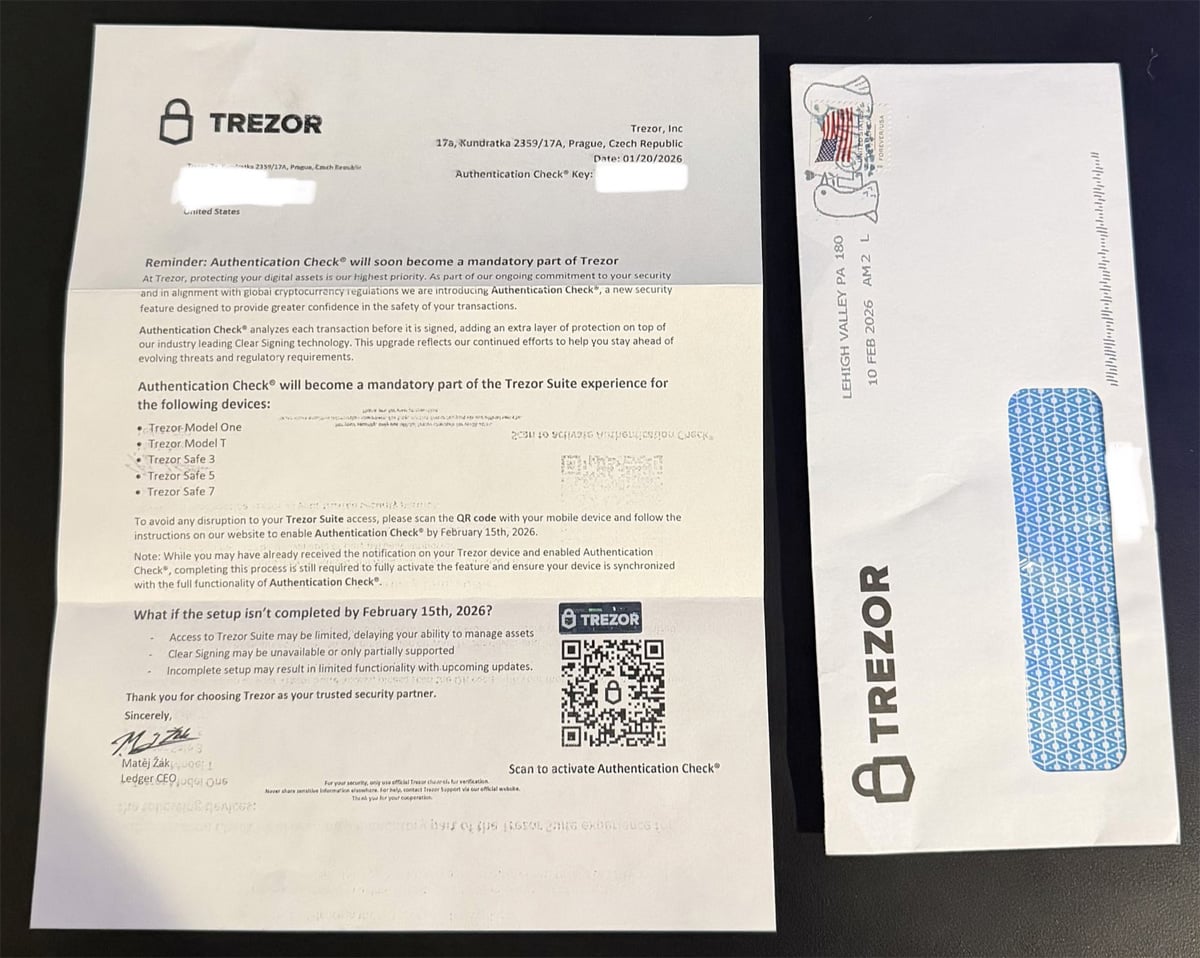
Source: Smilyanets
Clicking the “Get Started” button on the phishing sites leads users to pages warning about potential consequences of not completing the authentication process, creating a sense of urgency to proceed.
If victims continue, they are directed to a final phishing page where they are asked to enter their wallet recovery phrase. This critical information is then transmitted to the threat actors, enabling them to access and potentially steal funds from the victim’s wallet.
Although phishing emails targeting Trezor and Ledger users are common, physical mail phishing campaigns are relatively rare. In previous instances, threat actors have mailed modified Ledger devices to steal recovery phrases during the setup process.
Protect Your Recovery Phrases
Recovery phrases, also known as seed phrases, are vital for accessing cryptocurrency wallets as they represent the private keys controlling the funds. It is crucial never to share these phrases with anyone as it grants full control over the wallet and its contents.
Both Trezor and Ledger emphasize that they will never request users to disclose their recovery phrases through any means. When restoring a wallet, recovery phrases should only be entered directly on the hardware wallet device, not on any external device or website.

Keeping up with modern IT infrastructure can be challenging due to the pace of technological advancements. Learn how automated response systems can streamline workflows and enhance reliability in our latest Tines guide.
Transform the following sentence into a question:
“The cat is sleeping on the windowsill.”
Is the cat sleeping on the windowsill?













Uncovering the Dangers of Routine Access: A Comprehensive Threat Report Reveals Modern Intrusions

Battle for Survival: Stormgate’s Last Stand Against the AI Invasion

Samsung Galaxy Watch: Monitoring Blood Pressure with the Latest Upgrade

Countdown to StrictlyVC San Francisco: Less than a Month Away!

Revolutionizing Supply Chain Efficiency: Hershey’s AI Integration

Samsung Galaxy Phones Expected to See Price Increase

Prep Steps for Emojifying Your Messages

Unlocking the Potential: How Language AI is Revolutionizing Enterprise Infrastructure

A Record-Breaking Sale: A Mint Condition BMW E28 M5 Fetches Nearly $200,000

EU Takes Action Against Instagram and Facebook for Violating Illegal Content Rules

Warning: Facebook Creators Face Monetization Loss for Stealing and Reposting Videos

Facebook Compliance: ICE-tracking Page Removed After US Government Intervention

Facebook’s New Look: A Blend of Instagram’s Style

Facebook and Instagram to Reduce Personalized Ads for European Users

InstaDub: Meta’s AI Translation Tool for Instagram Videos

Reclaim Your Account: Facebook and Instagram Launch New Hub for Account Recovery

Meta discontinues Messenger apps for Windows and macOS

Breaking Updates: Meta Connect 2025 Unveils Latest Developments

OnePlus 8T vs Google Pixel 5 – The Brutal Truth.

iPhone 12 / 12 Pro Unboxing – ft MKBHD!

iPhone 12 Pro vs iPhone 12 vs iPhone 11 Pro Camera Test Comparison.

Huawei Mate 40 Pro Unboxing – WHAT.

iPhone 12 vs iPhone 12 Pro / 11 Pro Max / 11 Pro / 11 / XR / SE Battery Life DRAIN Test.

19 Smartphone Gadgets that Blew me Away.

iPhone 12 Pro Max Unboxing & Review!

iPhone 12 Pro Max vs Samsung Note 20 Ultra / Huawei Mate 40 Pro Camera Test Comparison.

iPhone 12 Pro Max vs Samsung Note 20 Ultra / Huawei / Xiaomi / OnePlus Battery Life DRAIN Test.
-
 Facebook5 months ago
EU Takes Action Against Instagram and Facebook for Violating Illegal Content Rules
-
 Facebook6 months ago
Warning: Facebook Creators Face Monetization Loss for Stealing and Reposting Videos
-
 Facebook6 months ago
Facebook Compliance: ICE-tracking Page Removed After US Government Intervention
-
 Facebook4 months ago
Facebook’s New Look: A Blend of Instagram’s Style
-
 Facebook4 months ago
Facebook and Instagram to Reduce Personalized Ads for European Users
-
 Facebook6 months ago
InstaDub: Meta’s AI Translation Tool for Instagram Videos
-
 Facebook4 months ago
Reclaim Your Account: Facebook and Instagram Launch New Hub for Account Recovery
-
 Apple5 months ago
Meta discontinues Messenger apps for Windows and macOS
