
Security
Breach of Trust: Iranian Hackers Strike Government Organizations with Phoenix Backdoor

A state-sponsored Iranian hacker group known as MuddyWater has conducted cyberattacks on more than 100 government entities using the Phoenix backdoor version 4.
Referred to by aliases such as Static Kitten, Mercury, and Seedworm, this threat actor primarily focuses on government and private organizations within the Middle East region.
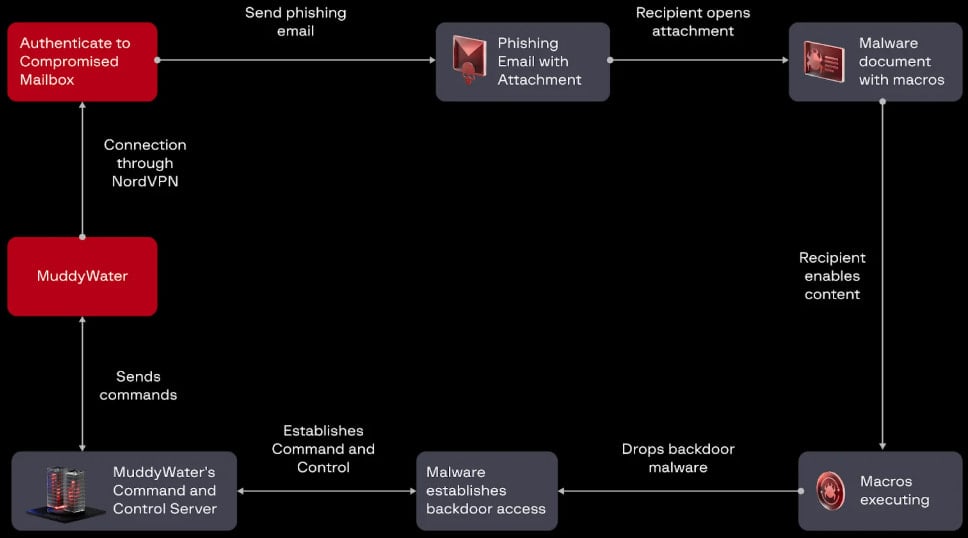
Commencing on August 19, the hackers initiated a phishing campaign through a compromised account accessed via NordVPN, targeting various government and international organizations across the Middle East and North Africa, as reported by cybersecurity company Group-IB.
Group-IB’s report reveals that the threat actor disabled the server and server-side command-and-control (C2) component on August 24, potentially signifying a shift to a new phase of the attack involving different tools and malware to extract information from compromised systems.
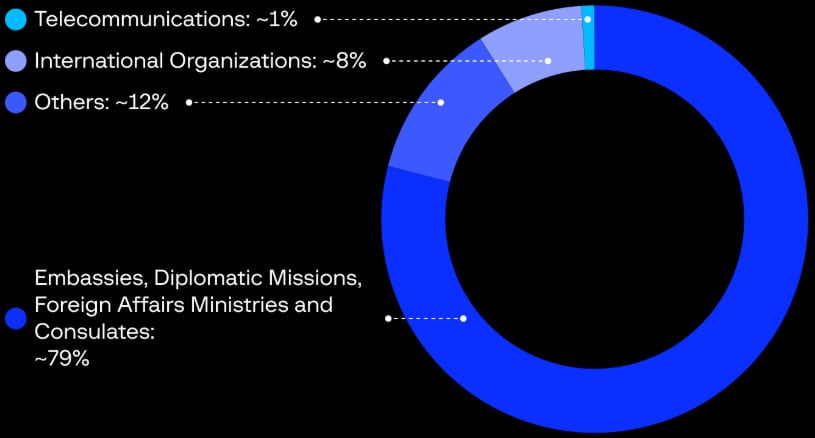
The majority of targets in MuddyWater’s campaign are embassies, diplomatic missions, foreign affairs ministries, and consulates.
Source: Group-IB
Return of Macro Attacks
Group-IB’s research indicates that MuddyWater employed emails containing malicious Word documents with macro code that executed the FakeUpdate malware loader.
The malicious Word documents attached to the emails prompt recipients to enable content in Microsoft Office, triggering a VBA macro that writes the ‘FakeUpdate’ malware loader to the disk.
It remains unclear why MuddyWater reverted to delivering malware via macro code concealed in Office documents, considering that macros were previously popular years ago when they automatically ran upon opening a document.
As Microsoft disabled macros by default, threat actors shifted to alternative methods, with a recent one being ClickFix, also utilized by MuddyWater in previous campaigns.
According to Group-IB researchers, the loader employed in MuddyWater’s recent attacks decrypts the Phoenix backdoor, which contains an embedded, AES-encrypted payload.
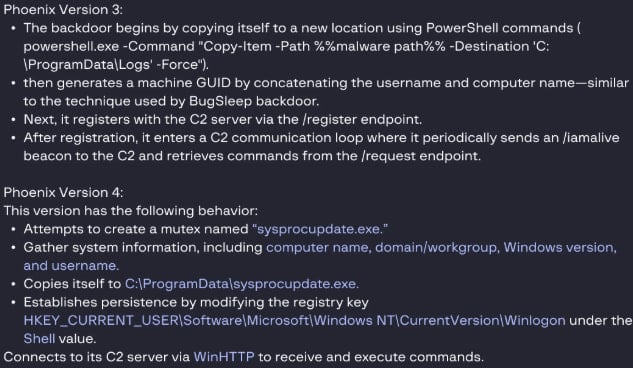
The malware is written to ‘C:\ProgramData\sysprocupdate.exe’ and establishes persistence by altering the Windows Registry entry with configurations for the current user, specifying the app to run as the shell after logging into the system.
Source: Group-IB
Phoenix and Chrome Stealer
The Phoenix backdoor, previously identified in MuddyWater attacks, features additional COM-based persistence mechanisms and functional variances in its version 4 used in this campaign.
Source: Group-IB
The malware collects system information such as computer name, domain, Windows version, and username to profile the victim. It connects to its command-and-control (C2) via WinHTTP, initiating beaconing and command polling.
Group-IB confirms that Phoenix v4 supports commands including sleep, upload file, download file, start shell, and update sleep interval time.
Another tool employed by MuddyWater in these attacks is a customized infostealer designed to extract databases from Chrome, Opera, Brave, and Edge browsers, retrieve credentials, and capture the master key for decryption.
Within MuddyWater’s C2 infrastructure, researchers discovered the PDQ utility for software deployment and management, along with the Action1 RMM (Remote Monitoring and Management) tool, both utilized in attacks linked to Iranian hackers.
Group-IB attributes these attacks to MuddyWater with a high level of confidence, citing the use of malware families and macros seen in previous campaigns, common string decoding techniques on new malware akin to known families, and specific targeting patterns.

46% of environments had passwords cracked, nearly doubling from 25% last year.
Access the Picus Blue Report 2025 for comprehensive insights into prevention, detection, and data exfiltration trends.












RealMe 2 UNBOXING and REVIEW

Get Ready for the Future: Apple Maps Advertising is Coming Soon

Unraveling the Mysteries of Wiesmann’s BMW V8-Powered MF5

Controversy Brews as Twitch Utilizes Livestreams for AI Training

Securing Enterprise AI in Healthcare: Mitigating Cybersecurity Risks

Silent Surveillance: An Unreal Engine Thriller

Collaboration and Investment: Cashflows and Tap & Go Empower Female-Led FinTech Innovation in the UK

Unlocking the Future: How Digital Twin Technology Gives Enterprises a Time Travel Advantage

Say Goodbye to Google Gemini’s Watermarks

EU Takes Action Against Instagram and Facebook for Violating Illegal Content Rules

Warning: Facebook Creators Face Monetization Loss for Stealing and Reposting Videos

Facebook’s New Look: A Blend of Instagram’s Style

Facebook Compliance: ICE-tracking Page Removed After US Government Intervention

Facebook and Instagram to Reduce Personalized Ads for European Users

InstaDub: Meta’s AI Translation Tool for Instagram Videos

Reclaim Your Account: Facebook and Instagram Launch New Hub for Account Recovery

Meta discontinues Messenger apps for Windows and macOS

Breaking Updates: Meta Connect 2025 Unveils Latest Developments
RealMe 2 UNBOXING and REVIEW

Does GPU Turbo make this the Best Budget Gaming Phone?

Pixel 3 Leaked Unboxing – Is Google Lying to us?

Vivo V11 Pro UNBOXING AND REVIEW

Vivo V11 Pro vs Pocophone F1 vs Samsung Note 9 Camera Test Comparison

Huawei Mate 20 PRO – This is why you should be excited.

Huawei Mate 20 lite UNBOXING!

Top 10 Smartphone Gadgets – 2018!

iPhone XS / XS Max vs Galaxy Note 9 vs iPhone X Battery Life DRAIN TEST
-
 Facebook10 months ago
EU Takes Action Against Instagram and Facebook for Violating Illegal Content Rules
-
 Facebook10 months ago
Warning: Facebook Creators Face Monetization Loss for Stealing and Reposting Videos
-
 Facebook8 months ago
Facebook’s New Look: A Blend of Instagram’s Style
-
 Facebook10 months ago
Facebook Compliance: ICE-tracking Page Removed After US Government Intervention
-
 Facebook8 months ago
Facebook and Instagram to Reduce Personalized Ads for European Users
-
 Facebook10 months ago
InstaDub: Meta’s AI Translation Tool for Instagram Videos
-
 Facebook8 months ago
Reclaim Your Account: Facebook and Instagram Launch New Hub for Account Recovery
-
 Apple10 months ago
Meta discontinues Messenger apps for Windows and macOS
