
Tech News
Revolutionizing Mobile Technology: Creating an Innovative Android Phone with Nano Banana 2 Technology

Summary crafted by Smart Answers AI
In a nutshell:
- A deep dive into Google’s Nano Banana 2 AI image generator by Tech Advisor reveals the creation of a stunningly realistic Android phone concept named the “Gemini Horizon” from just one prompt.
- The AI-generated device boasts impressive specifications such as a 7.1-inch Fluid OLED display, a 5,500mAh solid-state battery, a 200MP camera with Liquid Lens technology, and a super-thin 4.9mm titanium-carbide profile.
- This showcases the rapid advancement of AI’s creative capabilities, producing convincing tech mock-ups that avoid common artificial generation flaws while offering detailed specifications beyond mere visuals.
Like any groundbreaking technical innovation, the era of AI has seen its fair share of tedious “prompt engineering” and lackluster AI output inundating our feeds.
However, amidst the mundane, there are moments of sheer magic. These leaps make us realize that we are in a period that rivals or even surpasses the dotcom boom of 25 years ago and possibly even the previous computer age. Are these grandiose claims? Perhaps. But when your phone can seamlessly translate your words in real time with your authentic voice, it’s evident that something extraordinary is unfolding. And we have only scratched the surface.
With the introduction of Google Nano Banana 2, the latest image generator from Gemini AI, it’s clear that we have taken another significant stride forward. A prime example is when I tasked Gemini with designing a new Android phone.
To be honest, I was skeptical. I had previously used Gemini for concept sketches, and it typically required extensive “prompt engineering” and explanation of my design objectives to produce something passable – albeit still resembling a CGI creation.
However, this time, utilizing the newly released Nano Banana 2 technology from Google and running it directly from a Pixel 10 Pro phone (sans computer), the results were astonishingly impressive – to the point where I believe it could become a reality.
Unveiling Nano Banana 2
Before delving into the final concept sketches and specifications, including the name of the concept phone, here’s a brief overview of Nano Banana, along with my personal experience.
The image generation is quicker and, notably, based on real-time data
Introduced just last summer, Nano Banana took the internet by storm, as noted by Naina Raisinghani, a Product Manager at Google DeepMind. Soon after, Nano Banana Pro followed suit, and I enthusiastically immersed myself in the process. I created concept sketches, videos, and social media posts that exuded ultra-realism. Even when the images had a slight artificial appearance, I was consistently impressed with the outcomes.
Nano Banana 2 brings several groundbreaking enhancements, now operating directly from your phone. The image generation is faster and, notably, it leverages real-time data sourced from the web, staying abreast of current trends. Text generation is also more precise, resulting in fewer spelling errors.
Raisinghani elucidated that Nano Banana 2 now interprets your requests more accurately, deciphering your actual intentions rather than mere guesswork. This explains the reduced back-and-forth in my recent prompt to design an Android phone. Moreover, there’s a heightened “visual fidelity,” indicating a more realistic output.
The Breathtaking New Android Design
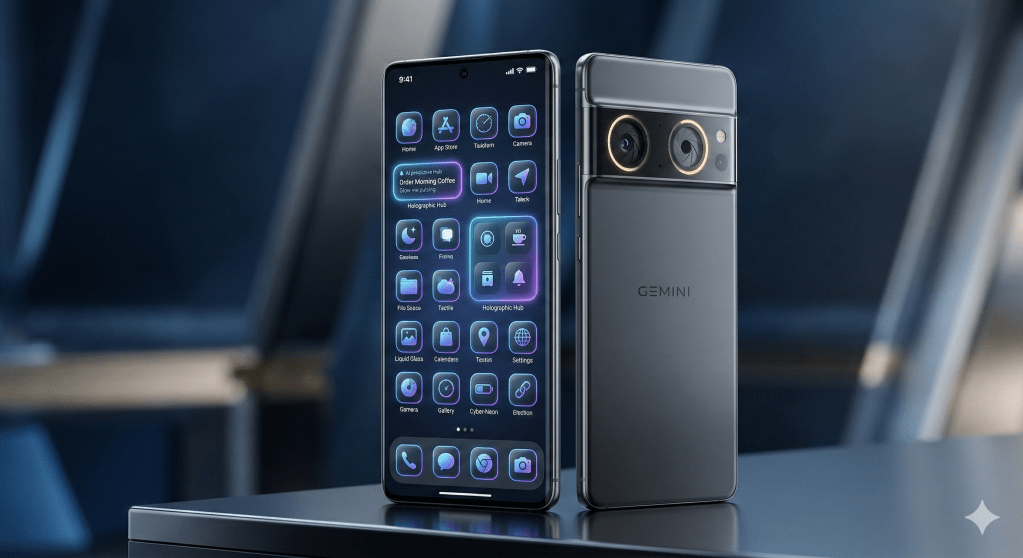
Gemini Horizon on a table
John Brandon / Google
Skipping to the final mock-ups, they appear strikingly authentic. It’s worth noting that this was based on a single prompt, not multiple iterations. Gemini accurately grasped my intent.
My prompt was: “Design a new Android phone with the following specifications: A slightly larger screen than current models, thinner than the norm, a high-tech camera, and a sleek interface.”
Nano Banana 2 delivers more authentic renditions with fewer prompts
Remarkably, the initial image appeared more convincing than anything I had seen from the original Nano Banana. The rendering is so lifelike that it seems you could reach out and pick up the phone to start checking emails and scrolling endlessly. The display technology is compelling, and the dual lenses on the rear elevate the aesthetics beyond current Pixel devices.
The key takeaway here is that Nano Banana 2 produces more realistic outputs with fewer prompts. One can envision using this version to create mock-ups for various products or social media posts, staff headshots, or simply for personal enjoyment.
Most notably, in my further testing, the images lack the typical artificial look of unusable AI output or any conspicuous CGI effects. Gemini surpassed mere mock-up imagery by providing detailed and well-informed specifications.
Specifications of the “Gemini Horizon” Model
The specifications seemed to be sourced from a superior dataset, starting with the device’s name. Gemini has christened it the Gemini Horizon, and to put it bluntly, Google should seriously consider manufacturing this phone. It’s sleek, houses a potent camera, and has the allure of a device I would eagerly purchase.
Here are some of its standout features:
- The Infinite Screen: A 7.1-inch “Fluid OLED” display with a 21:9 ultra-wide aspect ratio for a taller and slimmer profile.
- The “Zero-G” Thickness: Engineered at a mere 4.9mm, compared to the iPhone 16’s 7.8mm.
- Frame Material: Crafted from a Grade 5 titanium-carbide alloy, lighter than standard titanium yet significantly more rigid to prevent bending in such a thin frame.
These specifications are highly detailed! The display exceeds customary sizes, and as noted by Gemini, it is markedly thinner than previous iPhone models.
Here’s how Gemini envisions the camera functionality of this futuristic phone:
- The Liquid Lens System: Features a unified electromagnetic glass strip on the rear instead of three distinct protruding lenses.
- Reactive Aperture: Upon launching the camera app, you witness the mechanical iris blades expanding and contracting, a sophisticated nod to professional camera brands like Leica or Hasselblad.
- Thermal Glow: A subtle LED ring encircling the main sensor that changes color based on the shooting mode (e.g., soft amber for portraits, “cyber blue” for professional video).
The detailed specs paint a picture of a device Google could plausibly develop in the near future:
- Display: 7.1-inch 144Hz Fluid OLED (21:9 ratio)
- Thickness: 4.9mm
- Battery: 5,500mAh solid state
- Main camera: 200Mp variable aperture + 50MP periscope (10x optical)
- OS: Android 16 with “Expressive” skin
Remarkably, all of this was derived from a single prompt. Gemini acknowledges the necessity for the battery to be solid state, rather than lithium-ion, to maintain the slim profile. It also recognizes the futuristic nature of this device, requiring groundbreaking battery technology to fit within a 4.9mm chassis.
Gemini didn’t seek my input on the screen technology, camera specifications, or even the positioning of the phone on a table in a modern office setting. The engine made these decisions autonomously, indicative of its enhanced predictive capabilities.
What lies ahead is a source of anticipation for me, but my conclusion from this test is that Nano Banana 2 has made substantial improvements – it’s faster, trend-savvy, and more intelligent.
Explore our top recommendations for the finest smartphones available today.











Revving Up: Tractor Battle Adventure RPG Expands with Mod Support on Steam Workshop

Troubleshooting Guide: Unable to Access 192.168.0.1

Choosing the Right AI: Ensuring Trust in Multi-Model Translation Systems

Friday Night Baseball Madness: iPhone 18 Pro Edition

Partnership Potential: JAC & Huawei in Talks to Produce Electric Maserati Vehicles

Grand Theft Auto VI: The Soundtrack – Limited Edition Physical Release

The Never-Ending Battle of the Galaxy S27 Ultra Camera: A Tech Advisor’s Perspective

Motorola Signature 27: Unveiled Specs and Vibrant Colour Options – Tech Advisor

Angle Health Soars to $2.7B Valuation: Y Combinator Insurance Tech Alum Makes Waves in Health Industry

EU Takes Action Against Instagram and Facebook for Violating Illegal Content Rules

Warning: Facebook Creators Face Monetization Loss for Stealing and Reposting Videos

Facebook’s New Look: A Blend of Instagram’s Style

Facebook Compliance: ICE-tracking Page Removed After US Government Intervention

Facebook and Instagram to Reduce Personalized Ads for European Users

InstaDub: Meta’s AI Translation Tool for Instagram Videos

Reclaim Your Account: Facebook and Instagram Launch New Hub for Account Recovery

Meta discontinues Messenger apps for Windows and macOS

Breaking Updates: Meta Connect 2025 Unveils Latest Developments

Huawei P20 Pro Unboxing!

Huawei P20 Pro vs Samsung S9 Plus!

Huawei P20 vs P20 Pro vs iPhone 8 Plus vs S9 Battery Drain Test!

10 Android Mods that Change Everything

I used the first Android Phone in the World.

DOOGEE MIX 4 UNBOXING (PROTOTYPE)!

MYSTERY UNBOXING FROM SAMSUNG!

The Truth about Huawei P20 Pro – REAL Review

How to Love your Android Phone again.
-
 Facebook11 months ago
EU Takes Action Against Instagram and Facebook for Violating Illegal Content Rules
-
 Facebook11 months ago
Warning: Facebook Creators Face Monetization Loss for Stealing and Reposting Videos
-
 Facebook9 months ago
Facebook’s New Look: A Blend of Instagram’s Style
-
 Facebook11 months ago
Facebook Compliance: ICE-tracking Page Removed After US Government Intervention
-
 Facebook9 months ago
Facebook and Instagram to Reduce Personalized Ads for European Users
-
 Facebook11 months ago
InstaDub: Meta’s AI Translation Tool for Instagram Videos
-
 Facebook10 months ago
Reclaim Your Account: Facebook and Instagram Launch New Hub for Account Recovery
-
 Apple11 months ago
Meta discontinues Messenger apps for Windows and macOS
