
Tech News
Selecting the Best Automation Solution for Your Business

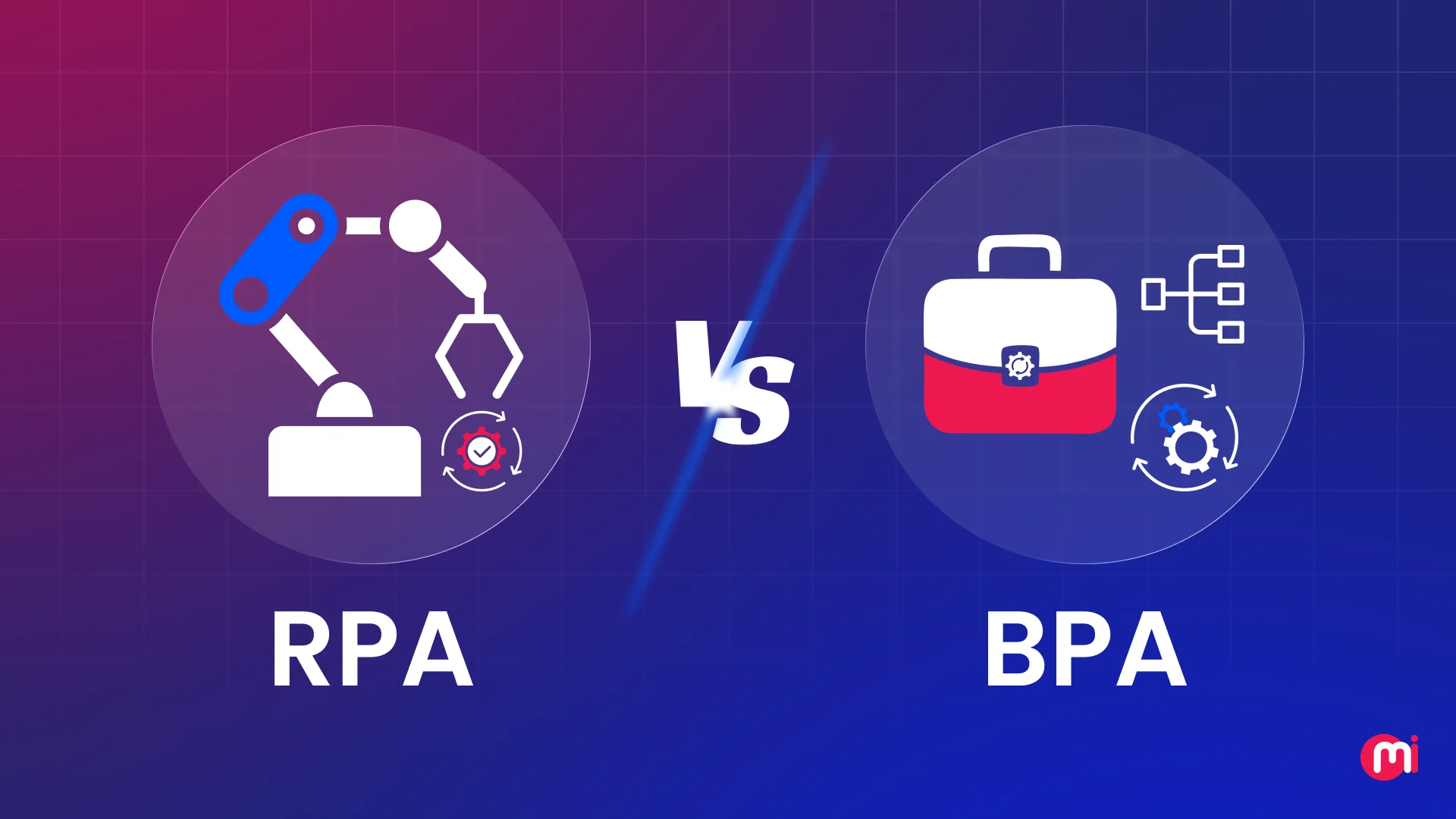
Business executives face the challenge of reducing expenses, increasing efficiency, and freeing up employees for more valuable tasks. Automation is the solution, with the market expected to reach $170.89 billion by 2035 at a CAGR of 5.9% from 2026 to 2035. But the question arises: Robotic Process Automation (RPA) or Business Process Automation (BPA)?
Many decision-makers view RPA and BPA as interchangeable, but they serve different purposes.
RPA solutions provide quick wins by automating repetitive tasks, while BPA solutions deliver strategic, end-to-end transformation by automating entire workflows.
Choosing the wrong automation type can lead to:
- Automation failures when user interfaces change
- Disconnected workflows that create more work than they eliminate
- Wasted licenses, stalled pilots, and poor return on investment

Therefore, this guide aims to help you make the right choice between business process automation and robotic process automation based on your process maturity, systems, and business objectives.
It outlines the differences between RPA and BPA, when to utilize each, how leading companies integrate them (hyperautomation), and which approach yields the quickest ROI in 2026.
Key Takeaways
- RPA is tactical, while BPA is strategic
- RPA automates repetitive tasks for quick wins, whereas BPA orchestrates full end-to-end processes for enduring transformation
- RPA may fail when interfaces change, but BPA is generally more stable due to integration and workflow focus
- Utilize RPA for rapid ROI on high-volume tasks, then add BPA for complex processes to achieve significant cost reductions, workflow automation, and improved ROI
- RPA vs. BPA emphasizes that they are not competitors but collaborators
- The most effective automation strategy in 2026 is hyperautomation, combining RPA + BPA + AI to deliver faster, smarter, and more sustainable automation
- In the RPA vs. BPA debate, choose based on process maturity and business goals
What Is Robotic Process Automation (RPA)?
Robotic Process Automation (RPA) involves software bots mimicking human actions across digital systems. It entails bots performing tasks like clicking, typing, copying data, logging into apps, and more.
RPA acts as a digital assistant following precise rules on the existing screen, executing repetitive tasks faster and more consistently.
Key characteristics of RPA
RPA excels in:
- Task-level automation, not process-level
- Rule-based, structured data, low variability
- Repetitive tasks
- Non-invasive and compatible with legacy systems
- UI-driven (operated through screens, clicks, forms)
- Inter-system operation (data exchange between applications)
- 24/7 operation with minimal errors
How RPA operates
RPA is akin to providing a digital employee with a computer and teaching it to perform repetitive screen-based tasks exactly like a human, but faster, round-the-clock, and without errors. Here’s how it functions in practice:
- Step 1: A trigger initiates the bot, such as a scheduled time, reception of a new email, upload of a file to a folder, creation of a new entry in a system, or a manual “run bot” action
- Step 2: The bot gathers input data from sources like spreadsheets, PDFs, forms, emails, CRM/ERP screens, and databases
- Step 3: The bot executes tasks akin to a human, like accessing an ERP system, navigating to a module, inputting invoice details, validating fields, submitting forms, etc.
- Step 4: The bot manages exceptions when a rule doesn’t match by retrying, logging the issue, routing it to a human for review, or skipping and continuing based on the setup
- Step 5: The bot generates an output, such as updated records in a system, a report, a confirmation email, or a compliance log
Common RPA use cases
- Extraction and entry of invoice data
- Synchronization of employee data between HR tools and payroll systems
- Generation and distribution of reports
- Bank reconciliations
- Updates to customer data across CRM/ERP systems
- Status updates on orders between eCommerce platforms and logistics systems
- Support for claims processing
- Conducting compliance checks and regulatory reporting
Also Read: Challenges in Robotic Process Automation and Their Solutions
What Is Business Process Automation (BPA)?
Business Process Automation (BPA) involves automating an entire business workflow, not just individual tasks. It is a comprehensive, strategic approach that automates, orchestrates, and continuously enhances complete end-to-end workflows across departments, systems, and individuals.
BPA encompasses process modeling, workflow orchestration, rules engines, API integrations, human-in-the-loop approvals, analytics, and low-code app development.
BPA emphasizes orchestration, automating task routing, approvals, handovers, system integrations, notifications, SLAs, escalations, and reporting and audit trails.
If RPA automates the work, BPA automates how work flows.
Key characteristics of BPA
BPA is ideal when:
- End-to-end workflow automation is required (process-level)
- It handles complexity, decisions, exceptions, and handovers
- It usually involves process redesign or optimization
- Approval routing spans teams and roles
- It is API-first or hybrid (may include RPA bots)
- It provides dashboards, SLAs, and continuous improvement
- It offers process visibility and reporting
- It focuses on integration-first automation
- It incorporates governance and compliance controls
- Scalability across departments is essential
How BPA operates
BPA is akin to constructing a smart assembly line for a complete workflow (e.g., full employee onboarding from offer letter to first-day access).
Instead of automating a single repetitive step, BPA automates how work progresses from start to finish.
A typical BPA workflow functions as follows:
- Step 1: A process is triggered, like form submission, marking a new deal as “closed won,” creating a customer ticket, raising a purchase request, or a compliance event
- Step 2: The workflow engine generates the workflow instance and automatically assigns the initial task
- Step 3: Rules determine the subsequent steps, such as approval thresholds, department routing, priority rules, SLA timelines, and escalation conditions
- Step 4: BPA automates task assignments, approval routing, reminders, escalations, and handovers between departments
- Step 5: Integrations synchronize data across platforms, such as updating ERP records, creating CRM entries, generating invoices, and provisioning access in IT systems
- Step 6: Unlike RPA, BPA typically includes audit trails, workflow status tracking, bottleneck visibility, and reporting dashboards. Leaders can determine where processes are stalled, who approved what, and how long each stage takes
Common BPA use cases
- Complete employee onboarding (from offer letter to IT provisioning to training to first-day welcome)
- Procure-to-pay process (requisition, approval, purchase order, receipt, invoice, payment)
- Customer onboarding, KYC, loan processing
- Incident and change management in IT/operations
- Claims processing in insurance
RPA vs. BPA: Head-to-Head Comparison
Robotic Process Automation (RPA) and Business Process Automation (BPA) are distinct technologies designed to enhance efficiency, but they operate on different scales. While RPA functions as a digital worker for specific, repetitive tasks, BPA serves as a manager for end-to-end business processes.
An apt analogy is that RPA is an actor in a scene, while BPA is the director overseeing the entire movie.
The simplest way to grasp the difference is this: RPA automates tasks, and BPA automates workflows.
Here’s a clear comparison to understand the key difference between RPA and BPA:
| RPA vs. BPA | ||
| Factor | RPA | BPA |
| Scope | Single tasks or small task groups | Complete end-to-end processes and workflows |
| Best for | Repetitive, rule-based, high-frequency manual tasks with quick wins | Complex, multi-step, cross-departmental/strategic workflows |
| Implementation time | Days to a few weeks | Weeks to months |
| Initial cost | Lower | Higher (but greater long-term ROI) |
| Approach | Mimics human actions at the UI level | Integrates backend systems, APIs, and logic |
| Maintenance | Vulnerable to UI changes | More resilient (API-driven) |
| Scalability | Add more bots for similar tasks | Scales the entire process and analytics |
| Flexibility | Rigid; breaks if UI changes | High; adapts to intricate, dynamic rules |
| Process optimization | No, but automates existing processes | Yes, it redesigns and continuously improves |
| Typical ROI timeline | 3-6 months (often 100-300% in year 1) | 6-12 months (higher sustained ROI) |
| Best starting point | Quick wins and proof of concept | Strategic transformation |
RPA vs. BPA: Key SimilaritiesSee also Ultimate Tracking Solution: Ugreen FineTrack Duo Bluetooth Tracker Review












Apple Boosts US Manufacturing for iPhone Duo & 18 Pro Models

Freelander Sets Sights on 25 Dealers for 2027 Launch in Australia

Global Crackdown: Taking Down a Multimillion-Dollar Phishing Network

Visa Troubles: Umamusume Live Concert Amid US Regulations

Exciting News: iPad Mini OLED Release Imminent, Price Concerns Loom

Revamping Android: Why Samsung Isn’t the Solution – Tech Advisor

Quantum Leap: Enhancing Collaboration in Quantum Technology between Japan and Finland

Empowering Underrepresented Entrepreneurs: EIF Invests €20 Million in Swedish VC BackingMinds

Google Home Speakers Accused of Secretly Downloading Massive Amounts of Data

EU Takes Action Against Instagram and Facebook for Violating Illegal Content Rules

Warning: Facebook Creators Face Monetization Loss for Stealing and Reposting Videos

Facebook’s New Look: A Blend of Instagram’s Style

Facebook Compliance: ICE-tracking Page Removed After US Government Intervention

Facebook and Instagram to Reduce Personalized Ads for European Users

InstaDub: Meta’s AI Translation Tool for Instagram Videos

Reclaim Your Account: Facebook and Instagram Launch New Hub for Account Recovery

Meta discontinues Messenger apps for Windows and macOS

Breaking Updates: Meta Connect 2025 Unveils Latest Developments

Oneplus 5T vs Oneplus 1 – 3 Years Later.

Top 20 BEST Smartphones of 2017!

5 Amazing Upcoming Smartphone Features – 2018 / 2019

ULTIMATE Power Banks / The Best Power Banks (2017-2018)

TOP 5 BEST UPCOMING SMARTPHONES – 2018!!

How to Apply a Screen Protector

The Flagship Samsung Smartphone you Never Considered.

Finally Fixing my Wi-Fi – Zyxel Multy X!

$25,000 Gaming Setup – EVOLUTION!
-
 Facebook12 months ago
EU Takes Action Against Instagram and Facebook for Violating Illegal Content Rules
-
 Facebook1 year ago
Warning: Facebook Creators Face Monetization Loss for Stealing and Reposting Videos
-
 Facebook10 months ago
Facebook’s New Look: A Blend of Instagram’s Style
-
 Facebook1 year ago
Facebook Compliance: ICE-tracking Page Removed After US Government Intervention
-
 Facebook11 months ago
Facebook and Instagram to Reduce Personalized Ads for European Users
-
 Facebook1 year ago
InstaDub: Meta’s AI Translation Tool for Instagram Videos
-
 Facebook11 months ago
Reclaim Your Account: Facebook and Instagram Launch New Hub for Account Recovery
-
 Apple12 months ago
Meta discontinues Messenger apps for Windows and macOS
