
Microsoft
Revolutionizing Technology: The Rise of AI Agents in the Digital World

[Editor’s Note: Agents of Transformation is an independent GeekWire series, underwritten by Accenture, exploring the adoption and impact of AI and agents. See coverage of our related event.]
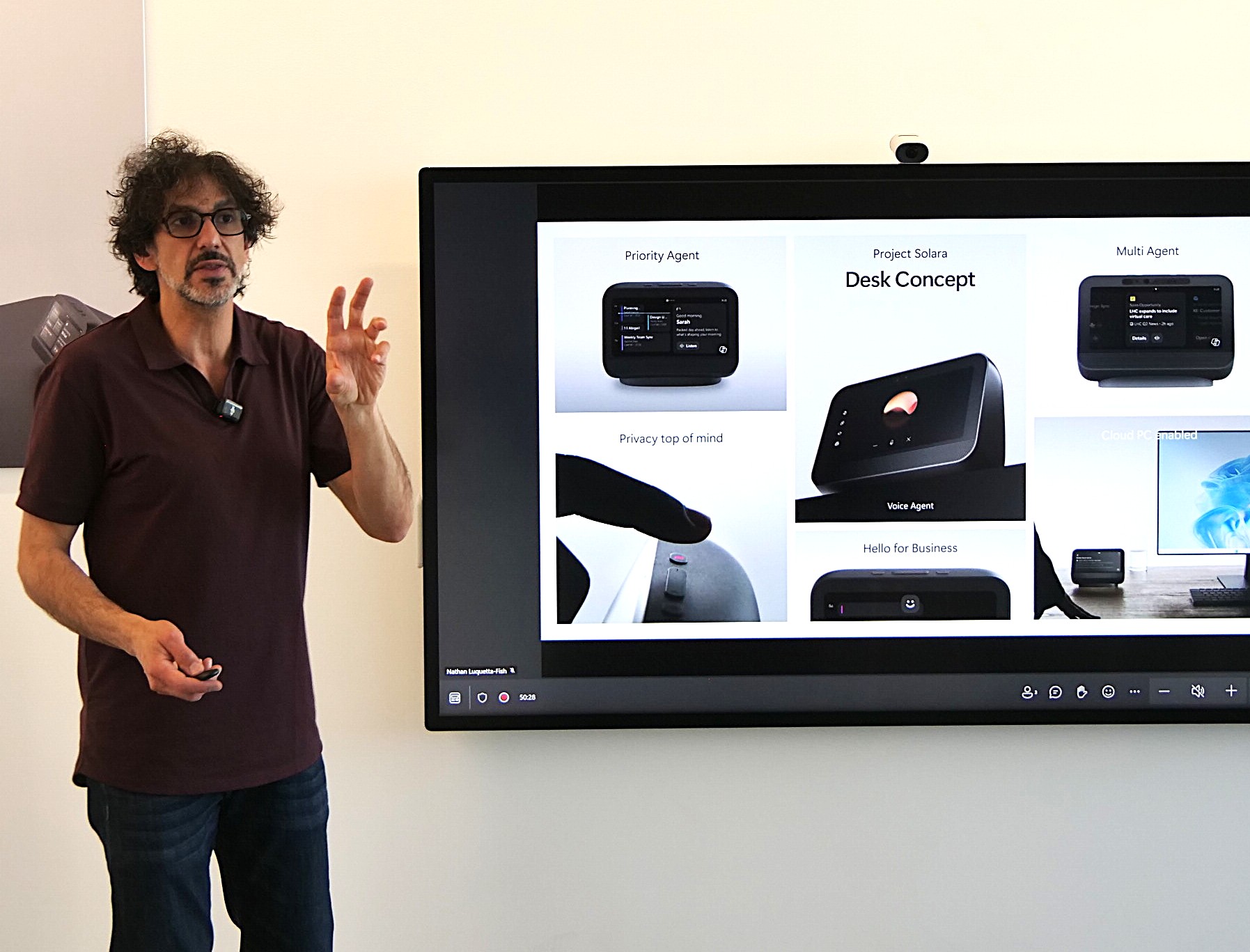
A team inside Microsoft has been quietly building a platform for devices that run AI agents instead of apps, based on Android instead of Windows, with two working hardware designs so far, and an initial set of big-name companies lined up to run pilots.
The platform, dubbed “Project Solara,” is Microsoft’s bet that AI will open up entirely new scenarios for computing — using agents to avoid the constraints of traditional software, and off‑the‑shelf components to develop new devices quickly and inexpensively.
Microsoft is racing against Google, Amazon, OpenAI and others to bring AI to devices and provide the technical backbone for a new generation of computing. In effect, the company is attempting to repeat with AI what it did for personal computers five decades ago, with much stiffer competition this time but also far greater technical freedom.
“Boundaries are collapsing,” said Stevie Bathiche, the Microsoft corporate vice president and technical fellow who leads its Applied Sciences Group. “You don’t necessarily need the traditional app model. You don’t need the traditional way of developing experiences.”
The company unveiled Solara on Tuesday at its Build conference in San Francisco, describing it as a new platform that spans from chip to cloud. GeekWire got a behind-the-scenes look at the project during a briefing last week in Redmond, including demos of the first two concept devices based on the platform:

- A desktop hub that sits beside a PC and responds to voice commands, signs users in using facial recognition, and surfaces the day’s most pressing items. With a monitor attached, it becomes a full Windows machine running in the cloud.
- A wearable badge that reimagines the standard employee ID card. A fingerprint button wakes an agent in one press; a single tap records and transcribes a conversation; and a built-in camera lets the agent act on what the user sees.
Microsoft says it won’t ship these devices itself. Instead, it envisions hardware makers and other industry partners turning the reference designs into implementations of their own, each intended for a specific industry, company, or scenario.
For example, in one demo shown by the company, the high-tech badge ran on agents designed for use by a health-care worker, including the ability to scan a patient’s QR code, record and transcribe the visit, log vitals, and start a prescription.
In another application of the same badge, the built-in camera scanned a brainstorm board with ideas for an office revamp, and made a suggestion: add some plants.
The two devices are a starting point. The bigger opportunity, the company says, is all the tasks and workflows where a PC or phone gets in the way or isn’t practical to use.
A display inside the Microsoft Applied Sciences lab gave a hint of where things could be headed, including smart glasses, rings, earbuds, scanners, and other form factors.

“This is a way to put computing in those spaces easily and cheaply, but more importantly, it’s a way to put your agent into those spaces,” Bathiche said.
In the coming months, companies including AccuWeather, Best Buy, CVS Health, Levi’s, and Target are expected to begin pilots of devices based on the reference designs.
The operating system is the Microsoft Device Ecosystem Platform, or MDEP, an enterprise version of Android that Microsoft developed for devices including Teams meeting-room hardware.
The company says it chose MDEP over Windows deliberately, to run on smaller, lower-power devices while keeping the management and security features IT departments expect: patch and over-the-air updates, device integrity, Microsoft Defender, Intune, and Entra ID sign-in.
What’s different
At first glance, the concept devices raise a couple of natural questions:
1) Why not just use a phone? Bathiche said companies have tried, particularly in healthcare, and it didn’t go well. Asking a nurse to pull up patient data on a personal device felt wrong to patients and created security problems.
A purpose-built device, he said, has a far smaller attack surface, can last a week on a single charge, and can orient its camera for face-to-face interaction rather than forcing the user to hold up a screen.
“Computers are continuing to specialize,” he said, describing a trend he has been calling out for years now. “Computers are continuing to come closer to you.”
2) Isn’t the desk device basically an Amazon Echo? Here, Bathiche drew a distinction: Alexa is one agent trying to do everything, while Solara is designed for each organization’s own agents, secured and managed by its IT department.
The practical difference was visible in the demo. The desk hub pairs with a PC over Bluetooth, hands off tasks between the two, and keeps them locked in sync. An Echo Show sitting next to the same PC wouldn’t know it was there.
Pushing the timeline
Still, the project is very early, by Microsoft’s own admission.
Microsoft’s Project Solara Unveiled: A Glimpse Into the Future of AI
During a recent briefing, Bathiche, a key figure at Microsoft, revealed that CEO Satya Nadella was impressed by the team’s work on Project Solara and suggested showcasing it at Build, a major event, much sooner than usual. This indicates the intense competition and rapid advancements in the AI industry, as well as the incredible pace at which new technologies are evolving.
The team managed to get the badge running on the platform in just three days, using existing software on a different chipset. This quick turnaround showcases the efficiency enabled by new technologies in the development process.
However, despite these advancements, there are still some fundamental aspects that need to be addressed. When questioned about the business model for the platform, Bathiche highlighted the reliance on Microsoft’s Azure cloud. Beyond this, the economic aspects are still being refined.
While the potential applications of the platform are promising, they are still in the early stages. For instance, the healthcare demo was a conceptual illustration rather than a clinical tool.
The platform allows for the simultaneous operation of multiple agents, with a coordination layer that selects the most suitable agent for a given task. Organizations can utilize Microsoft’s agents or integrate their own into the platform.
Qualcomm and MediaTek are the initial chip partners for the project. The badge runs on a new Qualcomm wearable chip, while the desk hub operates on MediaTek IoT silicon. By using off-the-shelf chips instead of custom ones, Microsoft aims to streamline production and reduce costs.
It is worth noting that OpenAI’s AI-agent phone is also being developed on MediaTek and Qualcomm silicon, highlighting the growing competition in this sector.
For Bathiche, Project Solara represents a vision of the future of computing. The project aims to redefine the user-computer interaction by bringing computing closer to the individual.








Oneplus 5T vs Pixel 2 XL vs S8 vs iPhone 8 Battery Charging Speed Test!

The Affordable Next-Gen Xbox: Debunking the $1,800 Price Tag

Revelation: A New Dawn in the Helldivers Universe

Battery Life Halved by Garmin’s New Voice Controls

Revolutionizing Energy: The Future of Next-Gen Battery Life

Warhound Secures $200M Investment to Develop Advanced Military Canines Equipped with Anduril Technology

No, the iPhone Duo isn’t a miniature device

Rebirth of Resilience: The Evolution of Crisis Management in the Digital Age

Australian Court Rules Against Apple’s App Store Monopoly

EU Takes Action Against Instagram and Facebook for Violating Illegal Content Rules

Warning: Facebook Creators Face Monetization Loss for Stealing and Reposting Videos

Facebook’s New Look: A Blend of Instagram’s Style

Facebook Compliance: ICE-tracking Page Removed After US Government Intervention

Facebook and Instagram to Reduce Personalized Ads for European Users

InstaDub: Meta’s AI Translation Tool for Instagram Videos

Reclaim Your Account: Facebook and Instagram Launch New Hub for Account Recovery

Meta discontinues Messenger apps for Windows and macOS

Breaking Updates: Meta Connect 2025 Unveils Latest Developments
Oneplus 5T vs Pixel 2 XL vs S8 vs iPhone 8 Battery Charging Speed Test!

MY NEW CAR?! (Q&A)

Should you buy your Smartphones Refurbished!?

6 Amazing SECRET Android Launchers (2017 / 2018)

6 Value for Money Tech Products you NEED to try!

iPhone X Helicopter 1200ft Drop Test!! + Mous Case Review

7 UNBELIEVABLE Smartphone Magic Tricks!

Oneplus 5T vs Oneplus 1 – 3 Years Later.

Top 20 BEST Smartphones of 2017!
-
 Facebook12 months ago
EU Takes Action Against Instagram and Facebook for Violating Illegal Content Rules
-
 Facebook1 year ago
Warning: Facebook Creators Face Monetization Loss for Stealing and Reposting Videos
-
 Facebook11 months ago
Facebook’s New Look: A Blend of Instagram’s Style
-
 Facebook1 year ago
Facebook Compliance: ICE-tracking Page Removed After US Government Intervention
-
 Facebook11 months ago
Facebook and Instagram to Reduce Personalized Ads for European Users
-
 Facebook1 year ago
InstaDub: Meta’s AI Translation Tool for Instagram Videos
-
 Facebook11 months ago
Reclaim Your Account: Facebook and Instagram Launch New Hub for Account Recovery
-
 Apple1 year ago
Meta discontinues Messenger apps for Windows and macOS
