
Amazon
Retail Revolution: A Decade of Innovation and Evolution

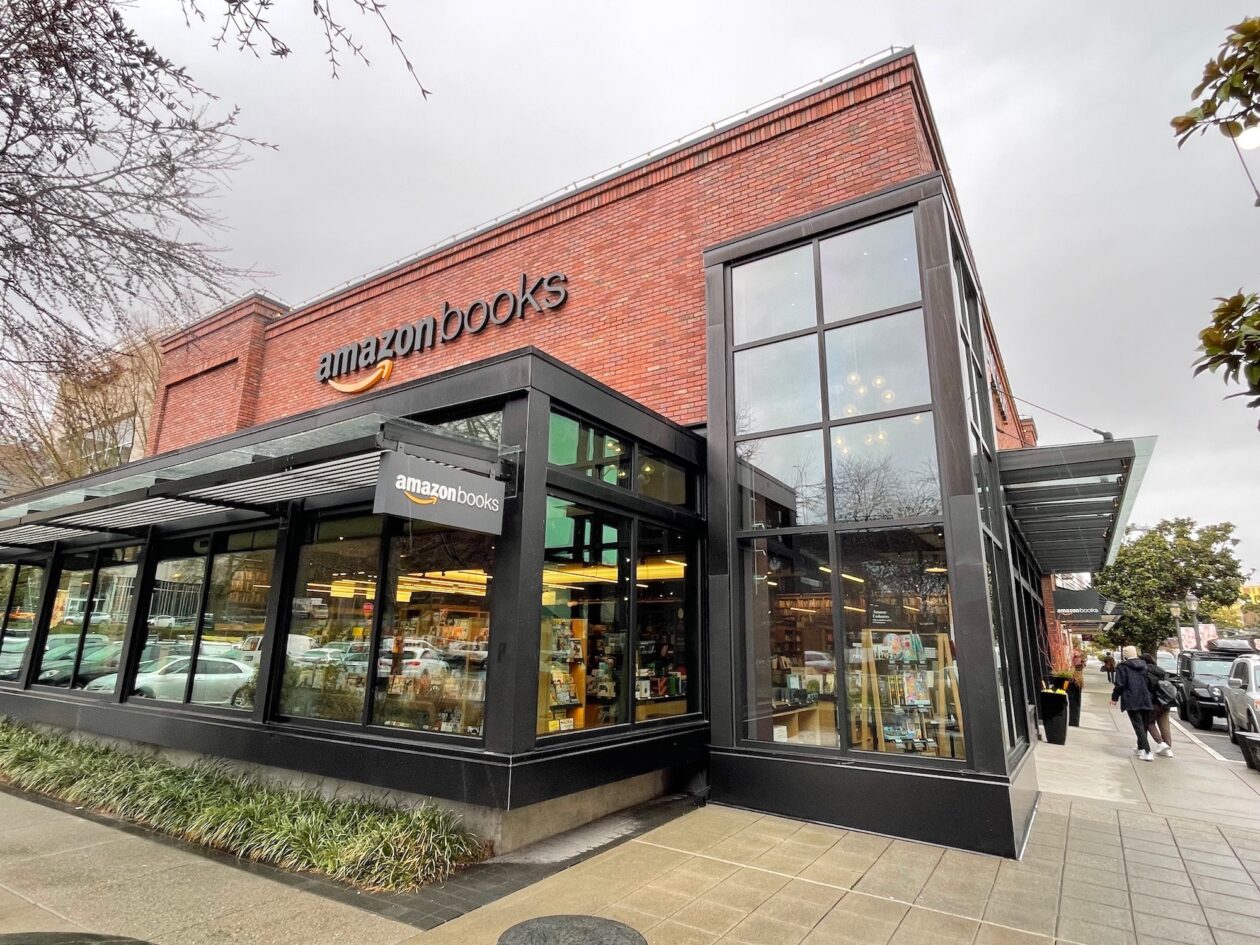
In November 2015, an intrepid GeekWire photographer attached a camera to a pole in an attempt to get a look inside Amazon’s first bookstore before it opened. OK, so maybe we went a little overboard, in hindsight, but it was a sign of just how significant the moment felt.
The world’s biggest online retailer was finally opening a store in the real world.
But in the ensuing decade, we’ve gone from peeking through the windows to watching the doors close on Amazon’s homegrown physical retail brands.
The news Tuesday that Amazon will shutter all 57 Amazon Fresh stores and 15 remaining Amazon Go locations isn’t just the end of Amazon-branded grocery stores. It’s a full-circle moment for a vision that dates back to Jeff Bezos’ heyday at the helm of the company.
Amazon says it will keep experimenting with new physical store concepts. And the Just Walk Out technology born in Amazon Go — a system of cameras and sensors that tracks what shoppers pick up and charges them automatically — will survive as a licensing business, now installed in more than 360 third-party locations including stadiums and airports.
But as a physical retailer in its own right, the company’s peculiar brand of innovation has yet to produce a formula that sticks.
The bookstores closed in 2022, along with the Amazon 4-star and Pop Up stores. The Amazon Style clothing stores followed in 2023. Now, Amazon Go and Fresh will soon be gone. What’s left is Whole Foods, a 45-year-old chain that Amazon acquired in 2017, not one it invented.
Amazon emphasizes a bias for action and calculated risk-taking in its leadership principles, and the company has never shied away from killing projects that don’t work. But as much as anything it has ever tried to do, Amazon’s physical retail initiatives have tested those values.
Efficiency vs. experience
Brittain Ladd, a supply chain consultant who worked at Amazon from 2014 to 2017, said he believes the core issue is that Amazon’s retail culture is built around efficiency and technology, not real-world customer experience. The company specializes in optimizing logistics and building systems, not in creating the kind of warm, inviting environments that draw shoppers into physical stores.
“What customers wanted was value, an experience, and quality,” Ladd said via phone Tuesday afternoon, expanding on his earlier comments on LinkedIn. “You walk into an Amazon Go store and it’s like, OK, I get it — this is what happens when the world ends and only robots are left.”
Others see a strategic shift, not a failure.
Amazon is betting the future of its Amazon Fresh brand on delivery, not stores. Same-day delivery of perishables — milk, eggs, produce — is now available in more than 2,300 U.S. cities, integrated into the same shopping cart as electronics and household goods.

Jason Goldberg, chief commerce strategy officer at Publicis, pointed to that progress as evidence that Amazon is simply winning grocery a different way.
“Don’t assume this means they are giving up Grocery,” Goldberg wrote on LinkedIn. “What has changed is that Amazon has figured out how to win Everyday Essentials and Perishables through same-day delivery from climate-controlled zones in fulfillment centers.”
In an internal memo to employees Tuesday, Jason Buechel, the Amazon Worldwide Grocery Stores VP and Whole Foods CEO, thanked the people who built and ran the Amazon Go and Amazon Fresh stores, calling them pioneers.
“Although we’re closing these stores, the impact of your work will shape our next generation of store concepts and customer experiences,” he wrote in the memo, obtained by GeekWire.
The delivery bet
Wall Street seemed unfazed by the store closures. Wedbush Securities called them “an important step forward in Amazon’s broader strategy,” noting that Amazon has struggled to displace incumbents in the grocery category, particularly for perishables.
The focus on delivery, the Wedbush analysts said, plays to Amazon’s strengths — its fulfillment network and Prime membership — rather than trying to compete store-for-store with Walmart, Kroger, and other entrenched players with thousands of locations.
The company is also testing “Amazon Now,” an ultra-fast delivery service that promises groceries and essentials in 30 minutes or less, using small rapid-dispatch hubs, starting in Seattle and Philadelphia.
Amazon stock closed up 2.6% on Tuesday. Instacart fell nearly 6%, a sign that investors see Amazon’s shift to delivery as a direct threat to the grocery delivery company’s core business.
The broader stakes are huge. Americans spend more than $1 trillion a year on groceries, and Amazon has been chasing that market since it launched Fresh delivery in Seattle in 2007.
The company now claims to be one of the top three grocers in the U.S., with more than $150 billion in annual gross sales. Whole Foods sales have grown more than 40% since the 2017 acquisition, and Amazon plans to open more than 100 new stores over the next several years.
Challenges for Whole Foods
But Ladd asserts that even Whole Foods has a fundamental problem Amazon isn’t adequately addressing. He says a large number of Whole Foods customers leave the store to finish their grocery shopping at competitors that offer mainstream brands like Coke, Tide, and Oreos.
Amazon is testing a workaround.
Revolutionizing the Shopping Experience at Whole Foods
In Plymouth Meeting, Pa., Whole Foods has introduced a groundbreaking “store within a store” concept that allows customers to scan QR codes on shelf displays to order popular products like Kraft Mac & Cheese, Tide Pods, and Pepsi. These items are then fulfilled by a 10,000-square-foot automated micro-fulfillment center located discreetly at the back of the store. By the time shoppers finish their shopping, the products are ready for pickup, thanks to a fleet of specialized robots working behind the scenes. Amazon has announced plans to expand this innovative concept to more Whole Foods locations in the near future.
Challenging Traditional Grocery Shopping
Some critics, like Ladd, believe that a simpler approach would be to stock these products directly on the Whole Foods shelves in an “Amazon Grocery” section. They argue that the current method of using expensive workarounds to fulfill orders may not effectively address the underlying issue. Despite these concerns, Amazon is committed to maintaining a hybrid Amazon grocery store alongside Whole Foods in Chicago and has received approval to construct a 230,000-square-foot “supercenter” that combines groceries with general merchandise.
Origins of Amazon’s Grocery Store Vision
The concept of Amazon’s physical grocery and convenience stores originated from Jeff Bezos himself, who believed that computer vision and artificial intelligence could revolutionize the shopping experience by eliminating the need for customers to wait in line to pay. Bezos envisioned thousands of Amazon Go stores across urban areas, but the project faced challenges and was eventually scaled back. The initial focus on convenience stores led to the development of larger formats such as Amazon Go Grocery and Amazon Fresh grocery stores.
In a 2012 interview, Bezos expressed a desire to open physical stores only if they could introduce a truly unique concept that reflected Amazon’s innovative spirit. Despite evolving ideas and formats over the years, Amazon continues to explore new ways to differentiate its physical stores and enhance the shopping experience for customers.
While the journey to find the perfect approach may be ongoing, Amazon’s commitment to innovation and customer-centric solutions remains steadfast.










Exploring the Exciting Updates of iOS 27: A Look Beyond Artificial Intelligence

A $50,000 Smartphone for $400?

Ram Trucks Australia Braces for Price Increases Due to Emissions Regulations

Revving Up: Tractor Battle Adventure RPG Expands with Mod Support on Steam Workshop

Troubleshooting Guide: Unable to Access 192.168.0.1

Choosing the Right AI: Ensuring Trust in Multi-Model Translation Systems

Friday Night Baseball Madness: iPhone 18 Pro Edition

Partnership Potential: JAC & Huawei in Talks to Produce Electric Maserati Vehicles

Grand Theft Auto VI: The Soundtrack – Limited Edition Physical Release

EU Takes Action Against Instagram and Facebook for Violating Illegal Content Rules

Warning: Facebook Creators Face Monetization Loss for Stealing and Reposting Videos

Facebook’s New Look: A Blend of Instagram’s Style

Facebook Compliance: ICE-tracking Page Removed After US Government Intervention

Facebook and Instagram to Reduce Personalized Ads for European Users

InstaDub: Meta’s AI Translation Tool for Instagram Videos

Reclaim Your Account: Facebook and Instagram Launch New Hub for Account Recovery

Meta discontinues Messenger apps for Windows and macOS

Breaking Updates: Meta Connect 2025 Unveils Latest Developments
A $50,000 Smartphone for $400?

Huawei P20 Pro Unboxing!

Huawei P20 Pro vs Samsung S9 Plus!

Huawei P20 vs P20 Pro vs iPhone 8 Plus vs S9 Battery Drain Test!

10 Android Mods that Change Everything

I used the first Android Phone in the World.

DOOGEE MIX 4 UNBOXING (PROTOTYPE)!

MYSTERY UNBOXING FROM SAMSUNG!

The Truth about Huawei P20 Pro – REAL Review
-
 Facebook11 months ago
EU Takes Action Against Instagram and Facebook for Violating Illegal Content Rules
-
 Facebook11 months ago
Warning: Facebook Creators Face Monetization Loss for Stealing and Reposting Videos
-
 Facebook9 months ago
Facebook’s New Look: A Blend of Instagram’s Style
-
 Facebook11 months ago
Facebook Compliance: ICE-tracking Page Removed After US Government Intervention
-
 Facebook9 months ago
Facebook and Instagram to Reduce Personalized Ads for European Users
-
 Facebook11 months ago
InstaDub: Meta’s AI Translation Tool for Instagram Videos
-
 Facebook10 months ago
Reclaim Your Account: Facebook and Instagram Launch New Hub for Account Recovery
-
 Apple11 months ago
Meta discontinues Messenger apps for Windows and macOS
