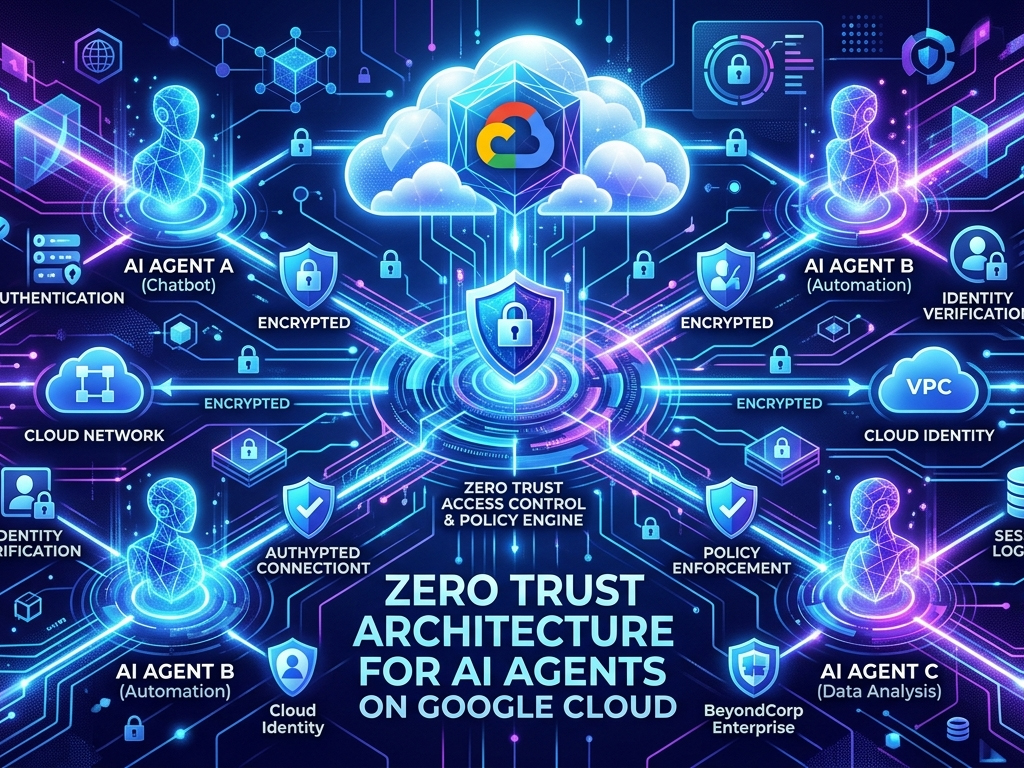
Exploring the Evolution of AI Agents in Enterprise Environments
Artificial Intelligence (AI) Agents have witnessed a significant transformation within enterprise settings, progressing from basic chatbots to sophisticated autonomous systems that can perform tasks on behalf of users, interact with APIs, and manipulate backend resources. This shift towards absolute autonomy brings substantial business benefits but also challenges the conventional perimeter-based security model. This article delves into the intricacies of establishing a robust Zero Trust Architecture tailored specifically for AI agent workloads within the Google Cloud ecosystem.
The Emergence of AI Agents and the Complex Security Landscape
AI agents, often powered by advanced Large Language Models (LLMs) and frameworks like Vertex AI, LangChain, or AutoGPT, possess the ability to perceive, reason, and execute intricate business processes independently. Unlike traditional applications with predefined execution paths, AI agents dynamically determine their actions based on real-time inputs, prompts, and interconnected data sources.
This dynamic nature introduces new vulnerabilities that traditional network defenses may fail to detect:
- Manipulating Prompts: Deceiving an agent into executing unintended commands or altering its core instructions by manipulating input strings.
- Flawed Tool Usage & Excessive Autonomy: Exploiting logic errors or unchecked inputs to trick an agent into executing authorized yet potentially harmful backend commands (e.g., invoking a delete_all_files() function).
- Data Breaches & Manipulation: Coercing an agent to disclose sensitive data through Retrieval-Augmented Generation (RAG) sources or tampering with these underlying sources (e.g., BigQuery, Google Cloud Storage) to manipulate agent decisions deliberately.
- Resource Exhaustion: Inducing the agent into resource-intensive operations, leading to excessive LLM token consumption or complex database queries.
Given that an agent operates as a dynamic entity within an environment, the traditional static network perimeter is no longer effective. Security measures must pivot towards resource-level controls, embracing Zero Trust principles such as explicit verification, least privilege access, and minimizing the impact radius.
Essential Security Pillars for Safeguarding AI Agents
Implementing Zero Trust for AI workloads necessitates a comprehensive security framework encompassing identity management, data protection, API utilization, network traffic oversight, and behavior monitoring.
- Enhancing Workload Identity Security
Conventional applications often rely on static, exportable service account keys, posing a significant vulnerability if an agent is compromised.
- Keyless Authentication: Link the agent’s deployment environment, whether on Google Kubernetes Engine (GKE) or Cloud Run, directly to a Google Cloud Service Account (SA) through Workload Identity. This ensures that the agent only uses ephemeral, non-exportable credentials without relying on keys.
- Context-Aware Identity Management: Enforce stringent Identity and Access Management (IAM) permissions on the service account. Employ IAM Conditions to impose time-bound or resource-specific constraints, ensuring that the agent operates within predefined boundaries.
- Securing Inputs and Outputs
Every interaction with an LLM, whether input or output, should be treated with suspicion and handled cautiously.
- Frontline Defense: Deploy Cloud Armor to safeguard user-facing agent endpoints against common web vulnerabilities (e.g., SQL injection, XSS) and emerging prompt injection techniques before they reach the orchestration layer.
- Data Sanitization: Utilize native code or regex libraries to eliminate control characters. Additionally, leverage Vertex AI Safety Filters to establish thresholds that prevent hate speech, harassment, or unsafe content in both incoming prompts and generated responses.
- Data Leakage Prevention: Direct inputs and outputs through Cloud DLP (Data Loss Prevention) to automatically redact Personally Identifiable Information (PII) or sensitive corporate data, mitigating the risk of confidential information leakage.
- Enforcing Explicit Authorization for Tools and APIs
Any external application or database invocation by an agent must undergo explicit authentication and authorization.
- Fine-Grained API Access: Expose agent tools through Apigee or Cloud Endpoints. The agent’s dedicated Workload Identity should authenticate via OAuth 2.0 / IAM for each specific tool, preventing unauthorized access to unapproved API endpoints.
- Secure Secret Management: Store third-party API tokens in Secret Manager instead of hardcoding them. Grant the agent’s service account restricted IAM privileges solely to the necessary secret path.
- Human Validation: For critical tasks such as high-value transactions or resource deletions, mandate human verification before the tool invocation is finalized.
- Implementing Least Privilege Data Controls (RAG Security)
When utilizing Retrieval-Augmented Generation (RAG), it is crucial to restrict the agent’s access to global corporate data repositories.
- Granular Data Security: Limit the agent’s service account to read-only permissions on specific Google Cloud Storage (GCS) buckets or BigQuery. Implement row-level and column-level security in BigQuery to precisely define the data accessible to the agent.
- Data Encryption and Access Controls: Secure sensitive RAG repositories within a VPC Service Controls (VPC-SC) to prevent compromised agents from transferring data to unauthorized external entities. Utilize Customer-Managed Encryption Keys (CMEK) through Cloud KMS to encrypt datasets at rest.
- Advanced Network Segmentation and Outbound Traffic Management
An unrestricted network environment can enable a compromised agent to move laterally or communicate with malicious external servers.
- Isolated Environments: Deploy agent runtimes on private GKE clusters or isolated Cloud Run configurations supported by VPC Connectors. Implement a Default-Deny policy for all inbound and outbound traffic.
- Comprehensive Outbound Inspection: Route necessary outbound internet traffic through Cloud NGFW Enterprise, leveraging its Intrusion Prevention Service (IPS) to detect malware, spyware, and abnormal communication. Enable TLS Inspection to decrypt and monitor outbound HTTPS traffic for potential data exfiltration attempts.
- Controlled Gateways: Utilize Secure Web Proxy (SWP) with Fully Qualified Domain Name (FQDN) filtering to restrict agent connections to approved third-party domains. Safely route authorized outbound traffic through Cloud NAT.
- Secure Service Connections: Access Google APIs, Vertex AI, or internal data repositories exclusively through Private Service Connect (PSC), isolating traffic from public routing tables.
Continuous Monitoring and Anomaly Detection
Pairing a static configuration with real-time monitoring is essential to ensure that the agent operates within expected behavioral parameters.
| Source of Logs | Security Metrics Monitored |
| Cloud Audit Logs | Tracking every API call, configuration alteration, and IAM request made by the agent’s service account. |
| Application Logs | Maintaining a comprehensive record of text prompts, generated LLM responses, and tool invocation sequences. |
| VPC Flow Logs | Capturing Netflow data to monitor destination IPs and packet sizes, identifying potential data exfiltration attempts. |
Security teams should establish proactive alerts within Cloud Monitoring to detect anomalies indicative of a security breach:
- Unusual spikes in API activity or unexpected LLM token consumption (indicating potential Denial of Wallet scenarios).
- Frequent PERMISSION_DENIED errors from the agent’s service account, suggesting unauthorized exploration attempts.
- High rates of tool execution failures, signaling potential exploit or prompt injection incidents.
Centralize these alerts within the Security Command Center to consolidate insights across the entire Google Cloud organization.
In Conclusion
The autonomy exhibited by AI agents necessitates a robust security framework. Relying on outdated perimeter defenses exposes organizations to vulnerabilities. By adopting a Zero Trust approach and leveraging Google Cloud’s native security tools—from Workload Identity and VPC-SC to Cloud NGFW and Vertex AI Safety Filters—businesses can harness the transformative potential of AI agents securely.
 Harika Rama Tulasi Karatapu, a seasoned Network Security Architect with extensive experience in cloud and traditional networking, brings a wealth of expertise to her role. As an IEEE Speaker, she specializes in designing and implementing secure, high-performance networking solutions across Google Cloud Platform (GCP) and Amazon Web Services (AWS).
Currently serving as a Network Security Specialist, Customer Engineer at Google LLC, Harika architects cloud-native, multi-cloud, and hybrid networking solutions for enterprise clients, focusing on optimizing cost, performance, and security. She collaborates with C-suite executives on cloud adoption strategies, leads the Network Architecture for Health Care Life Sciences, and contributes to Google Cloud for Startups as a technical mentor.
Prior to her tenure at Google, Harika honed her skills at Juniper Networks, Amazon Web Services, and Infosys, where she worked on network architecture, troubleshooting, automation, and security. A certified Juniper expert with JNCIE-ENT and JNCIE-DC credentials, Harika completed her master’s degree in Electrical Engineering with a specialization in Computer Networking from San Jose State University.
Connect with Harika Rama Tulasi Karatapu online at LinkedIn and visit the company website here.