
Microsoft
Tech Titans Clash: Inside the Courtroom as Elon Musk Battles OpenAI and Microsoft

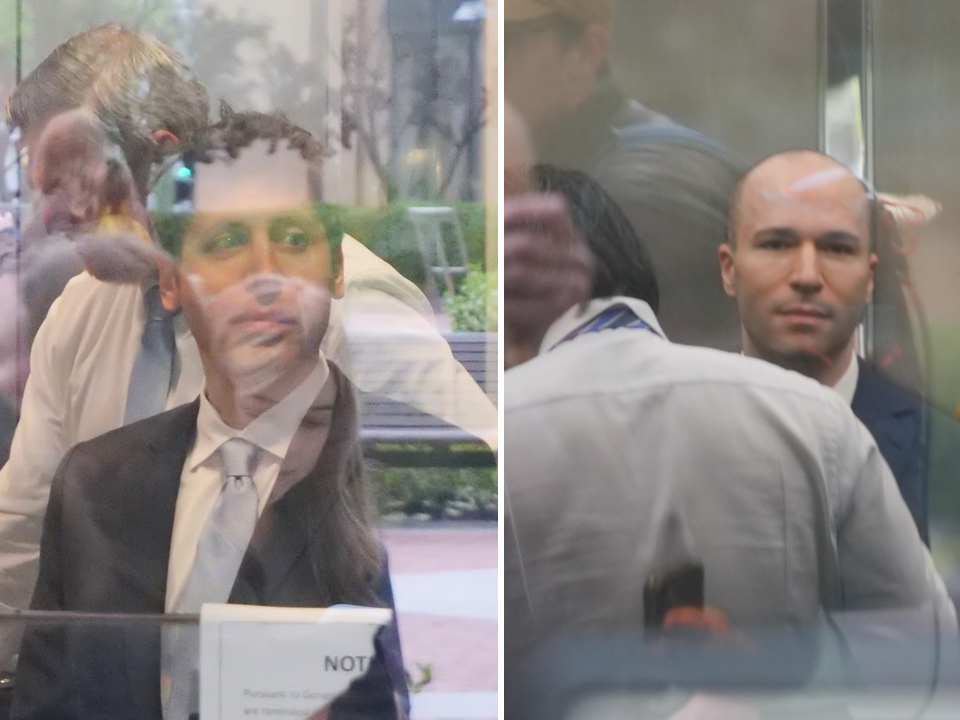
OpenAI CEO Sam Altman, left, and President Greg Brockman as photographed through the windows of the federal courthouse in Oakland as they arrived for jury selection in Elon Musk’s lawsuit against Altman, OpenAI, and Microsoft. (GeekWire Photos / Todd Bishop)
OAKLAND — Did Microsoft knowingly help OpenAI abandon its nonprofit mission?
That question sits at the center of a trial starting here this week, pitting the world’s richest man against the AI nonprofit he helped found and the tech giant that bankrolled its transformation.
It’s being called the “AI Trial of the Century,” with Elon Musk and Sam Altman in starring roles, and a supporting cast that includes Microsoft CEO Satya Nadella, CTO Kevin Scott and CFO Amy Hood. Current and former OpenAI execs and board members are also on the witness list.
Monday morning in Oakland, Altman and OpenAI President Greg Brockman were on hand for jury selection, with the OpenAI CEO sitting in the front row behind the lawyers’ tables in a dark suit and light blue tie, quietly scrolling on his phone as he waited for the process to begin.
Musk was not present for jury selection. He is expected to take the stand later in the trial.
A protest was scheduled for midday outside the courthouse, organized by the Tesla Takedown activist group under the banner “Whoever Wins, We Lose” — arguing that a billionaire power struggle over AI’s future has little to do with ordinary people.

A crowd of lawyers and reporters waits outside the U.S. Courthouse in Oakland for the start of jury selection Monday in Elon Musk’s lawsuit against Sam Altman, OpenAI and Microsoft. (GeekWire Photo / Todd Bishop)
A nurse said AI creates more work in her job, requiring frequent checking and correction.
One prospective juror, when asked by the judge if she has worked in teams, asked if the judge was referring to the conferencing app. “Microsoft is happy that you asked that question,” the judge said.
When another prospective juror expressed concern about being able to follow the technical nuances of the case, the judge replied, “This is just a case about promises and breaches of promises.”
What’s at stake for Microsoft: Amid the feud between two of tech’s most polarizing personalities, Microsoft might seem like a subplot, but its actions are at the heart of the case.
The company has invested more than $13 billion in OpenAI since 2019, building its products around the partnership and betting its competitive future on the deal, before hedging its bets more recently with rival AI firms and its own in-house models.
A victory for Elon Musk would mean a federal judge ordering Microsoft to hand over a slice of what its OpenAI partnership has been worth — not to Musk, but to the OpenAI nonprofit.
Musk’s damages expert puts the combined demand as high as $134 billion across both defendants, with Microsoft’s share between $13.3 billion and $25 billion. However, the judge has already called these figures into question, saying Musk’s expert was “pulling these numbers out of the air.” Microsoft called the methodology “unverifiable” and “unprecedented.”
A loss could also hand regulators in the United States and Europe new ammunition just as the company tries to defend its OpenAI relationship from antitrust scrutiny. In that way, it could force every major tech company to rethink how it invests in mission-driven AI labs.
The story took a new twist Monday morning when Microsoft and OpenAI announced a major amendment to their partnership — loosening the terms of their alliance and, perhaps not coincidentally, demonstrating that their fortunes aren’t as aligned as they once were.
Microsoft’s defense: In short, the company says it was kept in the dark, that it invested as a commercial partner, never informed by OpenAI of any charitable restrictions attached to Musk’s contributions or any duties the company owed to the Tesla and SpaceX founder.
Former OpenAI CTO Mira Murati appeared to back that up in her deposition, testifying that she never told anyone at Microsoft about those restrictions. In a filing over the weekend, Microsoft’s lawyers flagged a discrepancy: Murati’s answer to that question was missing from the official deposition transcript. It was audible on the video recording, but absent from the written record.
Microsoft has also pointed to its work with Musk’s own AI company, xAI, as evidence of its neutrality — arguing in pretrial motions that hosting xAI’s Grok model on Azure proves it is simply a platform for competing AI models, not a partisan actor in OpenAI’s transformation.
Microsoft’s cleanest path to victory, however, may be procedural.
The Legal Battle Between Elon Musk and Microsoft-OpenAI: Unveiling the Truth
Elon Musk’s legal claims against Microsoft-OpenAI are met with a strong defense citing the statute of limitations, with the company’s key evidence being Musk’s own statements.
In a tweet from September 2020, Musk accused OpenAI of being under Microsoft’s influence. Microsoft aims to prove that Musk was aware of this connection over three years before filing the lawsuit, which could negate the massive financial implications.
A Crucial Piece of Evidence? Musk’s legal team highlights an internal email from Microsoft dated March 2018, in which Microsoft’s CTO questioned the transformation of OpenAI into a profit-driven entity.
The email expressed concerns about the shift in OpenAI’s approach and whether the major donors were informed about it. Despite these reservations, Microsoft proceeded to invest significant amounts in OpenAI.
Various internal Microsoft communications have surfaced during the case, shedding light on deliberations regarding OpenAI’s board composition during a crisis in November 2023.
During Nadella’s deposition, Musk’s lawyers presented him with the aforementioned email, to which Nadella responded diplomatically, emphasizing the autonomy of OpenAI’s nonprofit board in decision-making.
Microsoft argues that the email demonstrates due diligence rather than culpability, as OpenAI’s board had provided assurances that their actions would not infringe on any third-party rights, which Microsoft relied upon legally.
The Origin Story: Musk co-founded OpenAI in 2015 with a philanthropic vision for AI development, contributing substantial funds before parting ways with the board in 2018. His lawsuit in late 2024 alleges a deviation from the nonprofit mission, with Altman and others accused of turning OpenAI into a for-profit enterprise for personal gain.
What Lies Ahead: Judge Gonzalez Rogers anticipates the trial’s conclusion by May 21, with nine jurors deliberating the case following three weeks of evidence presentation. If Musk prevails, the judge will determine the damages owed by Microsoft-OpenAI in a subsequent proceeding.
Related Read: Delving into the Microsoft-OpenAI Files: Exposing the Realities of AI’s Pivotal Partnership







Unleashing the Beast: A Closer Look at the 2022 Lamborghini Countach LPI 800-4

Microsoft Unveils Exciting Updates at Windows and Surface Event on October 7th

Alien Surgery Showdown: A Four-Player Chaos Experience

Essential Tips for Traveling to Japan: A Tech Advisor’s Guide

Oppo Find X10 Pro Max: Making a Bold Statement in the Global Market

Understanding the Impact of Comparative Fault Laws on Your Injury Compensation

The Value of Connection: How Meta’s Subscription Model is Revolutionizing Social Media and AI

Revamped Apple Stores: The Return of the Genius Bar

MYSTERY UNBOXING FROM SAMSUNG!

EU Takes Action Against Instagram and Facebook for Violating Illegal Content Rules

Warning: Facebook Creators Face Monetization Loss for Stealing and Reposting Videos

Facebook Compliance: ICE-tracking Page Removed After US Government Intervention

Facebook’s New Look: A Blend of Instagram’s Style

Facebook and Instagram to Reduce Personalized Ads for European Users

InstaDub: Meta’s AI Translation Tool for Instagram Videos

Reclaim Your Account: Facebook and Instagram Launch New Hub for Account Recovery

Meta discontinues Messenger apps for Windows and macOS

Breaking Updates: Meta Connect 2025 Unveils Latest Developments
MYSTERY UNBOXING FROM SAMSUNG!

The Truth about Huawei P20 Pro – REAL Review

How to Love your Android Phone again.

The LG G7 has a Big Problem.

The most Beautiful Android Games you’ve never played.

Charge your Smartphone in 5 Minutes – How Batteries are about to Change!

10 CHEAP Smartphone Gadgets that Change Everything.

Huawei Mobile Cloud – The Huawei P20 Feature you didn’t know about!

PUBG MOBILE on Android – Disastrous or Revolutionary?
-
 Facebook11 months ago
EU Takes Action Against Instagram and Facebook for Violating Illegal Content Rules
-
 Facebook11 months ago
Warning: Facebook Creators Face Monetization Loss for Stealing and Reposting Videos
-
 Facebook11 months ago
Facebook Compliance: ICE-tracking Page Removed After US Government Intervention
-
 Facebook9 months ago
Facebook’s New Look: A Blend of Instagram’s Style
-
 Facebook9 months ago
Facebook and Instagram to Reduce Personalized Ads for European Users
-
 Facebook11 months ago
InstaDub: Meta’s AI Translation Tool for Instagram Videos
-
 Facebook9 months ago
Reclaim Your Account: Facebook and Instagram Launch New Hub for Account Recovery
-
 Apple11 months ago
Meta discontinues Messenger apps for Windows and macOS
