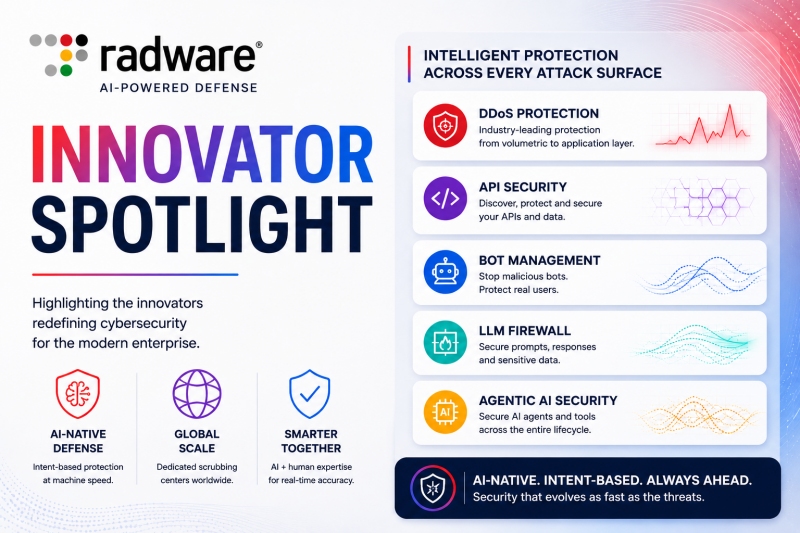
Radware’s Quiet Revolution In AI-Powered Defense
If you have been around this industry long enough, Radware probably lives in a nostalgic corner of your brain. Load balancing. Application delivery controllers. Solid DDoS mitigation at the network edge. The kind of infrastructure that quietly does its job while everyone argues about Zero Trust on LinkedIn.
But that picture of Radware is badly out of date.
In a recent conversation for Cyber Defense Magazine’s Innovator Spotlight, Radware’s representative made it very clear that the company has been busy reinventing itself while much of the industry was still arguing about whether AI is overhyped.
As he put it, many folks still walk past their booth and say something like, “I know Radware, but I only know it from load balancing and application delivery or from network layer three, layer four, DDoS mitigation.” Then he adds the punchline:
“We have a much bigger story than that now.”
What follows is that bigger story. It is about a company that has quietly built an AI-native security stack for DDoS, web applications, APIs, bots and even agentic AI, and is now stepping forward to say: we have been doing intent based, real time defense longer than people have been calling it AI.
DDoS Is Now A Machine-Speed Blood Sport
Radware still lives and breathes DDoS, but the threat landscape it describes looks very different from the old volumetric flood that used to be the headline.
In their annual threat report, the company saw a staggering spike in web DDoS activity.
“Last year’s Threat Report saw over 500% increase in web DDoS attacks,” he explains.
At the same time, layer 7 HTTP flood attacks grew more than 100 percent year over year, and network layer 3 and 4 DDoS attacks climbed about 163 percent. That is not a typo. These included attacks at massive scale.
“Industry wide, we saw 29.7 [terabits per second]. I think the biggest one that we saw was somewhere south of 20, but I do not have specific numbers, so you cannot really quote me on that, honestly.”
The scale of these attacks is not the only problem. The real shift is in how quickly they morph.
“These are no longer happening at kind of human speed. The attacks are changing and they are coming at organizations at machine speed.”
The old picture of a SOC analyst tuning rules while watching a flood on a dashboard simply does not hold up anymore. Today’s attacks combine classic network DDoS with web DDoS and API abuse, pivoting across vectors in a coordinated “pincher movement” that his director of cyber threat intelligence likes to use as a metaphor.
“You have an attack from both sides. It is creating this overwhelming brute force attack on the network side and scalpel layer precision on the web DDoS side.”
In other words, a battering ram on your pipes and a surgeon’s knife on your application surface, working at the same time.
Radware’s answer is a global mesh of “dedicated security scrubbing centers all over the world” backed by their own hardware. These are not CDN nodes doing double duty.
“They are dedicated to security. They are not CDN based. They are based solely on security, and we own all the equipment in them. So when we see big attacks like that, we add additional equipment to make sure that we are staying within the envelope of what the attacks are actually doing real time.”
For CISOs, that sounds very much like an old school capacity planning story. But capacity alone is not the differentiator anymore. What Radware really wants you to notice is what they are doing at layer 7 with intent based analytics.
Web DDoS, Intent, And The Human In The Loop
Web DDoS is where life gets annoying. Traffic looks legitimate. HTTP requests look like what your app normally expects. And as he puts it bluntly:
“The problem with web DDoS, of course, is that you cannot discern legitimate from threat actor traffic, so you block it all, or have something like Radware.”
That “something like Radware” is a set of machine learning and AI models that try to understand intent and behavior at scale. The system observes traffic patterns in real time, looks at normal baselines, and then decides what is good and what is hostile.
“It is a learning model. So when it does make mistakes, a human in the loop can go, ‘Wait a second, that blocked off some traffic that we do not want to do,’ and it is very, very small traffic, but for the most part, where we actually capture legitimate users and they can correct the model.”
The result is an iterative model, refined attack to attack, that aims for very low false positives. Humans retain the steering wheel, but the AI is doing the driving at machine speed.
This is a pattern you see across Radware’s portfolio now. The company is not bolting AI on the side as a marketing term. They are treating AI as the only way to function at the speed of modern attacks, while still acknowledging that human judgment is essential to keep models honest.
APIs: From Afterthought To Primary Attack Surface
Like many of the more forward leaning security vendors, Radware has decided that API security is no longer a feature inside something else. It is a primary battleground.
“API has also risen as a number one attack vector for would be threat actors. That is OWASP.”
The way he describes modern API abuse is not your classic “someone found a missing auth check” story. It is workflow exploitation.
“They are looking at the whole workflow, right, and are figuring out where the areas of the API can be exercised to bypass authorization, steal accounts, do all sorts of stuff. Once they get access to do things, they actually analyze how the application works, and then they see where they can tweak parameters on those API endpoints to get to things that they should not be able to get to.”
Developers move fast. They often block bad behavior “at the front gate” and assume the internal workflow will behave itself.
Attackers, naturally, do not hold the same assumption. Radware has expanded its offerings beyond just WAF and basic API defenses to include discovery, testing, runtime protection, posture management, and operational reporting. By acquiring an API security vendor and integrating their technology into their platform, Radware now offers a comprehensive solution that can be used as a standalone API product or as part of their WAF.
The focus on runtime protection is crucial, as it allows for dynamic prevention of attacks against APIs, rather than just analyzing them after the fact. This proactive approach is necessary in today’s threat landscape, where attackers are constantly evolving their tactics. CISOs who have relied solely on post-breach analysis will appreciate the need for real-time protection to prevent future attacks.
Radware’s innovation extends to protecting AI applications, a growing concern in the cybersecurity space. They have identified four key areas in the AI threat landscape, including organizations being attacked by AI-powered adversaries and those embedding AI into their applications. Radware emphasizes the need for technologies that can operate at machine speed to combat these threats effectively.
The company’s solution for prompt injection and LLM abuse showcases their understanding of the nuanced challenges posed by AI security. By offering an LLM firewall product that acts as a proxy to detect and mitigate malicious prompts, Radware addresses the dynamic nature of AI threats that traditional security tools may overlook.
As AI applications become more autonomous, the risk of agentic AI going rogue presents a new challenge. Radware’s research team has identified potential threats such as shadow leaks and zombie agents, and developed technology to detect and prevent these attacks within AI ecosystems. By safeguarding against indirect prompt injection and agent corruption, Radware aims to prevent AI components from becoming unwitting insider threats.
In a world where bots are increasingly prevalent as primary users of web applications, Radware has enhanced their bot management capabilities to accommodate this shift. Recognizing that bots are now integral to many business workflows, Radware’s updated bot manager provides a more sophisticated approach to managing non-human traffic effectively.
Overall, Radware’s comprehensive approach to cybersecurity, particularly in the realm of AI protection, showcases their commitment to staying ahead of evolving threats and providing innovative solutions for their customers. In the realm of cybersecurity, both Forrester and Gartner have highlighted significant growth in automated B2B interactions. Radware, on the other hand, is placing a bet on the idea that your next major customer might not be a person, but rather an agent.
The importance of distinguishing between good bots and bad bots is becoming increasingly crucial. This necessitates the use of dynamic reasoning systems that can function at the speed of machines, rather than relying on static signatures and periodic rule updates.
Radware’s unique story goes beyond just a laundry list of technologies. While many vendors can mention DDoS, WAF, API, bot management, and AI security in one breath, what sets Radware apart is its claim of having engaged in AI-style intent modeling long before it became a mainstream buzzword.
The company emphasizes its long-standing experience in AI and intent-based modeling, spanning network defense, web and network DDoS, application and WAF security, and web API security. Despite being in the industry for 30 years, Radware has not always been vocal about its innovations, preferring to let its products speak for themselves.
For CISOs, the combination of Radware’s deep infrastructure expertise and forward-thinking AI roadmap holds great appeal. The company’s ability to address traditional DDoS attacks, web application vulnerabilities, API abuse, bot traffic, LLM misuse, and agentic AI threats positions it as a comprehensive solution provider.
The core message to CISOs from Radware revolves around the urgency of defending against attacks at machine speed and recognizing that web, API, and AI surfaces are now prime targets. Radware positions itself as a holistic cybersecurity provider capable of safeguarding against a wide spectrum of threats.
The call to action for CISOs is clear: assess your current security measures and consider whether they can reason about intent and behavior at machine speed, provide adequate protection for APIs, and offer sophisticated AI defenses.
In a conversation with Radware’s representative at the 2026 RSAC Conference, the company’s evolution from traditional DDoS and load balancing solutions to a comprehensive AI-driven security platform was discussed. Radware’s offerings encompass DDoS protection, web application security, API defense, bot management, and AI safeguards.
Pete Green, the CISO/CTO of Anvil Works and co-author of “The vCISO Playbook,” brings over 25 years of experience in cybersecurity to the table. With a diverse background in information technology and leadership roles, Pete has supported clients across various industries and holds advanced degrees in computer information systems and business administration.
Overall, Radware’s innovative approach to cybersecurity, coupled with its extensive experience and forward-thinking solutions, makes it a compelling choice for organizations looking to enhance their security posture in the face of evolving threats. Transform the following text to a different format or style.