Implementing cybersecurity frameworks like NIST CSF, ISO/IEC 27001, and the CIS Critical Security Controls has played a crucial role in standardizing security practices across various industries. These frameworks establish a common language, outline control domains, and assist organizations in assessing risk in a structured manner.
Nevertheless, the real challenge in practical settings, particularly for small and mid-sized businesses, lies not in the absence of frameworks but in their execution.
Security leaders often face constraints that theoretical models fail to fully consider: limited budgets, small teams, diverse infrastructures, legacy systems, and conflicting business priorities. In such scenarios, cybersecurity maturity is not measured by the number of controls documented but by the effectiveness of deploying, maintaining, and recovering from a small set of controls when failures inevitably occur.
Therefore, cyber resilience should be viewed as an operational capability rather than a mere checklist.
Challenges of Traditional Security Models in Constrained Environments
Many security initiatives falter not because the controls are incorrect but because they are implemented in ways that surpass the organization’s operational capacity.
Common patterns of failure include:
- Vendor-driven complexity: A proliferation of tools increases the attack surface and operational workload.
- Control overload: Trying to enforce numerous controls simultaneously diminishes their effectiveness.
- Compliance-first mindset: Focusing on meeting audit requirements rather than enhancing real-world recovery capabilities.
- Fragile architectures: Systems designed to prevent failure rather than recover from it.
In constrained environments, every control must not only justify its security value but also its operational cost. A control that cannot be sustained, monitored, or recovered from under stressful conditions actively undermines resilience.
Key Principles of an Operational Cyber Resilience Model
Derived from extensive hands-on experience in devising and managing security programs in resource-constrained environments, several principles consistently emerge as essential for operational cyber resilience.
- Minimum Viable Security
Not all controls need to be implemented simultaneously. Organizations should identify the smallest set of controls that effectively mitigate risks and expand from there.
- Failure-Expected Design
Assume breaches, misconfigurations, and outages will happen. The focus should be on prompt detection and recovery, not flawless prevention.
- Automation Over Optimization
Automated, “good enough” controls outperform manual optimizations that rely on scarce human resources.
- Recoverability as a Primary Control
Backups, system rebuild procedures, and configuration reproducibility are not secondary measures but pivotal for resilience.
- Repeatability and Simplicity
Controls should be easy to redeploy, audit, and replicate across varied environments.
These principles shift the focus from theoretical completeness to operational survival.
Implementing Principles in Practice: A Practical Framework
Translating these principles into actionable security controls necessitates a framework that prioritizes execution over abstraction.
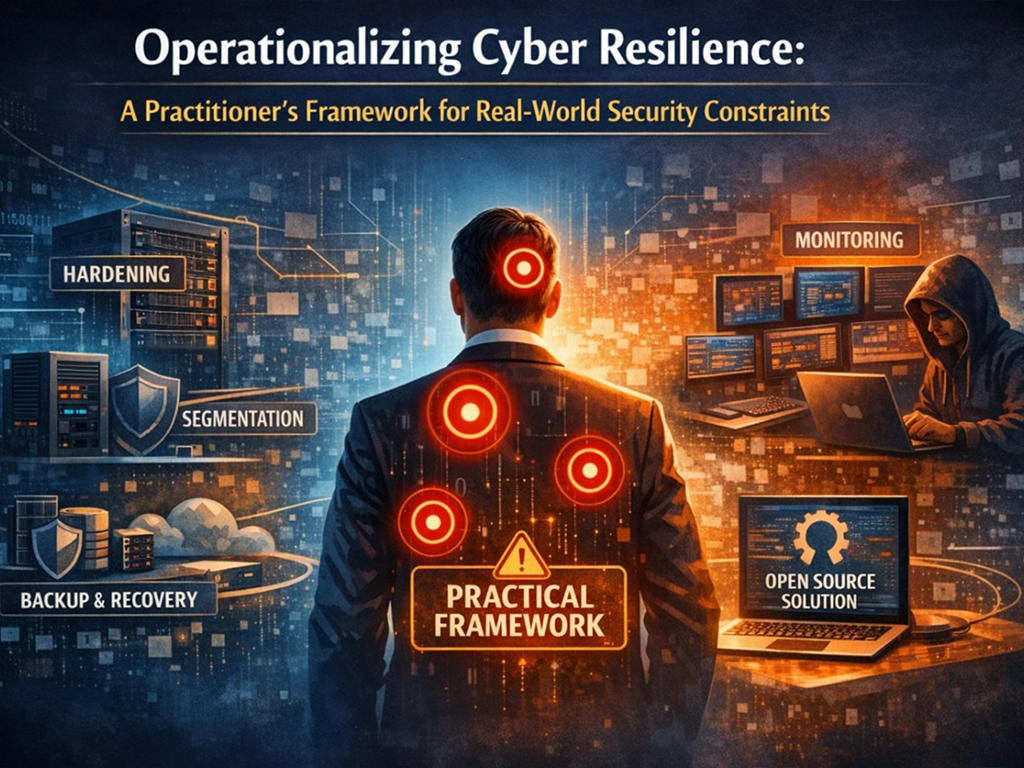
An example of such an approach is the S4T framework, an open-source initiative crafted to operationalize core cybersecurity and resilience principles in real-world constrained environments. Instead of competing with established standards, this framework aligns with them while emphasizing implementation feasibility.
At its core, the framework organizes security efforts around a handful of technical pillars:
- System Hardening: Establish secure baseline configurations for operating systems, hypervisors, and network devices.
- Network Segmentation: Segment assets logically to contain lateral movement.
- Backup and Recovery: Implement automated, tested, and immutable backup strategies.
- Monitoring and Logging: Attain centralized visibility using lightweight and open tools.
- Incident Response Readiness: Enact predefined procedures focused on containment and recovery, not attribution.
The framework’s open-source nature allows organizations to tailor it to their infrastructure while maintaining transparency and avoiding vendor lock-in. Furthermore, each pillar is designed for independent deployment, enabling incremental maturity enhancements without substantial initial investments.
Insights from Real-World Implementations
Across various environments, certain recurring lessons surface when applying an operational resilience mindset.
Less Controls, Better Results
Organizations that implement a small number of well-integrated controls consistently achieve superior security outcomes compared to those aiming for broad control coverage.
Backup Strategy Determines Survival
The ability to swiftly and reliably restore systems often distinguishes a security incident from a business-ending catastrophe. Backup maturity strongly correlates with resilience.
Segmentation Outperforms Solely Relying on Detection
Restricting lateral movement limits the impact even when detection fails or is delayed.
Documentation Facilitates Recovery
Concise and clear documentation, focusing on rebuilding and recovery, proves more valuable during incidents than complex policies.
Process Trumps Tooling
While tools support resilience, the effectiveness of controls under pressure hinges on the underlying processes.
Key Takeaways for CISOs and Security Leaders
True cyber resilience is not attained by acquiring more tools or adopting additional frameworks but by aligning security controls with the organization’s operational realities.
For security leaders navigating constraints, several strategic takeaways are noteworthy:
- Prioritize time-to-recover over theoretical prevention.
- Design controls that can be redeployed under stress.
- Consider recoverability and segmentation as primary security objectives.
- Favor open, transparent, and repeatable approaches over complex opacity.
Ultimately, operational cyber resilience is a cultural and architectural decision. Organizations that embrace simplicity, automation, and recovery-oriented design are better equipped to endure cyber incidents’ inevitability.
Conclusion
The efficacy of cybersecurity lies not in expanding control catalogs endlessly but in operationalizing a concise set of resilient, repeatable, and recoverable security practices.
Frameworks offer guidance, but practitioners must translate that guidance into architectures that withstand real-world conditions. Initiatives like the S4T framework demonstrate that bridging the theory-execution gap is feasible, particularly when security is viewed as an operational discipline rather than a compliance task.
Cyber resilience does not revolve around avoiding failure but ensuring that the organization persists even when failure strikes.
Diego Neuber is a Chief Information Security Officer (CISO) and the founder of Disatech, a Brazilian company specializing in IT security, training, audits, and secure infrastructure solutions. With over 14 years of cybersecurity experience, he currently serves as the CISO for multiple organizations across diverse industries.
He is a Senior Member of IEEE, an active contributor and reviewer of articles for international cybersecurity publications, and a frequent speaker at professional and academic events. Diego also acts as a judge for the Globee® Awards for Cybersecurity and the German Stevie® Awards, recognizing excellence and innovation in the cybersecurity realm.
You can reach Diego at [email protected], connect with him on LinkedIn at linkedin.com/in/diegoneuber, and visit his company website at www.disatech.com.br.