
Security
Ransomware Revolution: The Rise of Multi-Extortion Attacks


Ransomware’s Impact on Various Sectors
During February 2026, the University of Mississippi Medical Center (UMMC) encountered a ransomware attack that disrupted its Epic electronic health record system, affecting multiple clinics and telehealth sites. This led to the cancellation of crucial medical appointments and surgeries, emphasizing the severe consequences of cyber threats on patient care.
UMMC’s incident is not an anomaly. Recent data reveals that 93% of healthcare organizations in the U.S. experienced cyberattacks in 2025, with 72% reporting disruptions to patient care as a result.
Other industries, such as manufacturing and finance, are also vulnerable. In the same month, BridgePay, a payment processing network, faced a ransomware attack that completely halted its payment processing services. The prevalence of ransomware attacks increased by 49% in 2025, with 1,174 confirmed incidents across various sectors.
With hospitals unable to provide treatments, financial institutions unable to process transactions, and manufacturing facilities forced to shut down, ransomware has proven to be a significant business risk with tangible operational impacts.
The Emergence of Double Extortion Ransomware
Initially, ransomware focused on encrypting files and demanding payment for decryption. However, organizations began countering this by restoring from backups rather than paying the ransom, prompting threat actors to adopt a more lucrative strategy known as double extortion.
In a double extortion attack, cybercriminals first steal sensitive data before encrypting the system. This places victims in a dilemma: pay the ransom for decryption or risk having the stolen data publicly exposed.
Traditional backups are ineffective against this approach since attackers already have the data. Refusing to pay the ransom may result in the public release of sensitive information, leading to significant financial losses and regulatory penalties for organizations.
The threat landscape has evolved further, with the introduction of triple extortion, where attackers directly contact an organization’s customers or partners to exert additional pressure.
As of 2025, there are 124 active ransomware groups, 73 of which are newly identified.
The advancement of AI-driven tools has democratized cybercrime, making ransomware capabilities more accessible to less sophisticated actors.
D.AMO ensures stolen data remains unintelligible.
Discover how D.AMO safeguards against every facet of a ransomware attack.
Learn More
Building a Defense Strategy Against Multi-Extortion Threats
The prevalence of multi-extortion ransomware necessitates a shift in traditional defense strategies. Relying solely on perimeter-based prevention is no longer sufficient.
Organizations require a robust security posture that can prevent data exploitation post-breach, making exfiltrated data unreadable, blocking ransomware from accessing files, and enabling swift recovery in the event of an attack.
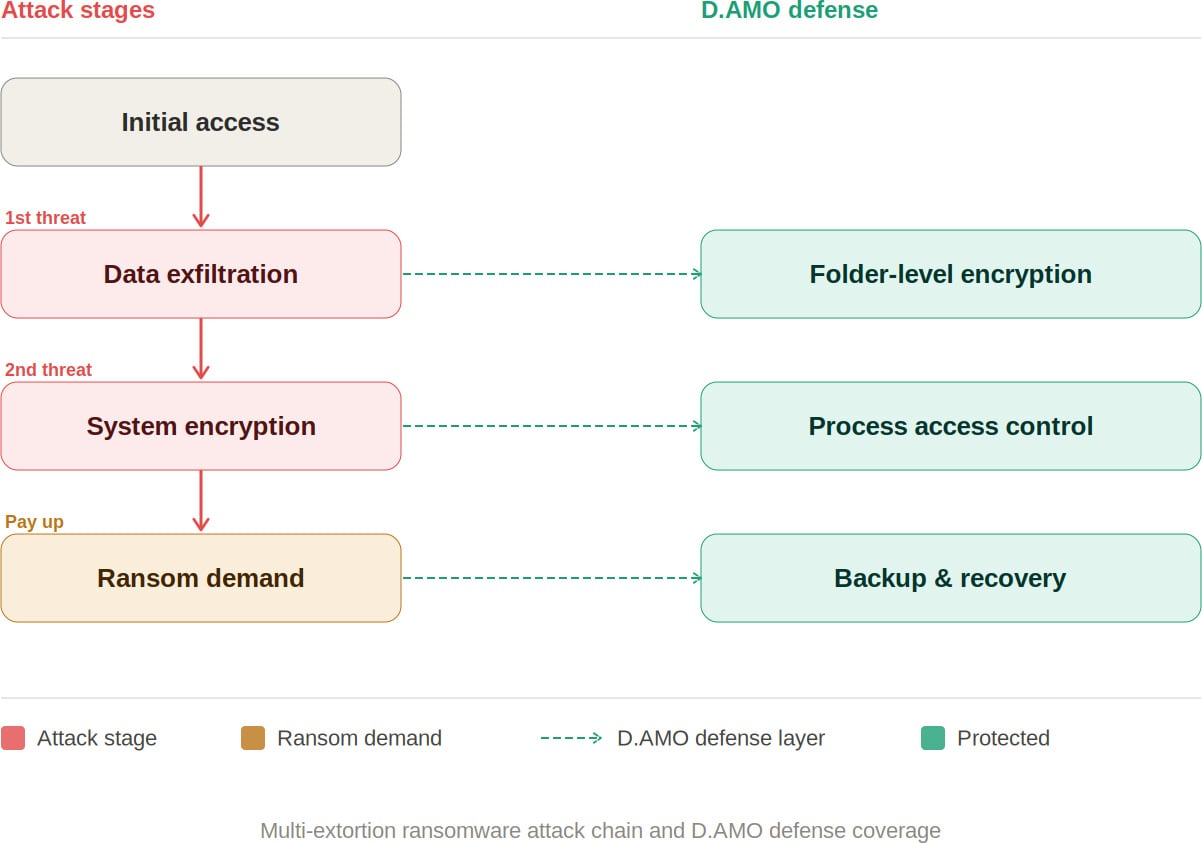
D.AMO: Safeguarding Against Ransomware Attacks
D.AMO, developed by Penta Security, is a data protection platform based on encryption that addresses every stage of a multi-extortion ransomware attack. It offers comprehensive encryption, access control, and backup recovery for on-premises and cloud environments.
By leveraging file encryption and access control mechanisms, D.AMO secures critical data stored on servers and PCs, protecting sensitive information from malicious threats through robust access restrictions. The key features of D.AMO include:
Folder-Level File Encryption
D.AMO KE encrypts all files within designated folders at the OS level. With kernel-level encryption technology, it can quickly and securely encrypt existing systems without disrupting user operations.
Encryption policies are enforced at the folder level, ensuring consistent data protection with minimal overhead. Importantly, even if data is stolen, the encryption keeps it secure, mitigating the data exposure risk associated with double extortion.
Access Control
D.AMO KE enforces strict access controls for processes and OS users, permitting only authorized access. This prevents ransomware and other malicious software from tampering with encrypted folders, thwarting unauthorized file access.
All blocked activities are logged in an audit trail and can be centrally reviewed through the D.AMO Control Center.
Backup and Recovery
In the event of a successful attack, organizations can swiftly resume operations using an independent recovery system. With D.AMO, the ability to restore from backups reduces reliance on negotiating decryption keys with threat actors.
Given the prevalence of multi-extortion tactics, securing targeted data has become a critical objective. Organizations must render exfiltrated data unreadable, prevent ransomware from accessing files, and recover promptly from incidents.
D.AMO offers a comprehensive defense against ransomware attacks, integrating encryption, access control, and backup recovery into a unified security platform.
Keen to delve deeper? Download the D.AMO Data Sheet.
Presented and sponsored by Penta Security.










Lando Norris’ Stunning Ferrari F40 Spotted in London

“Emberwing: Rise of the Dragonlord” – Unleash the Power in the Alpha Demo!

The Evolution of B2C Insurance: Adapting to Consumer Expectations

iPhone Duo Delay Sparks Surge in Galaxy Z Fold 8 Sales

10 Android Apps you NEED to try in 2018

BMW i3 Reigns Supreme While Audi A4 e-tron Faces Delay Until 2029

Legal Battle: Denuvo Takes on Anonymous Cracker for Breaching DRM on 26 Video Games

The Future of Innovation: A Physical AI Startup Raises $100M to Build the Next Generation of Startups

Boost Your iPhone Speed with These 30+ iOS 27 Tips and Tricks

EU Takes Action Against Instagram and Facebook for Violating Illegal Content Rules

Warning: Facebook Creators Face Monetization Loss for Stealing and Reposting Videos

Facebook’s New Look: A Blend of Instagram’s Style

Facebook Compliance: ICE-tracking Page Removed After US Government Intervention

Facebook and Instagram to Reduce Personalized Ads for European Users

InstaDub: Meta’s AI Translation Tool for Instagram Videos

Reclaim Your Account: Facebook and Instagram Launch New Hub for Account Recovery

Meta discontinues Messenger apps for Windows and macOS

Breaking Updates: Meta Connect 2025 Unveils Latest Developments
10 Android Apps you NEED to try in 2018

They could not believe how cheap this Phone is

A $50,000 Smartphone for $400?

Huawei P20 Pro Unboxing!

Huawei P20 Pro vs Samsung S9 Plus!

Huawei P20 vs P20 Pro vs iPhone 8 Plus vs S9 Battery Drain Test!

10 Android Mods that Change Everything

I used the first Android Phone in the World.

DOOGEE MIX 4 UNBOXING (PROTOTYPE)!
-
 Facebook11 months ago
EU Takes Action Against Instagram and Facebook for Violating Illegal Content Rules
-
 Facebook11 months ago
Warning: Facebook Creators Face Monetization Loss for Stealing and Reposting Videos
-
 Facebook9 months ago
Facebook’s New Look: A Blend of Instagram’s Style
-
 Facebook11 months ago
Facebook Compliance: ICE-tracking Page Removed After US Government Intervention
-
 Facebook10 months ago
Facebook and Instagram to Reduce Personalized Ads for European Users
-
 Facebook11 months ago
InstaDub: Meta’s AI Translation Tool for Instagram Videos
-
 Facebook10 months ago
Reclaim Your Account: Facebook and Instagram Launch New Hub for Account Recovery
-
 Apple11 months ago
Meta discontinues Messenger apps for Windows and macOS
