
Security
Preventing Fraud Throughout the Customer Journey: A Seamless Approach


Fraud Prevention Strategies: Balancing Security and User Experience
In the realm of online security, the age-old dilemma of fraud prevention versus user experience has plagued businesses for years. Tightening security measures can lead to alienating legitimate customers, while loosening them can invite account takeovers, synthetic identities, and payment fraud. However, with the advent of modern threat intelligence platforms, this false dichotomy is being dismantled.
Today, the most effective fraud prevention strategies work behind the scenes, leveraging real-time risk signals to thwart malicious actors before they can cause harm, all without inconveniencing legitimate users with unnecessary hurdles.
The impact of security friction is far from negligible. Every CAPTCHA, every extra authentication step, and every false positive that hinders a genuine customer from completing a transaction comes with a tangible cost. Cart abandonment rates soar when the checkout process becomes cumbersome, new user registrations plummet when signup forms are burdened with verification delays, and customer service expenses rise when account recovery procedures are slow or unclear.
On the flip side, the consequences of under-detection are dire. Organizations reportedly lose around 5% of their annual revenue to fraud each year, with payment fraud, account takeover, promo abuse, and synthetic identity fraud posing persistent and organized threats that are increasingly automated.
The Battle for Clean Accounts: Fraud at Signup
Signup processes represent a critical juncture in the fraud lifecycle. By preventing fraudsters from creating accounts, businesses can avert a slew of downstream attacks such as account takeovers, payment fraud, promo abuse, referral fraud, and synthetic identity exploitation. However, signup is also the primary point of interaction for legitimate new users, making false positives particularly damaging to business growth.
During signup, fraud teams have access to a wealth of signals that must be swiftly analyzed. Beyond basic email syntax validation, thorough email address scrutiny should encompass factors like domain age, mailbox activity, presence in breach databases, and associations with fraudulent patterns.
Similarly, phone number analysis should delve into carrier type, line activity, porting history, and flags across fraud networks to assess risk accurately.

Defending the Account Layer: Fraud at Login
Login fraud, particularly account takeover (ATO) attacks, poses a significant threat in the digital fraud landscape. Credential stuffing assaults can compromise even robustly password-protected accounts if credentials are reused. The scale of these attacks is staggering, with automated toolkits capable of testing hundreds of thousands of credential combinations per hour.
Combatting login fraud necessitates detecting anomalies without penalizing legitimate users. Legitimate logins exhibit recognizable patterns such as familiar devices, consistent geographic locations, regular login times, and typical session velocities. Identifying deviations from these norms, even subtle ones, can serve as potent risk indicators when coupled with network and identity intelligence.
Discover how to implement effective fraud checks without impeding user experience. Request a complimentary sample of IPQS risk scoring data for actionable insights.
Explore how multi-layered detection techniques can preemptively thwart fraudsters using bots, emulators, and high-risk sessions, safeguarding your revenue streams.
Try For Free
Protecting Revenue at the Finish Line: Fraud at Checkout
Checkout fraud represents the convergence of identity fraud, payment fraud, and social engineering tactics. At this critical stage, evaluating the coherence between the email, phone, and billing identity is crucial. Additionally, scrutinizing the IP address for proxy usage and geographic alignment with the shipping address, along with analyzing device signals against login history, can fortify fraud prevention efforts.
Payment instrument intelligence, encompassing factors like transaction velocity across merchants, historical chargeback rates, and card BIN data, introduces a financial risk dimension that complements identity-based approaches.
Operationalizing Frictionless Intelligence: The Role of IPQS
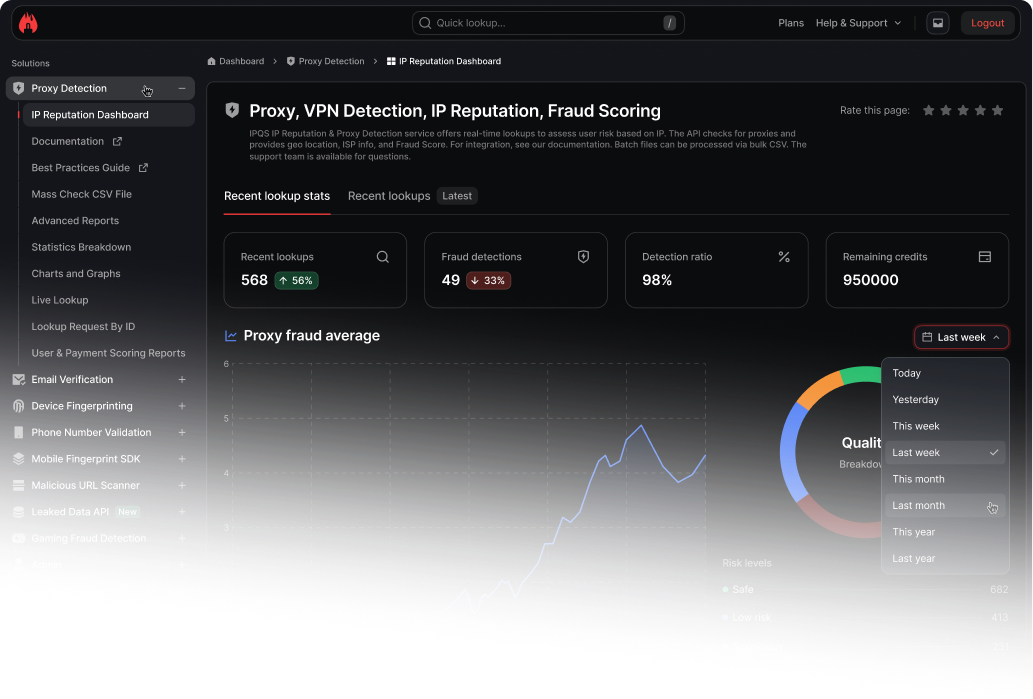
IPQS exemplifies the breed of platform-level fraud intelligence tools that operationalize a multi-signal, layered approach to fraud prevention. While offering individual solutions for IP reputation, email validation, and phone verification, IPQS functions as a unified intelligence platform that harmonizes various signals through a shared data model, furnishing composite risk scores optimized for real-time decision-making.
A tiered response strategy links risk score ranges to response types proportional to the likelihood and severity of fraud at each threshold. High-risk sessions can be subjected to targeted, lightweight verification methods, such as a single-tap push notification, while only the most high-risk sessions merit hard blocks or declines based on compelling evidence of fraud.
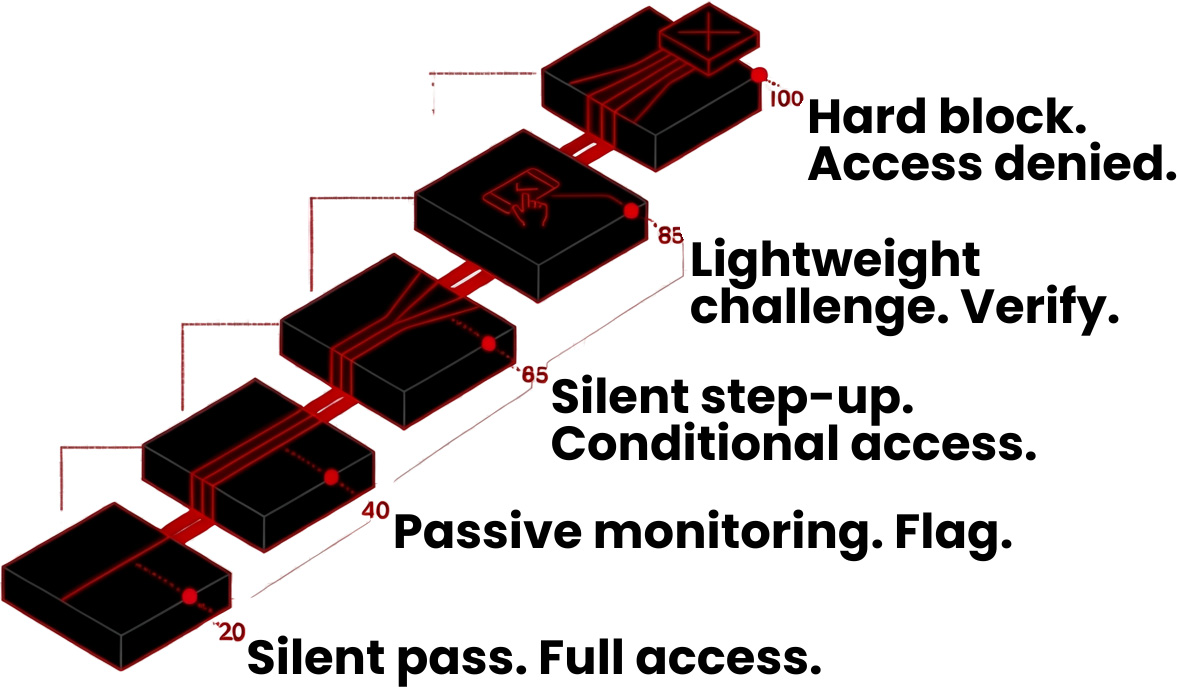
For the vast majority of users scoring in the low-risk tier, the experience remains seamless. In contrast, a small cohort of high-risk sessions may encounter additional friction, tailored and justified for the situations warranting it.
IPQS is at the forefront of fraud prevention, leveraging cutting-edge data sources to offer real-time solutions with unparalleled accuracy. By tapping into a global cyberthreat honeypot network, IPQS delivers comprehensive IP, device, email, phone number, and URL scanning capabilities. Its suite of tools ensures robust security with customizable scoring settings and straightforward fraud detection.
Contact our experts for a complimentary fraud consultation and learn how IPQS can fortify your defenses against online threats.
Article sponsored and authored by IPQS.













Escape Velocity: The Dartz SUV with a Fighter-Jet Ejection Seat

Silicon Labs Unveils State-of-the-Art $23m Austin Lab for Cutting-Edge Semiconductor Research

Crimson Desert: Secrets of the Uncharted Frontier – Constructing Mansions and Battling Laser Robots

The Ultimate Evolution: Unveiling Apple’s iPhone Ultra

Unveiling the Xiaomi 18 Fold: A Tempting Tease – Tech Advisor

Maximizing Employee Satisfaction: A Comprehensive Guide to Providing High-Value Dental Benefits for Small Businesses

The Rising Cost of iPhones: Why Prices are Set to Increase

Top 10 Android Launchers you’ve NEVER tried.

Revolutionizing Gaming: The Future of Apple Game Controllers Revealed in macOS 26.7 Code

EU Takes Action Against Instagram and Facebook for Violating Illegal Content Rules

Warning: Facebook Creators Face Monetization Loss for Stealing and Reposting Videos

Facebook Compliance: ICE-tracking Page Removed After US Government Intervention

Facebook’s New Look: A Blend of Instagram’s Style

Facebook and Instagram to Reduce Personalized Ads for European Users

InstaDub: Meta’s AI Translation Tool for Instagram Videos

Reclaim Your Account: Facebook and Instagram Launch New Hub for Account Recovery

Meta discontinues Messenger apps for Windows and macOS

Breaking Updates: Meta Connect 2025 Unveils Latest Developments
Top 10 Android Launchers you’ve NEVER tried.

Our Bezel-less future! Q&A 5.0

The $200 OnePlus phone? Lenovo S5 is HERE!

OnePlus 6 vs Samsung Galaxy S9 Plus

Honor 10 UNBOXING!

OnePlus 6 vs iPhone X Camera Test Comparison

MYSTERY Package from Xiaomi – MASSIVE UNBOXING!

The BEASTLY 2018 Gaming Setup.

10 Android Apps you should try RIGHT NOW!
-
 Facebook11 months ago
EU Takes Action Against Instagram and Facebook for Violating Illegal Content Rules
-
 Facebook11 months ago
Warning: Facebook Creators Face Monetization Loss for Stealing and Reposting Videos
-
 Facebook11 months ago
Facebook Compliance: ICE-tracking Page Removed After US Government Intervention
-
 Facebook9 months ago
Facebook’s New Look: A Blend of Instagram’s Style
-
 Facebook9 months ago
Facebook and Instagram to Reduce Personalized Ads for European Users
-
 Facebook11 months ago
InstaDub: Meta’s AI Translation Tool for Instagram Videos
-
 Facebook9 months ago
Reclaim Your Account: Facebook and Instagram Launch New Hub for Account Recovery
-
 Apple11 months ago
Meta discontinues Messenger apps for Windows and macOS
